
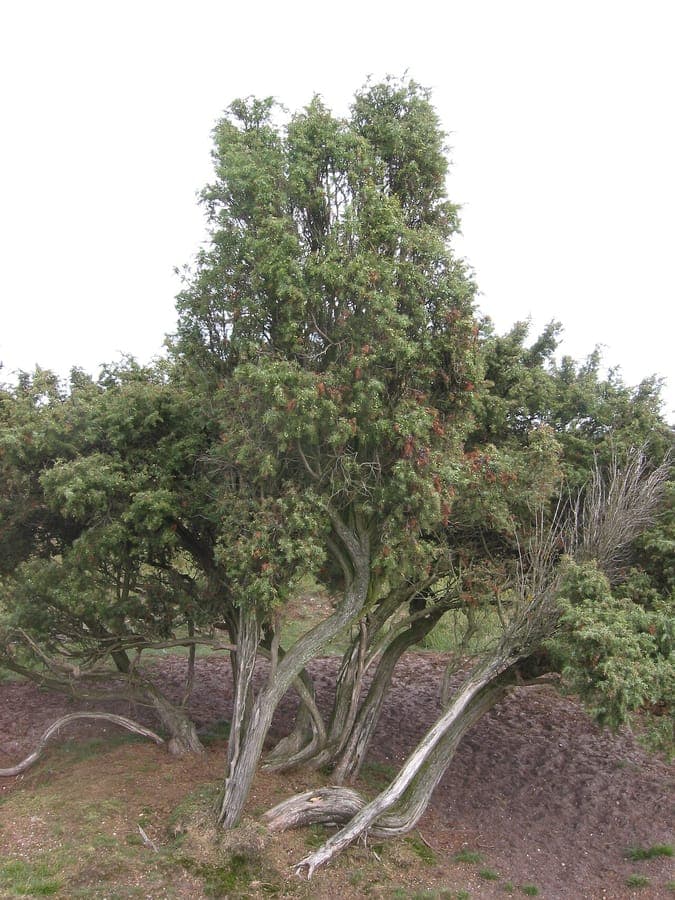
Rasbak at Dutch Wikipedia / CC BY-SA 3.0, via Wikimedia Commons
Common juniper: complete guide
Juniperus communis
Want to see Common juniper: complete guide in your garden?
1 minute, no credit card
Overview
Juniperus communis, better known as common juniper, is a tough, evergreen shrub that thrives where few other plants dare. Native across much of the northern hemisphere, including parts of the UK, this conifer is more than just a botanical survivor - it's a key ingredient in gin, giving it its distinctive flavour. But beyond the cocktail glass, it's a remarkable garden plant, valued for its resilience, structure, and year-round presence.
In the wild, you'll find it on heaths, rocky slopes, and open woodlands. In gardens, it's ideal for poor soils, dry banks, or as a natural-looking hedge. It grows slowly - just 5–10 cm per year - but can live for a century or more. If you're designing a low-effort, high-impact garden, common juniper should be on your shortlist.
On gardenworld.app, you can visualise how this plant fits into your garden layout, especially in xeriscaping or wildlife-friendly designs.
Appearance & bloom cycle
Common juniper typically grows 1–1.5 metres tall, though some upright forms may reach 4 metres. It has a loose, spreading habit with stiff, ascending branches covered in sharp, needle-like foliage. The leaves are dark green with a blue-grey cast, arranged in whorls of three. They're prickly to the touch - keep that in mind if planting near paths.
Flowering occurs from April to June. The flowers are inconspicuous, but if both male and female plants are nearby, the females produce small, berry-like cones. These 'berries' - actually modified seed cones - start green and mature to a bluish-purple over two to three years. Only fully ripe berries should be harvested; unripe ones can be toxic.
Ideal location
Full sun is best - aim for at least 6 hours of direct light daily. While it tolerates partial shade, growth becomes sparse and berry production drops significantly. Avoid heavily shaded areas under dense tree canopies.
This shrub excels on dry, rocky slopes, gravel gardens, or as ground cover in open areas. It's perfect for naturalistic planting schemes. On gardenworld.app, you can test light exposure in your garden and see if it matches the sun requirements for juniper.
Soil requirements
One of the most adaptable shrubs out there. Common juniper grows in sandy, loamy, or stony soils, as long as drainage is excellent. It prefers slightly acidic to neutral pH (5.0–7.0) but handles mildly alkaline conditions too.
Never plant it in heavy clay or waterlogged areas - root rot is the main killer. No fertiliser needed. In fact, rich soils can encourage weak, leggy growth. If your soil is poor, that's fine - juniper thrives in low-nutrient conditions.
Free design
Want to see Common juniper: complete guide in your garden? Make a free design now.
Watering
Once established (after about 12 months), it's highly drought-tolerant. Young plants need watering every 10–14 days during dry spells in their first summer, about 5 litres per plant. Use a slow-release method like a drip hose to encourage deep root development.
Avoid overhead watering, which can promote fungal diseases. The soil should dry out between waterings. In winter, no extra water is required - let rainfall do the work.
Pruning
Pruning is rarely needed. This plant maintains a natural shape that fits well in informal gardens. If you must trim, do it in March or early April, before new growth starts.
Never cut into old, bare wood - junipers don't regenerate from old stems. Use clean, sharp secateurs and remove only dead, damaged, or crossing branches. Avoid shearing into hedges; this species doesn't respond well to formal shaping.
Maintenance calendar
- January: inspect for winter damage
- February: check for signs of new buds
- March: light pruning if necessary
- April: water young plants during dry periods
- May: monitor for aphids or spider mites
- June: watch for developing berries
- July: no action needed
- August: water only if prolonged drought
- September: clear fallen debris
- October: note bird activity - birds eat the berries
- November: check soil drainage
- December: allow snow to melt naturally - avoid brushing it off branches
Winter hardiness
Extremely hardy, surviving down to -40°C. It's rated for USDA zones 2–7, making it perfect for most of the UK and northern Europe. No winter protection is needed. Snow cover actually insulates the plant.
The biggest winter risk is desiccation in dry, windy conditions with frozen soil. Water well in late autumn if the ground isn't frozen yet.
Companion plants
Pair with other drought-tolerant, sun-loving plants: lavender (Lavandula angustifolia), thrift (Armeria maritima), or sedum. Heathers (Calluna vulgaris) make excellent ground cover companions.
Avoid moisture-loving plants like hostas or astilbes. Stick to species that share the same preferences: good drainage, full sun, low fertility.
Closing
Common juniper is a quiet achiever in the garden - unsung, underrated, but incredibly useful. It adds structure year-round, supports wildlife, and asks for almost nothing in return.
You can find it at garden centres across the UK. Look for healthy, compact plants with no signs of dieback. And if you're planning a new border or rock garden, check gardenworld.app to see how juniper can anchor your design with minimal effort and maximum impact.
Want to see Common juniper: complete guide in your garden? Make a free design now.
Upload a photo, pick a style, and get a photorealistic design with plant list in under a minute.
No credit card required


Similar plants
Cupressus macnabiana: complete guide
Cupressus macnabiana
The Fragrant Cypress offers elegant growth with fine, aromatic foliage. Perfect for temperate climates and as specimen trees in contemporary gardens.
Cupressus guadalupensis: complete guide
Cupressus guadalupensis
The Guadalupe cypress: an elegant conifer for gardens. Complete cultivation guide for this Mexican cypress. Information about care, location, form and maintenance.
Austrocedrus chilensis: complete guide
Austrocedrus chilensis
Discover Austrocedrus chilensis, the Chilean Cedar ornamental conifer. Elegant specimen with fine foliage and columnar form for permanent structure.