
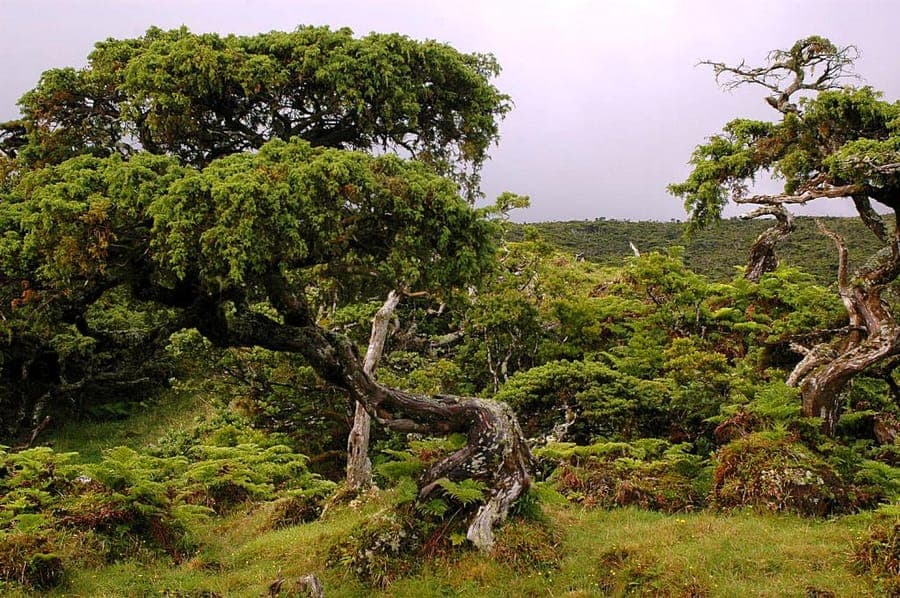
Alberto Garcia from Cartagena, Spain / CC BY-SA 2.0, via Wikimedia Commons
Azores juniper: complete guide
Juniperus brevifolia
Want to see Azores juniper: complete guide in your garden?
1 minute, no credit card
Overview
Juniperus brevifolia, commonly known as Azores juniper, is a slow-growing evergreen tree native to the misty, volcanic islands of the Azores, Portugal. Unlike many junipers that stay shrub-sized, this species matures into a proper tree, reaching 6 to 10 meters in height over decades. Growth averages 10 to 15 cm per year, so patience is key. But its steady pace is part of its charm - a rugged, architectural presence that adds structure to any garden. It's not commonly seen in UK or North American gardens yet, but its resilience and elegance are earning it more attention among gardeners who value low-maintenance, long-term plants.
On gardenworld.app, you can design a planting scheme that highlights the upright form and blue-green hue of Juniperus brevifolia, integrating it with complementary textures and seasonal interest.
Appearance & bloom cycle
The Azores juniper has a conical to slightly spreading habit, with stiff, upright branches that create a strong vertical line in the landscape. Foliage is short, scale-like, and a striking blue-green, remaining dense and vibrant year-round. There are no showy flowers - like most conifers, its reproductive cycle is subtle. In spring, male plants produce small yellow pollen cones, while females develop tiny green seed cones that mature into dark purple, berry-like cones by late summer. These are not edible and are best left for birds, who may occasionally peck at them.
This plant doesn't have a bloom season in the traditional sense, but it offers consistent visual interest. Its color contrasts beautifully with silver-foliaged plants or warm-toned perennials.
Ideal location
Full sun is non-negotiable for Juniperus brevifolia. It needs at least 6 hours of direct sunlight daily to maintain its density and shape. Partial shade leads to leggy growth and weak structure. It thrives in open, airy spots with good air circulation - ideal for slopes, rock gardens, or as a focal point in a xeriscape design.
It's tolerant of coastal winds, thanks to its island origins, but hates stagnant, humid air. Avoid planting it too close to walls or dense shrubs. On gardenworld.app, you can simulate sun exposure and wind patterns to find the perfect spot in your garden layout.
Soil requirements
This juniper isn't picky about soil type, as long as drainage is excellent. Sandy, loamy, or gravelly soils work well. It tolerates pH from slightly acidic to slightly alkaline (5.5–7.5). Heavy clay is a problem unless amended with grit or planted in a raised bed. When planting, mix in plenty of horticultural sand or perlite to prevent waterlogging.
Remember: Juniperus brevifolia despises wet feet. Standing water, even for a few days, can lead to root rot and rapid decline.
Free design
Want to see Azores juniper: complete guide in your garden? Make a free design now.
Watering
During the first growing season, water weekly if there's no rain - about 10 liters per plant. Deep, infrequent watering encourages roots to grow downward. After year one, it's highly drought-tolerant and only needs supplemental watering during extended dry spells (over 4 weeks without rain). In such cases, give 10–15 liters every 10 days until rain returns.
Avoid overhead watering - it promotes fungal issues. Use a soaker hose or water at the base.
Pruning
Pruning is rarely needed. The natural shape is attractive and self-supporting. If you must trim, do it in late winter or early spring before new growth emerges. Only cut into green, living tissue - never into bare wood, as junipers won't regenerate from old stems.
Use sharp, clean shears. Remove any dead, damaged, or crossing branches. Light shaping is fine, but avoid formal hedges - this species doesn't respond well to tight clipping.
Maintenance calendar
- January: Check for winter damage. No pruning.
- February: Inspect base for rodent activity. Light cleanup.
- March: Light shaping if needed. No feeding.
- April: Monitor for dryness during warm spells.
- May: No action required.
- June: Watch for spider mites on young plants, especially in dry heat.
- July: Water only in prolonged drought.
- August: No maintenance.
- September: Remove dead wood. Stop pruning.
- October: Clear fallen debris around base to prevent rot.
- November: Reduce watering. Check mulch layer.
- December: Protect young plants from harsh frosts with hessian wrap.
Winter hardiness
Hardy in USDA zones 8–10 (down to -12°C). In zone 7, it may survive with protection - use a 5 cm layer of bark mulch around the root zone and avoid wet winter winds. In colder areas, container growing with winter shelter is an option.
In the UK, it's best suited to southern and western regions. Avoid exposed north-facing sites or areas with icy, wet winter gales.
Companion plants
Pair with other drought-tolerant, sun-loving plants: Phlomis fruticosa, Eryngium giganteum, Santolina chamaecyparissus, Stachys byzantina, and Festuca glauca. These share similar water needs and create a harmonious, low-water border.
Low-growers like Thymus or Sedum spurium work well as ground cover, suppressing weeds without competing for moisture.
Closing
Juniperus brevifolia is a standout for gardeners who appreciate slow, steady beauty. It's tough, fire-resistant, and virtually pest-free. While not flashy, it brings year-round dignity to the landscape. Plant it where it has room to breathe and grow, and it will reward you for decades. You won't find it everywhere, but some garden centres in the UK and specialty nurseries occasionally stock it. Look out for it in spring. With the help of gardenworld.app, you can visualize how this unique conifer fits into your long-term garden plan.
Want to see Azores juniper: complete guide in your garden? Make a free design now.
Upload a photo, pick a style, and get a photorealistic design with plant list in under a minute.
No credit card required


Similar plants
Cupressus macnabiana: complete guide
Cupressus macnabiana
The Fragrant Cypress offers elegant growth with fine, aromatic foliage. Perfect for temperate climates and as specimen trees in contemporary gardens.
Cupressus guadalupensis: complete guide
Cupressus guadalupensis
The Guadalupe cypress: an elegant conifer for gardens. Complete cultivation guide for this Mexican cypress. Information about care, location, form and maintenance.
Austrocedrus chilensis: complete guide
Austrocedrus chilensis
Discover Austrocedrus chilensis, the Chilean Cedar ornamental conifer. Elegant specimen with fine foliage and columnar form for permanent structure.