
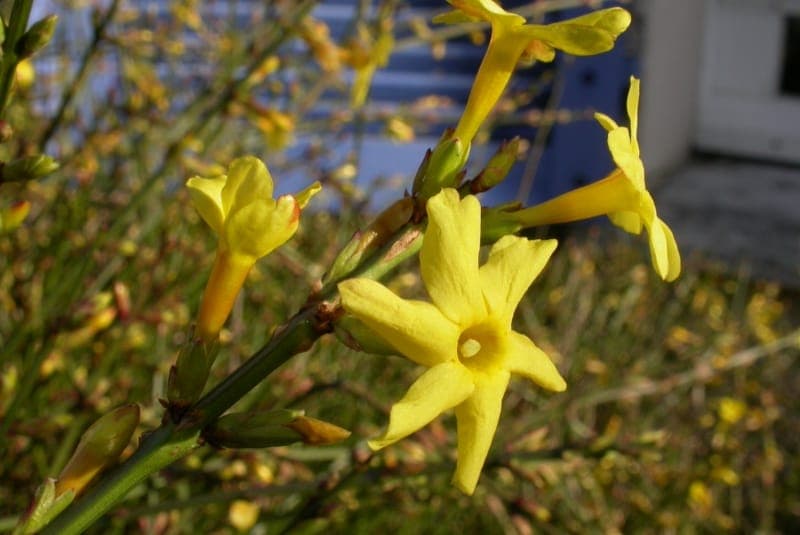
Jean-Jacques MILAN / CC BY-SA 3.0, via Wikimedia Commons
Winter jasmine: complete guide
Jasminum nudiflorum
Want to see Winter jasmine: complete guide in your garden?
1 minute, no credit card
Overview
Jasminum nudiflorum, commonly known as winter jasmine, is a tough, reliable vine that brings a burst of cheer in the bleakest months of the year. Unlike its fragrant relatives, this plant doesn't release a strong scent, but it more than makes up for it with its vibrant yellow blooms that appear when little else is flowering. Native to central and southern China, including Tibet, it has adapted well to temperate climates and thrives across much of the UK and northern Europe. It grows at a moderate pace - around 30 to 50 cm per year - and can cover walls, trellises, or slopes effectively over time.
One of its most distinctive traits is blooming on bare, leafless stems from late December through March, depending on the weather. The name 'nudiflorum' literally means 'naked flowering', referring to this unique habit. Though it doesn't cling on its own like ivy, it can be tied to supports with garden twine or soft plant ties. You can plan your ideal placement using gardenworld.app, where you can visualise how this vine will integrate with your garden layout.
Appearance & bloom cycle
Winter jasmine has slender, square, greenish-brown stems that turn yellow-green in full sun. The leaves are trifoliate - three small, glossy, oval leaflets - but they often emerge after the flowers, making the plant appear bare during its bloom. The flowers are small, about 2 to 3 cm wide, with four to five bright yellow petals, and appear singly along the stems. They start opening as early as late December in mild winters and can last into March.
Each bloom lasts about 10 to 14 days, and the overall flowering period spans 6 to 8 weeks. While not fragrant, these flowers are a vital early nectar source for bees and hoverflies. After blooming, the foliage fills in, creating a dense, leafy cover through summer and autumn. In colder zones, leaves may drop in late winter, but the plant quickly flushes new growth in spring.
Ideal location
Choose a spot with full sun to light shade - a 7 out of 10 on the light scale is ideal. South- or southeast-facing walls, fences, or pergolas work best. The plant can also be trained horizontally to encourage branching and more flowers. Avoid heavily shaded or windy areas, as these reduce flowering and increase dieback. It performs well in USDA hardiness zones 6 to 9, meaning it can survive winter lows down to -15°C without protection.
When planting near paved areas, allow some overhang - the arching stems look beautiful spilling over walls or rockeries. If you're unsure about microclimates in your garden, gardenworld.app lets you map sun exposure and wind patterns to find the perfect spot.
Free design
Want to see Winter jasmine: complete guide in your garden? Make a free design now.
Soil requirements
Winter jasmine isn't fussy but prefers well-drained soil with a pH of 6.5 to 7. It tolerates poor soils, chalk, and even drought once established. Avoid waterlogged conditions, especially in winter, as this leads to root rot. If planting in clay, amend with horticultural grit or sharp sand to improve drainage. Sandy or gravel gardens suit it well, as do dry slopes and raised beds.
Watering
During the first growing season, water weekly during dry spells. After that, it's drought-tolerant and only needs deep watering every 10 to 14 days during prolonged dry summers. Use rainwater when possible, as tap water high in lime can affect long-term soil health. Potted plants need more frequent watering - check the top 5 cm of soil; if dry, water thoroughly.
Pruning
Prune right after flowering ends, between March and early April. Pruning earlier removes flower buds. Cut back old, woody stems to about 15–20 cm from the base to encourage fresh growth. For a bushier habit, pinch out soft tips in early summer. If training as a climber, tie new shoots horizontally - this promotes side shoots and more blooms.
Avoid heavy pruning in autumn or winter. Light shaping is fine, but save major cuts for spring.
Maintenance calendar
- Jan–Feb: Monitor for blooms; avoid pruning
- Mar: Finish blooming; begin pruning
- Apr: Check for new growth; secure stems if needed
- May–Sep: Active growth; minimal care required
- Oct–Dec: Dormant period; inspect for pests, water potted plants if dry
Winter hardiness
This plant is reliably hardy in zones 6–9. It handles -15°C without damage, though extreme cold (below -18°C) may kill back stems. The roots usually survive and resprout in spring. No winter protection is needed in the ground, but container-grown plants should have pots wrapped or moved to a sheltered spot.
Companion plants
Pair winter jasmine with early bloomers like Helleborus, Galanthus, or Crocus toadflora. For vertical interest, combine with late Clematis varieties. Ground-level companions include Pachysandra, Heuchera, or Vinca. Avoid invasive spreaders like ground elder.
Closing
Winter jasmine is a no-fuss, dependable performer that lights up winter gardens with minimal effort. It's widely available at garden centres, including popular UK chains, often in 3-litre pots priced between £10–15. Plant it right, prune on time, and it'll reward you for years. For custom planting ideas and layout suggestions, visit gardenworld.app and design a garden that highlights your winter jasmine at its best.
Want to see Winter jasmine: complete guide in your garden? Make a free design now.
Upload a photo, pick a style, and get a photorealistic design with plant list in under a minute.
No credit card required


Similar plants
Rough menodora: complete guide
Menodora scabra
Full guide to Menodora scabra: a drought-tolerant desert subshrub with bright yellow flowers, ideal for rock gardens and xeriscapes.
Fraxinus dipetala: complete guide
Fraxinus dipetala
California ash or two-petal ash from southwestern USA. Beautiful spring flowers, drought-tolerant. Experimental choice for warm Mediterranean front gardens.
Syringa komarowii: complete guide
Syringa komarowii
Syringa komarowii is a striking lilac from central China with elegant flower spikes and lovely foliage. Discover the complete care guide here.