
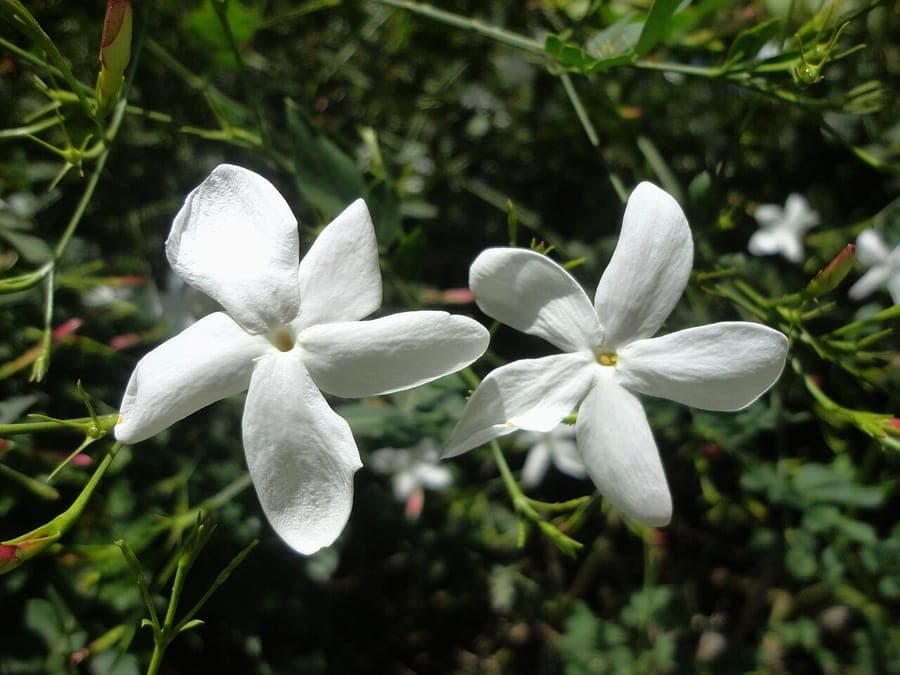
Juan Carlos Fonseca Mata / CC BY-SA 4.0, via Wikimedia Commons
Catalonian jasmine: complete guide
Jasminum grandiflorum
Want to see Catalonian jasmine: complete guide in your garden?
1 minute, no credit card
Overview
Catalonian jasmine, or Jasminum grandiflorum, isn't your average garden filler. It's a plant with presence - one that demands attention when it blooms and quietly retreats the rest of the year. Native to parts of East Africa and South Asia, including Ethiopia, Kenya, and Nepal, this member of the Oleaceae family thrives in warm, sunny spots and rewards careful tending with intensely fragrant flowers. In temperate climates like the UK and northern Europe, it's often grown in containers or trained against south-facing walls.
It's not fully hardy, but with the right care, it can survive several seasons. The key is understanding its rhythm - when to water, when to prune, and how to protect it from winter cold. On gardenworld.app, you can design a layout that integrates Catalonian jasmine into your outdoor space with precision, from support structures to scent zones.
Appearance & bloom cycle
This jasmine has a woody, vining habit with glossy, dark green, trifoliate leaves. The foliage is semi-evergreen, meaning it may drop leaves in colder months but often holds on if kept sheltered. Blooms appear from late June through October, depending on location and warmth. The white, star-shaped flowers are 2.5 to 3 cm wide, borne in terminal clusters, and often semi-double.
The real magic is in the scent - rich, sweet, and heady, especially at dusk. This isn't a plant to tuck away in a corner; plant it where you'll pass by daily, like near a patio or garden gate. Flowering isn't continuous - there are bursts and lulls. Deadheading spent blooms encourages repeat flowering, so keep an eye out from midsummer onward.
Ideal location
Full sun is non-negotiable - at least 6 hours of direct light daily. A south- or southeast-facing wall or trellis is ideal. The warmth radiating from a masonry surface boosts flowering. In containers, you can move it to follow the sun, which helps in early spring and late autumn.
Avoid windy spots - the stems are pliable but can snap. Deep shade leads to leggy growth and few flowers. If you're unsure about sun exposure in your garden, gardenworld.app offers sun-mapping tools to identify the best microclimates for delicate climbers like this.
Soil requirements
Use a well-draining, humus-rich mix. In-ground, aim for slightly acidic to neutral soil (pH 6.0–7.0). Avoid heavy clay without amending - mix in sand, compost, or grit to improve structure. In pots, a blend of loam-based compost, perlite, and coir works well to retain moisture without waterlogging.
This plant likes fertility but hates wet feet. If you're in a high-rainfall area, consider raised beds or containers with ample drainage holes. Poor drainage is the fastest way to kill it.
Free design
Want to see Catalonian jasmine: complete guide in your garden? Make a free design now.
Watering
Water regularly during the growing season, especially in containers. Let the top 2 cm of soil dry between waterings. In winter, reduce to once a week or less, depending on temperature. Rainwater is best - tap water with high lime content can cause chlorosis over time.
During hot, dry spells, daily watering may be necessary. Water deeply and slowly to encourage root development. Avoid wetting the foliage - it increases the risk of fungal diseases like powdery mildew.
Pruning
Prune right after the main flowering flush, between August and early September. Remove old, woody stems and cut back new growth to 2–3 buds to promote bushiness. Use clean, sharp secateurs to prevent disease spread. Avoid heavy pruning in spring - you'll remove potential flower buds.
When training as a climber, tie in new shoots and trim lateral growth to shape. This encourages more flowering stems. Without pruning, it becomes a tangled mass with sparse blooms.
Maintenance calendar
- Jan: Check for frost damage; keep container dry
- Feb: Inspect for pests; ensure good air circulation
- Mar: Begin light feeding if temps stay above 8 °C
- Apr: Repot if rootbound; move outdoors after last frost
- May: Start regular watering; watch for aphids
- Jun: Flowering begins; avoid disturbing roots
- Jul: Feed with liquid fertiliser every 3 weeks
- Aug: Prune after bloom; deadhead spent flowers
- Sep: Reduce watering; inspect for scale insects
- Oct: Bring indoors or protect container
- Nov: Keep dry; monitor for fungal issues
- Dec: Protect from freezing; maintain 3–10 °C
Winter hardiness
Jasminum grandiflorum is hardy in USDA zones 9–11. In the UK (zone 8b), it survives only with protection. Move potted plants to a cool, bright space (3–10 °C). For in-ground plants, wrap the base with hessian or fleece. Don't place it in heated rooms - it needs dormancy. If stems die back, it may reshoot from the base, but recovery takes time.
Companion plants
Pair with sun-loving, well-drained companions: lavender, rosemary, or dwarf geraniums. In containers, underplant with creeping thyme or silver mound artemisia for texture. Avoid moisture-hungry plants like hostas or aggressive spreaders like mint.
For a Mediterranean-style garden, this jasmine fits perfectly. Use gardenworld.app to plan companion groupings that balance scent, colour, and structure.
Closing
Catalonian jasmine isn't low-maintenance, but it's worth the effort. Its fragrance, elegance, and long bloom season make it a standout. It's not a filler - it's a focal point. If you're ready to experiment with exotic climbers, this is a great starting point. Buy from trusted garden centres where you can inspect the plant's health. With proper winter care and the right spot, you'll enjoy its perfume for years. On gardenworld.app, you can visualise how it fits into your overall garden design - no guesswork needed.
Want to see Catalonian jasmine: complete guide in your garden? Make a free design now.
Upload a photo, pick a style, and get a photorealistic design with plant list in under a minute.
No credit card required


Similar plants
Rough menodora: complete guide
Menodora scabra
Full guide to Menodora scabra: a drought-tolerant desert subshrub with bright yellow flowers, ideal for rock gardens and xeriscapes.
Fraxinus dipetala: complete guide
Fraxinus dipetala
California ash or two-petal ash from southwestern USA. Beautiful spring flowers, drought-tolerant. Experimental choice for warm Mediterranean front gardens.
Syringa komarowii: complete guide
Syringa komarowii
Syringa komarowii is a striking lilac from central China with elegant flower spikes and lovely foliage. Discover the complete care guide here.