
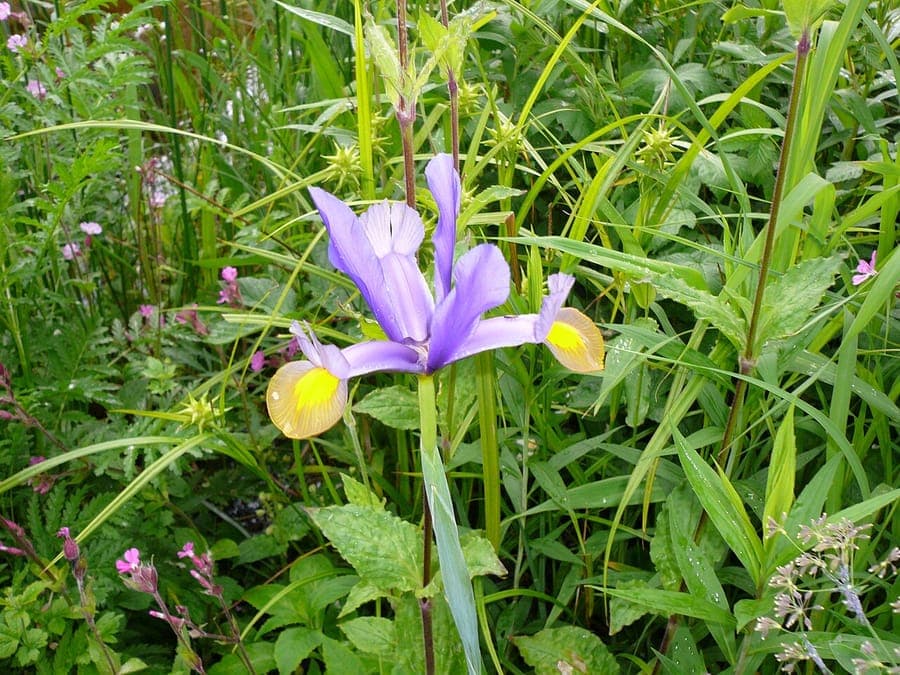
User:Florean Fortescue / CC BY-SA 2.5, via Wikimedia Commons
Spanish iris: complete guide
Iris xiphium
Want to see Spanish iris: complete guide in your garden?
1 minute, no credit card
Overview
The Spanish iris (Iris xiphium) is an elegant bulb flower originating from the Mediterranean. This beautiful iris grows from bulbs and produces stunning flowers in a wide range of colors: deep blue, purple, white, yellow and bicolor. Thanks to its compact growth and long flowering period, this plant is excellent for borders, containers, pots and cut flowers.
Bulb flowers like Spanish iris are among the most reliable color providers in your front garden. They create year-round spectacular blooms and require minimal maintenance.
Appearance and bloom
Spanish iris reaches a height of 40 to 50 centimeters and has slender, grass-like leaves that grow stiffly upright. The flowers are large, about 8 to 10 centimeters in diameter, and have the classic iris structure with three upright petals (standards) and three drooping petals (falls).
The flowers appear in May to June and last for several weeks. The color palette ranges from sky blue to violet, sometimes with yellow spots on the falls. Some cultivars are bright yellow with purple markings. The flower has a subtle, pleasant fragrance.
Ideal location
Spanish iris thrives best in a sunny spot in the garden. At least six hours of direct sunlight per day is essential for robust growth and rich blooms. In partial shade the plant grows, but flowers less abundantly.
This iris species is very suitable for sunny borders, rock gardens, containers and dry slopes. It also fits well in pots on the terrace, allowing you to enjoy the elegant flowers close to your home.
Soil
Spanish iris requires well-draining, not overly moist soil. Good drainage is of paramount importance, as excessive moisture leads to bulb rot. Acidic or neutral soil is ideal; the plant also grows in slightly alkaline soil.
Before planting the bulbs, work some coarse sand or gravel into the soil. This significantly improves drainage. Heavy clay soil can be improved by adding sand, compost and organic matter.
Watering
Spanish iris is very drought-tolerant once established. During the growing season (fall and spring) water when the soil feels dry. Strong moisture-loving behavior is not in order.
Once flowering is over and the foliage begins to withdraw, gradually reduce watering. In summer, when the plant goes dormant, almost no water is needed unless it is exceptionally dry.
Free design
Want to see Spanish iris: complete guide in your garden? Make a free design now.
Pruning and maintenance
After flowering, let the foliage die back and fall away. This may seem unattractive, but it allows the bulb to conserve energy for next season. However, remove wilted flower stems immediately after flowering.
Each early fall you can carefully dig up, thin out and replant older bulbs. This prevents overcrowding and promotes healthy growth. In mild climates, bulbs can remain in the ground to overwinter.
Maintenance calendar
September-October: Plant bulbs at 10-15 centimeter depth, about 10 centimeters apart. May-June: Flowering period; enjoy the beautiful blooms. June-July: Foliage dies back; gradually reduce watering. August: Plant dormancy; no special maintenance. Fall care: Remove dried stems and leaves; use disinfected tools.
Winter hardiness
Spanish iris is hardy to about -5 degrees Celsius, meaning it can overwinter outdoors without protection in much of the UK and Europe. In very cold regions, you can apply a thin layer of leaf mulch as frost protection.
Where winters are very wet, it is advisable to dig up the bulbs after the foliage dies, dry them and store them cool and dry until the following autumn.
Companion plants
Spanish iris combines beautifully with other spring bloomers: Grape hyacinths, Crocus and Small crowns. Later in the season it grows well between low-growing Lavender and Sage.
In containers, Spanish iris tolerates companions such as Silver sage, Hollyhock and White Gaura. Ensure that companion plants have the same light and moisture requirements.
Final thoughts
The Spanish iris provides year-round reliable blooms and is a hardy, easy-care bulb flower for the modern front garden. With basic care and suitable conditions, you will enjoy this elegant Mediterranean beauty for decades.
Plant your Spanish iris in the fall and your front garden will soon be awash in color again. You will find bulbs in regular assortment at garden centers and specialty shops. Gardenworld.app helps you find the ideal location in your garden for optimal bloom. With good orientation and basic soil preparation, your Spanish iris will flower abundantly each spring.
Want to see Spanish iris: complete guide in your garden? Make a free design now.
Upload a photo, pick a style, and get a photorealistic design with plant list in under a minute.
No credit card required


Similar plants
Iris tingitana: complete guide
Iris tingitana
Iris tingitana, the Morocco iris, is the bulb species behind the Dutch iris: early blue-violet blooms that need a sunny, well-drained position.
Iris hookeri: complete guide
Iris hookeri
Hooker's Iris is a compact North American native plant with blue flowers. Low-growing and moisture-loving water plant.
Siskiyou iris: complete guide
Iris bracteata
Complete guide to Iris bracteata, the Siskiyou iris: location, soil, bloom cycle, watering, pruning and companion plants for this rare Pacific Coast iris.