Susan Erwin / Public domain, via Wikimedia Commons
Iris tenuissima: complete guide
Iris tenuissima
Want to see Iris tenuissima: complete guide in your garden?
Full design in HD: €7.99
Look after your Iris tenuissima with the GardenWorld app
Identify plants with your camera and get a care calendar with reminders for this plant.


Overview
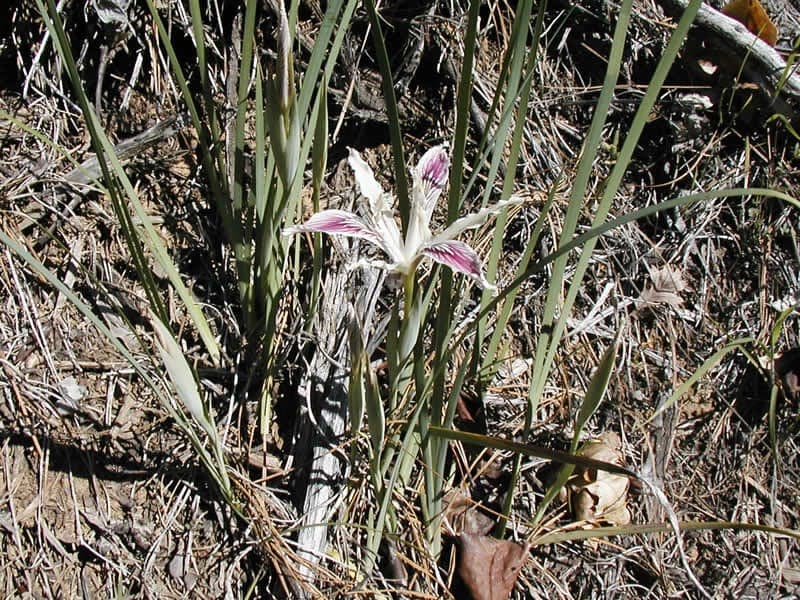
Iris tenuissima, commonly known as Slender Iris or Long-tube Iris, is a California iris species that excels in dry front yard designs and rock gardens. This plant grows compactly, reaching heights of 15 to 25 centimeters, and flowers in early spring with elegant purple blooms. Slender Iris is native to northern California and is ideal for gardeners in warmer regions.
The plant is renowned for its slender growth habit, delicate flowers, and preference for very dry, well-draining soils. At gardenworld.app, Slender Iris is ideal for gardeners in warmer climates wishing to create native California front yard collections.
Appearance and Bloom
Slender Iris has an extremely compact, low growth pattern with very thin, grass-like leaves positioned close to ground level. The plant reaches a height of only 15 to 25 centimeters and forms very compact, dense clumps.
The flowers are small but exquisite, approximately 4 to 6 centimeters across, and display an extremely elegant, delicate structure. Colors range from purple to purple-lilac with golden or yellow-green signals in the falls. The petals are very thin and delicate. They bloom in early spring, February through March, and are exceptionally long-flowering with many weeks of flowers. The blooms have a pleasant, subtle fragrance.
Ideal Location
Slender Iris performs best in full sunlight, requiring a minimum of eight hours of direct sun daily. The plant is absolutely unsuitable for shade or partial shade.
Select the warmest, sunniest location in the front yard. The plant excels in rock gardens, in dry gravel gardens, and on warm slopes. Slender Iris is also suitable for container cultivation on warm terraces. This iris is ideal for regions with warm, dry summers and mild winters.
Soil
Slender Iris is highly tolerant of soil composition but absolutely requires good drainage and a preference for poor soils. The plant thrives in sandy soils, gravel, and very dry stony earth. The ideal pH ranges from 6.0 to 7.5, neutral.
Heavy, water-retaining soils are completely unsuitable. Slender Iris actually prefers very dry, lean soils to rich garden earth. Raised beds with sand or gravel are ideal. This plant even takes root in extremely poor, barren soils.
Free preview
Want to see Iris tenuissima: complete guide in your garden? Make a free preview of your design.
Watering
Once established, Slender Iris is extremely drought-tolerant. This is a plant designed for dry Mediterranean summers. Water in the first year after planting, especially during dry spells, but minimize thereafter.
From February through March, during blooming, water once every two weeks if no rainfall occurs. After May, watering can largely cease. This plant actually requires less water than most irises and can be considered drought-tolerant once established.
Pruning
Pruning is minimal for Slender Iris. Remove dead leaves in late autumn or early spring. Spent flowers can be removed, but this is not necessary.
Plant clumps rarely need to be divided. Slender Iris remains small and compact and requires minimal intervention.
Maintenance Calendar
Winter (December-February): Preparation for blooming, removal of dead foliage Spring (March-May): Flowering, very minimal watering Summer (June-October): No maintenance needed, very dry Autumn (November-December): Winter preparation
Winter Hardiness
Slender Iris is hardy to approximately minus 10 degrees Celsius. In temperate climates, it may be problematic in very severe winters, especially if the ground freezes.
The plant performs best in warm, Mediterranean climates or in protected microclimates. In colder regions, the plant can be grown in containers and moved into shelter. In coastal climates of warmer regions, Slender Iris is highly suitable.
Companion Plants
Slender Iris combines beautifully with other California drought-lovers. Try combining it with:
- California sedums: California sedums form good ground cover
- Arctostaphylos: California manzanita provides foliage and texture
- Penstemon: California penstemons provide color and blooms
- Ornamental grasses: Dry grass species add movement
- Sclerophyllum: Other California drought-lovers
These combinations create authentic California dry garden schemes.
Conclusion
Slender Iris is a beautiful plant for dry front yard designs in warmer regions. With its delicate flowers, compact form, and extreme drought-tolerance, it offers unique charm for gardeners in drier climates. At gardenworld.app, you can use Slender Iris to create an authentic California dry garden. The plant requires minimal effort and rewards with early spring flowers. For dry front yard designs in warmer regions, Slender Iris is an excellent choice.
Frequently asked questions about Iris tenuissima
Is Iris tenuissima winter hardy?
Slender Iris is hardy to approximately minus 10 degrees Celsius. In temperate climates, it may be problematic in very severe winters, especially if the ground freezes.
When and how do you prune Iris tenuissima?
Pruning is minimal for Slender Iris. Remove dead leaves in late autumn or early spring.
How much water does Iris tenuissima need?
Once established, Slender Iris is extremely drought-tolerant. This is a plant designed for dry Mediterranean summers.
Where does Iris tenuissima grow best?
Slender Iris performs best in full sunlight, requiring a minimum of eight hours of direct sun daily. The plant is absolutely unsuitable for shade or partial shade.
What soil does Iris tenuissima need?
Slender Iris is highly tolerant of soil composition but absolutely requires good drainage and a preference for poor soils. The plant thrives in sandy soils, gravel, and very dry stony earth.

See it in your garden
See Iris tenuissima in your garden
One photo of your garden and a few questions. You see the result in about a minute.
Try it with a photoIdentify this plant in your own garden. Identify a plant
Similar plants
Giant montbretia (Crocosmia masoniorum): growing guide
Crocosmia masoniorum
Everything about giant montbretia (Crocosmia masoniorum): position, soil, planting, winter protection and companions for its fiery orange summer flowers.
Dierama pulcherrimum: growing angel's fishing rod
Dierama pulcherrimum
Everything about angel's fishing rod (Dierama pulcherrimum): full sun, moist but free-draining soil, spring planting and winter care for this graceful summer perennial.
Hesperantha coccinea (Schizostylis): autumn stars for your border
Hesperantha coccinea
A complete guide to Hesperantha coccinea, formerly Schizostylis coccinea: site, moist soil, dividing and overwintering this late-flowering crimson flag lily.
