
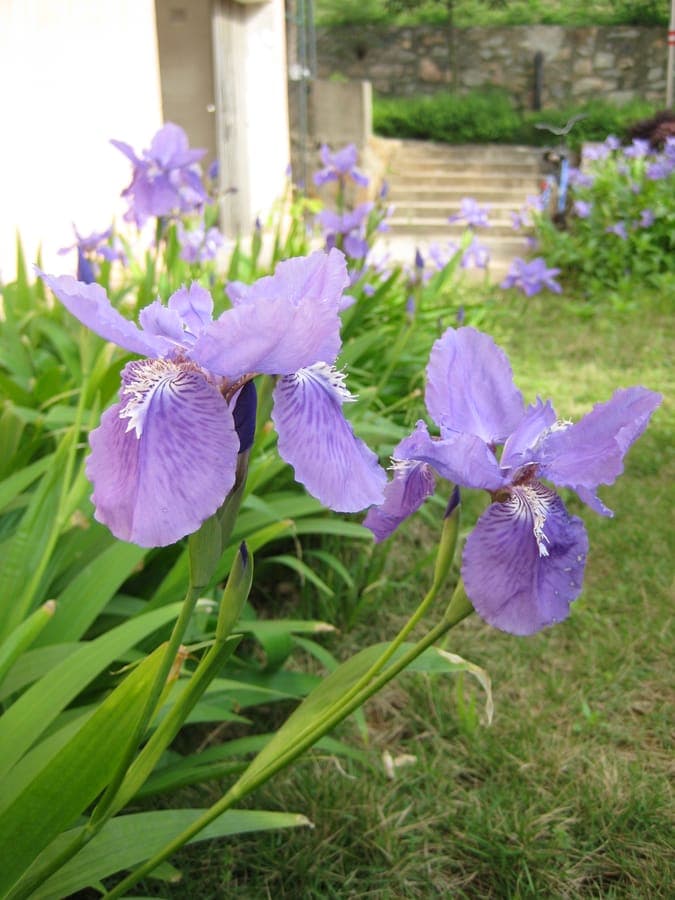
清水五月 / CC BY-SA 3.0, via Wikimedia Commons
Roof Iris: complete guide
Iris tectorum
Want to see Roof Iris: complete guide in your garden?
1 minute, no credit card
Overview
The roof iris, scientifically Iris tectorum, is an enchanting compact iris from China and Japan with rich history. The name "tectorum" refers to the Japanese tradition of planting this iris on roof tiles of temples and homes because of its resilience and significance. This iris is elegant, manageable, and highly suited to modern gardens seeking minimalist tendencies or Asian design integration.
The roof iris offers visual impact with striking purple flowers without being imposing. For architects, garden designers, and homeowners, this is an ideal choice adding elegance.
Appearance & Bloom
The roof iris grows more compact than many iris species, typically 30-50 centimeters tall. Leaves are sword-like, stiff and upright, with soft blue-green tint. They form elegant fan formations when grouped.
Flowers appear in May, each bloom on one stem. These are striking orange-purple to violet, with characteristic drooping sepals (outer petals) that are fragrant and hairy. Inner petals (standards) stand upright, giving the iris its distinctive form. Individual flowers last one day but appear in succession over weeks.
After flowering, seed pods form, though seed reproduction is unnecessary since the plant multiplies via rhizomes.
Ideal Location
Roof iris thrives with full sun to partial light, at least four hours direct sunlight daily. Plant on elevated terrain where water cannot stagnate. Walls, terraces, and slopes are ideal.
This iris tolerates rocky, cliff environments excellently due to its origins in mountainous regions of China.
Free design
Want to see Roof Iris: complete guide in your garden? Make a free design now.
Soil
Roof iris demands well-drained soil and feels uncomfortable in wet conditions. Heavy clay soils must be amended with coarse grit and sand. Light acidic to neutral pH (6-7) is ideal. Add humus-rich dry compost at planting, but avoid rich fertilizers.
After planting, limit fertilization to slow-release organic feeding in spring.
Watering
Roof iris is drought-loving. In the first season post-planting, water regularly until roots establish (6-8 weeks). Afterward, even in dry summers, occasional deep watering suffices. Excess moisture in winter invites rot.
Typical Dutch garden rainfall is usually sufficient unless in pronounced dry period.
Pruning
Roof iris requires minimal pruning. Remove only dead foliage in spring (March) when new growth begins. Spent flower stems can be trimmed, but this is optional. Rhizomes growing above soil require sun exposure.
Maintenance Calendar
Spring (March-April): Check rhizome exposure, remove dead foliage, add gentle feeding.
Summer (May-July): Enjoy blooming period. Water as needed (dry weather). Deadhead for neatness.
Autumn (August-October): Reduce watering. Ensure rhizomes stay dry preparing for winter.
Winter (November-February): Minimal maintenance. Prevent water stagnation around rhizomes.
Winter Hardiness
Roof iris is very cold hardy, tolerating temperatures to -20 degrees Celsius. This suits all Dutch regions. No winter protection needed.
Companion Plants
Roof iris pairs well with: low-growing alpines, sedums, alpine species, dwarf conifers, and other drought-loving perennials. Avoid tall plants shading it.
Closing
Roof iris is elegant, low-maintenance iris for modern gardens. Whether following Asian design or simply seeking something subtle and beautiful, this iris delivers. For more garden design ideas, visit gardenworld.app.
Want to see Roof Iris: complete guide in your garden? Make a free design now.
Upload a photo, pick a style, and get a photorealistic design with plant list in under a minute.
No credit card required


Similar plants
Iris tingitana: complete guide
Iris tingitana
Iris tingitana, the Morocco iris, is the bulb species behind the Dutch iris: early blue-violet blooms that need a sunny, well-drained position.
Iris hookeri: complete guide
Iris hookeri
Hooker's Iris is a compact North American native plant with blue flowers. Low-growing and moisture-loving water plant.
Siskiyou iris: complete guide
Iris bracteata
Complete guide to Iris bracteata, the Siskiyou iris: location, soil, bloom cycle, watering, pruning and companion plants for this rare Pacific Coast iris.