
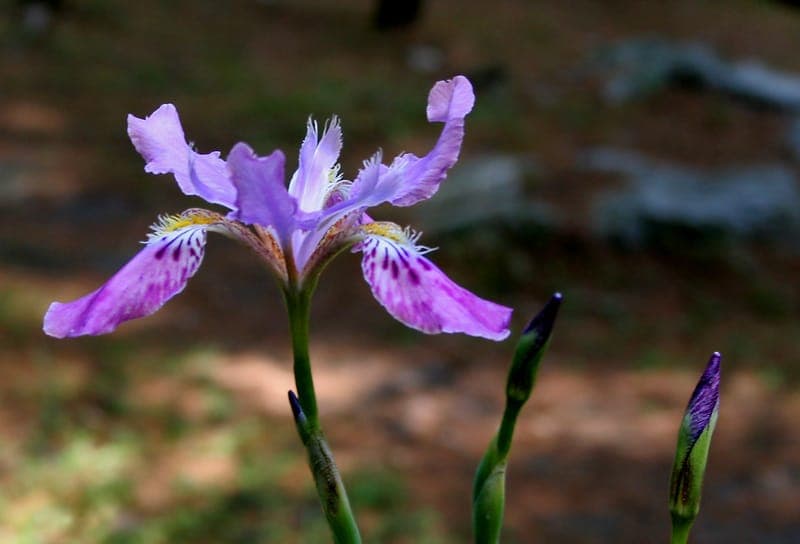
J.M.Garg / CC BY 3.0, via Wikimedia Commons
Iris milesii: complete guide
Iris milesii
Want to see Iris milesii: complete guide in your garden?
1 minute, no credit card
Overview
Iris milesii, the Red Flower Iris, is a fascinating iris native to the mountain regions of the Western Himalayas, Tibet, and South-Central China. This rare species is named after botanist John Stuart Mill and was first seen in cultivation in 1883. With its red to dark red flowers, this iris is a true gem for gardeners seeking something unusual. The plant grows at elevations from 2,000 to 4,000 meters above sea level.
Appearance and bloom
Red Flower Iris forms compact plants 40-60 cm tall with gray-green, linear leaves. The flower is uniquely red to dark red in color with orange-yellow marks on the hanging sepals, a contrast that truly stands out. Blooming occurs early in the season, April to May. Each flower lasts only one day, but produces multiple flowers sequentially over several weeks. The flower has a light sweet scent.
Ideal location
Milesii iris prefers full sun to light shade, at least 5-6 hours of direct sunlight per day. Plant in alpine, rocky environments where this iris can express its mountain origins. In temperate climates, grows well on south or west-facing slopes where morning sun arrives early.
Soil
Mountain origin requires exceptional drainage. Plant in rock gravel, rocky soil or bedrock, mixed with sand (2:1 rocks to soil). pH can be acidic to neutral (pH 5.5 to 7.0). Raised bed strategy works well: 15-20 cm raised with gravel. Add little organic matter; thin mulch of alpine stones is better than garden compost.
Free design
Want to see Iris milesii: complete guide in your garden? Make a free design now.
Watering
This mountain plant tolerates drought better than wetness. Water sparingly during growing season (April-May), only when topsoil feels completely dry. In summer dormancy, almost no water. In rainy areas, excess moisture can be harmful; provide extra drainage. Winter: keep dry as plant sleeps.
Pruning
Pruning remains minimal. After blooming, remove only wilted flower stalks below the flower head. Keep leaves until they yellow completely - this feeds underground rhizomes. Wilted leaves can be carefully removed in June-July. Remove dead or damaged parts immediately.
Maintenance calendar
April-May: Full bloom; give minimal water; enjoy red beauty; remove spent flowers. June-July: Leaves yellow; stop watering completely; plant transitions to dormancy. August-October: Rest period; no water; keep dry. November-March: Deep dormancy; no water; plant overwinters well; protect from hard frost.
Winter hardiness
Red Flower Iris is hardy to USDA zone 5b (-26 to -29 degrees C). Plant can handle heavy snow well. Ensure good drainage during thaw periods; rapid water accumulation can be problematic. In very wet climates, protective dry mulch can help.
Companion plants
Combine Iris milesii with other rock plants: alpine phlox, silene, helva, sedum. For color contrast, soft yellow or white alpine flowers are ideal. In container gardens, works well with other Himalayan alpine flowers.
Closing
Iris milesii offers gardeners a true alpine flower with spectacular red petals and unique Himalayan origins. Moderate maintenance needs and winter hardiness make this a smart choice. Available from specialist nurseries. Find more garden inspiration on gardenworld.app!
Want to see Iris milesii: complete guide in your garden? Make a free design now.
Upload a photo, pick a style, and get a photorealistic design with plant list in under a minute.
No credit card required


Similar plants
Iris tingitana: complete guide
Iris tingitana
Iris tingitana, the Morocco iris, is the bulb species behind the Dutch iris: early blue-violet blooms that need a sunny, well-drained position.
Iris hookeri: complete guide
Iris hookeri
Hooker's Iris is a compact North American native plant with blue flowers. Low-growing and moisture-loving water plant.
Siskiyou iris: complete guide
Iris bracteata
Complete guide to Iris bracteata, the Siskiyou iris: location, soil, bloom cycle, watering, pruning and companion plants for this rare Pacific Coast iris.