
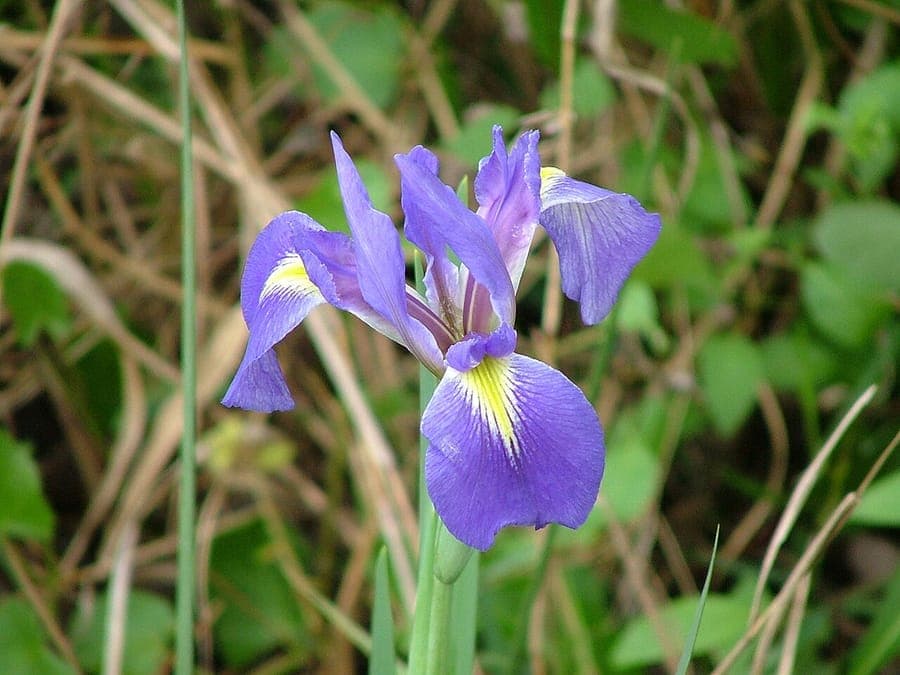
JaxStrong / Public domain, via Wikimedia Commons
Iris hexagona: complete guide
Iris hexagona
Want to see Iris hexagona: complete guide in your garden?
1 minute, no credit card
Overview
Iris hexagona, commonly known as Carolina Iris or Prairie Iris, is an American iris species that excels in moist, semi-wet front yard areas. This plant flowers from March to May with stunning blue blooms and reaches heights of 50 to 70 centimeters. Carolina Iris is native to the southeastern United States, where it grows naturally in marshes and wetlands.
The plant is renowned for its tolerance of moist soils and its elegant flowers that display the classic iris form. At gardenworld.app, Carolina Iris is ideal for homeowners with wetter front yard areas who want to create elegant early spring accents.
Appearance and Bloom
Carolina Iris has an elegant, upright growth pattern with slender, grass-like leaves that remain green throughout the season. The plant reaches heights of 50 to 70 centimeters and forms attractive, compact clumps.
The flowers are substantial, approximately 7 to 10 centimeters across, and display the classic iris structure with distinctive drooping petals (falls) and upright petals (standards). Colors range from deep blue to purple-blue with dark markings and patterns. They flower from March through May, peaking in April. After flowering, attractive seed pods develop.
Ideal Location
Carolina Iris performs best in full sun to partial shade locations, requiring a minimum of four to six hours of direct sunlight daily. The plant is far more shade-tolerant than many other iris species.
Select a location where the plant receives regular sunlight but tolerates some shade. Carolina Iris works well at the edges of water features, in rain gardens, and in marsh-like garden areas. The plant can also be planted in borders along wet ditches or drainage channels. This iris is excellent for naturalistic garden designs.
Soil
Carolina Iris is highly tolerant of soil composition, particularly since it naturally grows in marshes. The plant thrives in heavy clay, silt, and even muddy soils. The ideal pH ranges from 5.5 to 7.5, slightly acidic to neutral.
Unlike many iris species, Carolina Iris requires good moisture retention. This makes it ideal for areas with poor drainage. Even permanent water surplus is tolerated better than by many other garden plants. This makes the plant valuable in areas with water stagnation problems.
Free design
Want to see Iris hexagona: complete guide in your garden? Make a free design now.
Watering
Once established, Carolina Iris is very low-maintenance in terms of supplemental water needs. In fact, the plant requires regularly moist soils and is unsuitable for dry conditions.
Water regularly during the growth and flowering period (February through May). After flowering, watering frequency can decrease, but the plant should never dry out completely. In very dry summers, supplemental water can be beneficial. In wet winters, the plant requires no additional water.
Pruning
Pruning is minimal for Carolina Iris. Remove dead leaves in early spring before growth begins. After flowering, spent flower stems can be removed.
Once every three to four years, plant clumps can be thinned or divided to maintain full flowering vigor. This also helps prevent excessive spread in areas where control is desired.
Maintenance Calendar
Winter (December-February): Preparation for growth, removal of dead foliage Spring (March-May): Flowering, moisture management, seed collection Summer (June-September): Maintenance, division preparation Autumn (October-November): Winter preparation, foliage cleanup
Winter Hardiness
Carolina Iris is hardy to approximately minus 10 degrees Celsius. In temperate climates like the British Isles or Central Europe, the plant survives outdoors easily.
In very severe winters, some foliage may freeze, but the plant regrows normally in spring. In maritime climates with temperate winters, Carolina Iris is highly suitable. Snow presents no problems for this plant.
Companion Plants
Carolina Iris combines beautifully with other water-loving plants. Try combining it with:
- Rush species: Various rush types provide interesting texture
- Primula: Yellow or red primroses provide color contrast
- Hosta: Leaf interest alongside flowering focus
- Astilbe: White plumes provide airy contrast
- Water plants: Small water lilies in shallow pools
These combinations create natural, water-park-like garden effects.
Conclusion
Carolina Iris is an elegant plant for moist front yard areas. With its stunning blue flowers, grass-like foliage, and tolerance for wet soils, it offers reliable structure for marsh and water garden designs. At gardenworld.app, you can use Carolina Iris to create a natural, elegant aesthetic. The plant demands minimal effort and rewards the gardener with spring flowers. For wet front yard areas, Carolina Iris is an excellent choice.
Want to see Iris hexagona: complete guide in your garden? Make a free design now.
Upload a photo, pick a style, and get a photorealistic design with plant list in under a minute.
No credit card required


Similar plants
Iris tingitana: complete guide
Iris tingitana
Iris tingitana, the Morocco iris, is the bulb species behind the Dutch iris: early blue-violet blooms that need a sunny, well-drained position.
Iris hookeri: complete guide
Iris hookeri
Hooker's Iris is a compact North American native plant with blue flowers. Low-growing and moisture-loving water plant.
Siskiyou iris: complete guide
Iris bracteata
Complete guide to Iris bracteata, the Siskiyou iris: location, soil, bloom cycle, watering, pruning and companion plants for this rare Pacific Coast iris.