
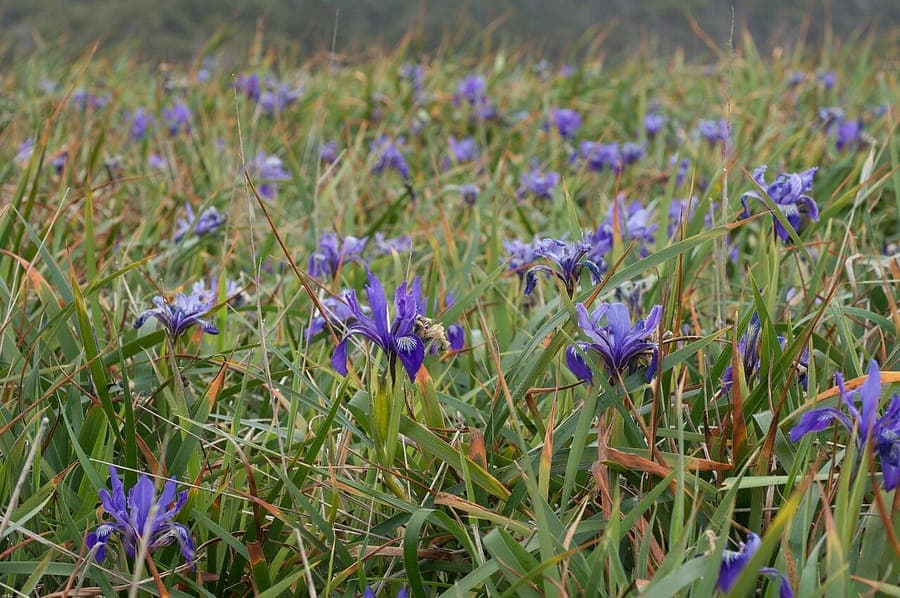
Eric Hunt / CC BY-SA 4.0, via Wikimedia Commons
Iris douglasiana: complete guide
Iris douglasiana
Want to see Iris douglasiana: complete guide in your garden?
1 minute, no credit card
Overview
Iris douglasiana, commonly called Douglas iris or Pacific Coast iris, is a native perennial from California and Oregon. This elegant iris thrives in open sunny spots and along streambanks where it flourishes in dry, bright conditions. The plant produces stunning purple to violet flowers blooming from April to May. With compact growth and minimal maintenance needs, it is an excellent choice for front yard designs with natural character.
Appearance and bloom
Douglas iris reaches 30 to 60 centimeters tall with narrow, gray-green foliage providing pleasant structure. Flowers are deep purple to blue-violet with yellow markings on the lower petals. Each bloom has classic iris architecture with upright and drooping petals. The blooming period extends April through May, giving early season color. Seeds mature in papery seed pods.
Ideal location
Select a fully sunny spot with at least six hours of direct daily sunlight. Douglas iris thrives in open areas and needs abundant light for optimal blooms. Avoid shaded locations where flowers may not fully develop. The plant also tolerates moderate wind well due to its compact form.
Soil
Dry, well-draining soil is essential. Douglas iris tolerates sandy, gravelly and other poor soils without issue. Avoid heavy clay or moist soils that can cause root rot. A pH between 6 and 8 is ideal. Add sand or gravel if your soil is too heavy.
Free design
Want to see Iris douglasiana: complete guide in your garden? Make a free design now.
Watering
Once established, this iris is extremely drought-tolerant. Water when planting, then only during extreme dry periods. Excessive water during growing seasons leads to disease. In rainy periods, supplemental watering is usually unnecessary.
Pruning
Remove faded flowers to direct energy toward root development. After blooming, stems can be cut back to ground level. Remove dead or damaged foliage in spring. This plant needs minimal maintenance.
Maintenance calendar
Spring: Remove dead foliage, prune as needed. Summer: Minimal water except in drought. Fall: No maintenance required. Winter: Plant is hardy and dormant.
Winter hardiness
Douglas iris is fully hardy to -15C and grows in USDA zones 8-10. In colder regions, winter protection with mulch can be beneficial. The plant tolerates frost and snow without issue in its natural range.
Companion plants
Combine Douglas iris with other drought-tolerant perennials such as Lavandula angustifolia, Dianthus, or Festuca glauca. Low-growing Sedum varieties form beautiful groundcover nearby. Ornamental grasses like vetiver add texture.
Closing
Douglas iris is an underrated perennial with great potential for front yard designs. The combination of elegant flowers, drought tolerance and minimal maintenance makes it a smart choice. Bring this Pacific Coast beauty to your garden and enjoy years of floral abundance with GardenWorld.app.
From our garden design expertise: Douglas iris is perfect for xeriscaping projects and Mediterranean garden styles. Available at major garden centers. See how you can integrate this into professional garden designs on gardenworld.app.
Want to see Iris douglasiana: complete guide in your garden? Make a free design now.
Upload a photo, pick a style, and get a photorealistic design with plant list in under a minute.
No credit card required


Similar plants
Iris tingitana: complete guide
Iris tingitana
Iris tingitana, the Morocco iris, is the bulb species behind the Dutch iris: early blue-violet blooms that need a sunny, well-drained position.
Iris hookeri: complete guide
Iris hookeri
Hooker's Iris is a compact North American native plant with blue flowers. Low-growing and moisture-loving water plant.
Siskiyou iris: complete guide
Iris bracteata
Complete guide to Iris bracteata, the Siskiyou iris: location, soil, bloom cycle, watering, pruning and companion plants for this rare Pacific Coast iris.