
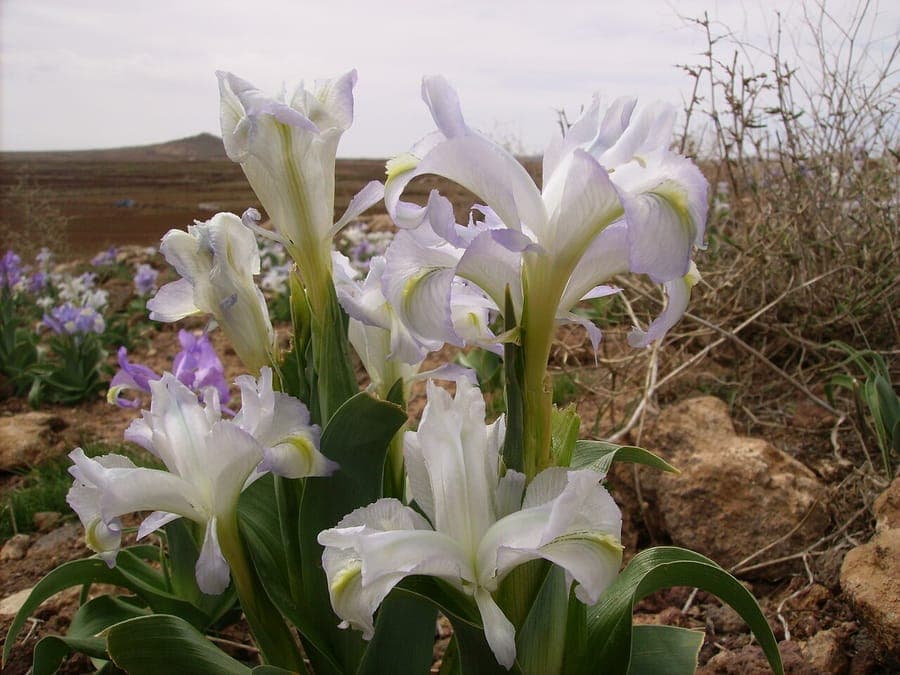
Anas A. Emad / CC BY-SA 4.0, via Wikimedia Commons
Iris aucheri: complete guide
Iris aucheri
Want to see Iris aucheri: complete guide in your garden?
1 minute, no credit card
Introduction
The Iris aucheri, also known as Aucher Iris or Babylonian Juno iris, is a fascinating and relatively rare iris species from the dry mountain regions of the Middle East. This plant grows naturally in regions stretching from Turkey to Jordan and western Iran. The plant is named after Aucher, a botanist and plant collector who identified the species in the 19th century. Despite its rarity in cultivation, this iris is an absolute gem for gardeners wanting to add something truly exclusive to their collection.
The Iris aucheri is special because it distinguishes itself with its small, elegant form and soft yellow flowers that charm in a subtle way. Unlike many larger iris species, this dwarf iris is perfect for rock gardens, small gardens, and container culture. With good drainage and a sunny location, this plant can provide years of beauty with minimal effort.
Appearance and Bloom
The Iris aucheri is a compact iris reaching only 15 to 30 centimeters high, making it perfect for smaller gardens and rock gardens. The plant grows from narrow, grass-like leaves that are gray-green in color and remarkably more elegant than many larger iris species. The leaves grow in compact clusters around the base of the plant.
The flowers appear in spring (March to April in most climates) and are the true attraction of this iris. The flowers are soft yellow to pale yellow in color, sometimes with subtle brownish markings. Each flower is approximately 4 to 5 centimeters in diameter and grows on short stems, giving a charming, compact effect. The flowers have the characteristic iris structure with upright standards and drooping falls.
After blooming, the plant becomes less prominent, but the gray-green foliage remains attractive. The plant develops seed pods that can be remarkably ornamental.
Ideal Location
The Iris aucheri requires full sun for optimal growth and flowering. Plant this iris in a location where it receives at least 6 to 8 hours of direct sunlight daily. The plant grows wild on open mountain slopes with full sun exposure, so it feels at home in bright, warm locations.
The plant is very sensitive to excessive shade. Without sufficient sun, flowering will disappoint and the plant may become susceptible to diseases. Choose therefore a sunny corner of your rock garden or a south-facing perennial bed.
The plant also feels at home in wind. In fact, some air circulation can help prevent moisture-related problems.
Soil
This is perhaps the most important aspect of Iris aucheri cultivation. The plant needs exceptionally well-drained, stony, and sandy soil. Heavy clay or other wet soils will lead to bulb rot and the plant will likely die.
The ideal mixture for Iris aucheri consists of approximately 40% coarse sand, 40% small gravel or pebbles, and only 20% nutrient-rich garden or leaf mold. This creates a very draining environment that prevents stagnant water.
The pH preference lies between 6 and 7.5, so neutral to slightly alkaline soil is acceptable. Some growers add considerable lime to the soil to improve pH and drainage.
Alternatively, the plant can also be grown in pots with a well-draining mixture of mineral soil and sand. This gives complete control over soil moisture.
Free design
Want to see Iris aucheri: complete guide in your garden? Make a free design now.
Watering
As with many bulbous irises, water must be handled carefully. Once planted, the plant needs regular but not heavy water during the growth and flowering seasons.
The goal is that soil moisture retention remains at approximately 40 to 50 percent - so moist but not wet. Check regularly and water only when the top centimeter feels dry.
Once the plant begins to die back at the end of the growing season, water should be drastically reduced. In summer and fall, when the plant is dormant, minimal water should be given. In fact, the plant can be kept almost completely dry.
Pruning
The Iris aucheri requires no pruning. Let the foliage die back and dry completely before removing it. This helps the plant build energy for next season. Remove only damaged or diseased parts.
Maintenance Calendar
Fall: Plant bulbs in September-October. Winter: Minimal care, frost protection in very cold environments. Spring: Begin with careful watering as growth starts. Summer: Minimize water as plant dies back. Fall: No water, preparation for rest.
Winter Hardiness
The Iris aucheri is reasonably winter-hardy and can tolerate temperatures down to approximately minus 10 to minus 15 degrees Celsius. In most Dutch gardens, the plant can overwinter outdoors, though frost protection in very cold regions can be beneficial.
In extremely cold winters, or in zones with many moisture problems, it may be better to dig up the bulbs after they have died back and store them in a dry, cool place until next season.
Companion Plants
The Iris aucheri combines well with other alpine plants. Sedums, sempervivums, and small mountain palms form perfect neighbors. Gray-foliage plants like small Artemisia form nice contrast.
In borders, the plant can be planted alongside other spring-blooming bulbs like small tulips and crocuses. These form a nice visual effect when planted together in groups.
Conclusion
The Iris aucheri is a unique and exclusive iris that adds genuine beauty and character to any garden collection. For those wanting to specialize in rare bulbs, this Middle Eastern beauty is certainly worth the effort. With good drainage and a sunny location, this iris will bring joy for years to come.
The plant can be ordered from specialized online bulb suppliers. Caution is advised as this plant is rarely found in regular garden centers. Plant this beauty today and enjoy the subtle elegance of this extraordinary iris. For more planting help and design tips, visit gardenworld.app where you can request personalized garden designs.
Want to see Iris aucheri: complete guide in your garden? Make a free design now.
Upload a photo, pick a style, and get a photorealistic design with plant list in under a minute.
No credit card required


Similar plants
Iris tingitana: complete guide
Iris tingitana
Iris tingitana, the Morocco iris, is the bulb species behind the Dutch iris: early blue-violet blooms that need a sunny, well-drained position.
Iris hookeri: complete guide
Iris hookeri
Hooker's Iris is a compact North American native plant with blue flowers. Low-growing and moisture-loving water plant.
Siskiyou iris: complete guide
Iris bracteata
Complete guide to Iris bracteata, the Siskiyou iris: location, soil, bloom cycle, watering, pruning and companion plants for this rare Pacific Coast iris.