
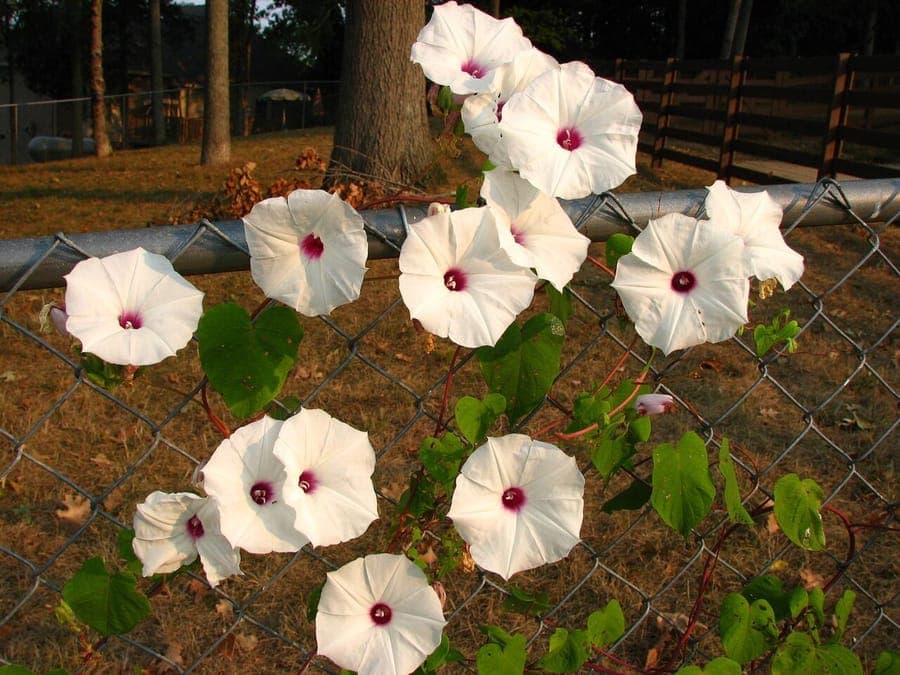
KevinTernes at English Wikipedia / CC BY-SA 3.0, via Wikimedia Commons
Ipomoea pandurata: complete guide
Ipomoea pandurata
Want to see Ipomoea pandurata: complete guide in your garden?
1 minute, no credit card
Overview
Ipomoea pandurata, known as Manroot, is an impressive perennial climbing plant. This North American plant has been known since 1818 and belongs to the Convolvulaceae family. With its characteristic heart-shaped foliage and white campanula flowers, it is an excellent choice for gardens that need dramatic height. The plant owes its name to massive underground tubers that can weigh up to 75 kg.
Appearance and bloom
Manroot grows to 3 meters tall and spreads via tendrils. The leaves are heart-shaped to fiddle-shaped, 5 to 12 cm long with clear venation. The flowers are spectacular white with a purplish throat, campanula or funnel-shaped, 3 to 5 cm diameter, and bloom from June to September. The foliage is medium-textured with soft green tones.
Ideal location
Manroot thrives best in a fully sunny spot with at least 6 hours of direct sunlight daily. Plant against a pergola, trellis or wall where the climbing stems can find support. The plant is well-suited for gardens in warm climates such as Southern Europe and Mediterranean regions.
Soil
Ipomoea pandurata grows best in well-draining, fertile soil. Heavy clay can be improved by mixing with sand and organic material. pH can range from acidic to neutral (pH 5.5 to 7). Before planting, enrich the soil with rotted organic matter. A 5-7 cm layer of mulch protects against drying out.
Free design
Want to see Ipomoea pandurata: complete guide in your garden? Make a free design now.
Watering
Manroot has moderate water requirements. Once established, the plant has good drought resistance thanks to its large tubers. During the growing season (May to September), water when the top layer feels dry. In autumn and winter, water is greatly reduced. Ensure good drainage to prevent root rot.
Pruning
Manroot responds well to pruning. Pruning stimulates branching and flowering. Pruning is best done in early spring. Remove dead, diseased or damaged stems immediately. Some gardeners prune the plant back to 30 cm after flowering.
Maintenance calendar
May: Plant after last frost; provide support. June-July: Water during dry periods; remove spent flowers; check for pests. August-September: Plant grows vigorously; apply fertilizer. October: Prune after flowering; collect seeds. November-April: Plant rests; no water; protect tubers from frost.
Winter hardiness
Manroot is hardy to USDA zone 5b. In colder areas, the plant should be replanted annually. A 10-15 cm layer of mulch provides protection.
Companion plants
Manroot combines beautifully with other climbing plants. Plant nearby lavender, liatris, phlox. Lower-growing groundcovers like sedum form a nice contrast. For background structure, ligustrum or spiraea work well.
Closing
Manroot is a perennial climbing plant for those who love spectacular white flowers. With minimal care, this is a low-maintenance choice. Available at garden centers. Discover more garden inspiration on gardenworld.app!
Want to see Ipomoea pandurata: complete guide in your garden? Make a free design now.
Upload a photo, pick a style, and get a photorealistic design with plant list in under a minute.
No credit card required


Similar plants
Spreading alkaliweed: complete guide
Cressa truxillensis
Full growing guide for Cressa truxillensis, the salt-tolerant groundcover of alkaline flats: location, soil, watering, pruning and winter care.
Betony-leaved bindweed: complete guide
Convolvulus betonicifolius
Full guide to betony-leaved bindweed (Convolvulus betonicifolius): origin, appearance, ideal site, soil, watering and garden uses.
Ivyleaf morning glory: complete guide
Ipomoea hederacea
Everything about Ipomoea hederacea: location, soil and climbing care. A fast-growing annual vine with blue funnel flowers for sunny walls and pergolas.