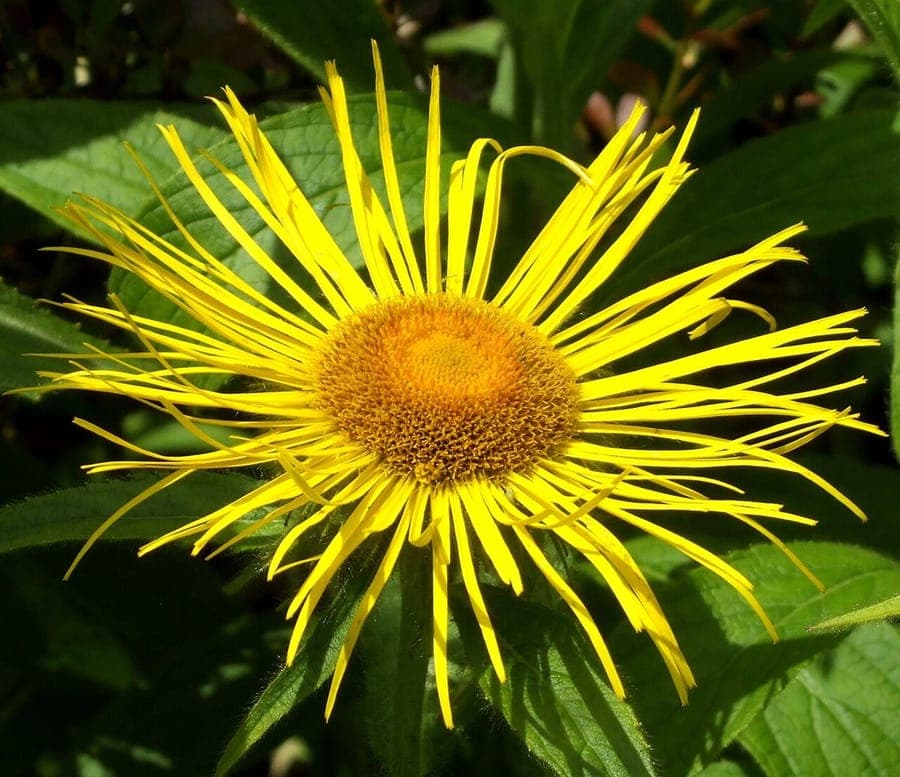
Agnes Monkelbaan / CC BY-SA 3.0, via Wikimedia Commons
Hooker's inula (Inula hookeri): complete guide
Inula hookeri
Want to see Hooker's inula (Inula hookeri): complete guide in your garden?
Full design in HD: €7.99
Look after your Hooker's inula with the GardenWorld app
Identify plants with your camera and get a care calendar with reminders for this plant.


Overview
Inula hookeri is one of those perennials you remember once you have seen it in flower. The blooms look like small suns with hundreds of thread-fine, soft yellow rays curling in every direction around a warm orange-yellow centre. They give a border a slightly wild, relaxed feel, which is exactly what you want in a naturalistic planting or along the edge of an orchard. In Britain it is usually sold as Hooker's inula.
The species belongs to the daisy family (Asteraceae) and comes from the Himalaya, from Nepal and Sikkim through Bhutan to south-west China and Myanmar. There it grows in mountain meadows and along woodland edges at considerable altitude, where summers are moist and winters cold. It is named after the British botanist Joseph Dalton Hooker, who collected plants in Sikkim in the nineteenth century.
Inula hookeri grows 60 to 90 cm tall. It forms a dense clump that slowly spreads by underground runners. That makes it ideal for filling a larger space, but in a small border you will need to keep it in check. It is not invasive in the wild anywhere in Europe; it is simply a vigorous garden plant.
No serious toxicity to people or pets is known. As with several other inulas, the hairy leaves can cause mild skin irritation in sensitive people, so wear gloves if you are cutting back or dividing a lot.
Appearance and bloom cycle
The leaves are oblong to lance-shaped, 10 to 15 cm long, fresh green and softly hairy on both sides. The stems are sturdy and hairy too. At the top they branch, each carrying one or a few flower heads 6 to 8 cm across.
The plant is worth a look even before it flowers. The buds are wrapped in woolly, slightly fringed bracts that look like small silvery-green balls in July. From late July they open and the pale yellow rays appear: so narrow that they look more like threads than petals. The centre is a deeper orange-yellow and slightly domed. Flowering continues into September and sometimes into early October.
Bees, bumblebees and hoverflies visit the flowers in large numbers. After flowering, fluffy seed heads follow. They are not spectacular, but the plant rarely self-seeds to a troublesome degree.
Ideal location
Unlike many yellow summer flowers, Inula hookeri does not like a bone-dry, baking spot. It flowers best in full sun or light shade, provided the soil does not dry out. A position with morning sun and some afternoon shade suits it very well. In deep shade flowering is sparse and the stems become floppy.
Give it room: allow at least 60 cm across, and bear in mind that it will spread further after a few years. It looks at home beside a pond, in a naturalistic border, at the edge of a shrubbery or in a cottage garden. On gardenworld.app you can have a garden design made in which vigorous perennials like this get exactly the space they need.
Soil requirements
Moisture-retentive, humus-rich soil is ideal. Light clay and loam are excellent; on poor, sandy soil, dig in some compost or well-rotted manure at planting time to help it hold moisture. It is less happy in truly waterlogged ground where water stands, but damp soil in summer is welcome.
The pH is not critical: slightly acidic to slightly alkaline is fine. Plant in spring or early autumn, while the soil is still warm and moist. A mulch of compost or bark in spring helps retain moisture and suppresses weeds.
Free preview
Want to see Hooker's inula (Inula hookeri): complete guide in your garden? Make a free preview of your design.
Watering
Water regularly for the first few weeks after planting so the roots establish well. An established plant on moisture-retentive soil needs little extra water in a normal summer. In prolonged drought and heat the leaves droop and the edges turn brown; water thoroughly every few days at the base of the plant, ideally in the morning or evening.
On sandy soil or in a sunny, dry corner you will need to water more often. In such gardens choose a spot that gets a little shade in the afternoon.
Pests and diseases are rarely a problem. Slugs like to graze the young shoots in spring, but later the hairy leaves protect the plant quite well. If it grows too crowded and too hot in a dry summer, powdery mildew can appear. Even soil moisture and good air movement are the best prevention. Simply remove any affected leaves and put them in the general waste rather than on the compost heap.
Pruning
Inula hookeri needs very little pruning. You can remove spent flowers if you like a tidy look, but it hardly extends flowering. If you leave them, birds get the chance to pick at the seed.
Cut the stems down to just above ground level in late autumn or early spring. Leaving the old stems until March gives insects somewhere to shelter over winter.
The most important job is division. Every three or four years, in spring, slice off a section of the clump with a spade. This keeps the plant within bounds, rejuvenates it and gives you new plants to move or give away. If you want a firm boundary, sink a root barrier about 30 cm deep at planting time.
Maintenance calendar
March: Cut back old stems if you left them over winter. Divide large clumps.
April: Apply a mulch of compost. Plant new specimens.
May-June: Protect young shoots from slugs. Chop off runners that stray beyond their space.
July: The woolly buds appear. Water in dry spells.
August-September: Full flower. Deadhead if you prefer.
October-November: Leave the stems for insects and birds, or cut them down.
December-February: Dormant. No protection needed.
You will find a plant calendar with these jobs for your own garden, month by month, on gardenworld.app.
Winter hardiness
Inula hookeri is very hardy. In its mountain home it spends the winter under snow, and in British and northern European gardens it survives temperatures down to about -25 °C without trouble. The top growth dies back in autumn and the plant resprouts from its rhizomes in spring.
It needs no winter protection anywhere in Britain or the Low Countries. The only thing it dislikes is soil that lies under water all winter. In a container the root ball is more vulnerable, so stand the pot against a sheltered wall.
Companion plants
The soft yellow of Inula hookeri looks lovely next to purple, blue and pink. Purple loosestrife (Lythrum salicaria) is an excellent partner in a damp spot, as are border phlox (Phlox paniculata) and bee balm (Monarda didyma). Cranesbills such as Geranium 'Rozanne' fill the front of the border nicely with violet-blue flowers into autumn.
Large grasses such as Chinese silver grass (Miscanthus sinensis) add structure and make a calm backdrop for the tousled yellow flowers. For a smooth transition into autumn, combine it with Michaelmas daisies (Symphyotrichum novi-belgii) and sneezeweed (Helenium autumnale).
Final thoughts
Inula hookeri is a cheerful, tough perennial for anyone who loves a natural garden. It asks for little: moisture-retentive soil, sun or light shade, and a spade every few years to keep it within bounds. In return you get an abundance of soft yellow, finely rayed flowers from late July into September that draw in insects and give the border a loose, summery mood.
Choose its spot carefully and give it room. Three plants together will form a broad yellow drift within two years that stands out from a distance, especially against a dark hedge or a group of grasses. Treat it that way and this Himalayan mountain plant will reward you for many years.
Frequently asked questions about Hooker's inula
Is Hooker's inula winter hardy?
Inula hookeri is very hardy. In its mountain home it spends the winter under snow, and in British and northern European gardens it survives temperatures down to about -25 °C without trouble.
When and how do you prune Hooker's inula?
Inula hookeri needs very little pruning. You can remove spent flowers if you like a tidy look, but it hardly extends flowering.
How much water does Hooker's inula need?
Water regularly for the first few weeks after planting so the roots establish well. An established plant on moisture-retentive soil needs little extra water in a normal summer.
Where does Hooker's inula grow best?
Unlike many yellow summer flowers, Inula hookeri does not like a bone-dry, baking spot. It flowers best in full sun or light shade, provided the soil does not dry out.
What soil does Hooker's inula need?
Moisture-retentive, humus-rich soil is ideal. Light clay and loam are excellent; on poor, sandy soil, dig in some compost or well-rotted manure at planting time to help it hold moisture.

See it in your garden
See Hooker's inula in your garden
One photo of your garden and a few questions. You see the result in about a minute.
Try it with a photoIdentify this plant in your own garden. Identify a plant
Similar plants
Purple loosestrife: complete guide
Lythrum salicaria
Discover Lythrum salicaria, a vigorous waterside plant with dramatic purple-pink flowers. Essential for water gardens, marsh edges, and landscape design on gardenworld.app.
Phlox paniculata: complete guide
Phlox paniculata
Everything about garden phlox (Phlox paniculata): growth, fragrance, beautiful flowers, pruning and propagation. Classic summer bloomer for borders.
Monarda didyma: complete guide
Monarda didyma
Monarda didyma (bee balm) is a vibrant perennial with striking pompon-like flower heads attracting butterflies, bees, and hummingbirds throughout summer.
