
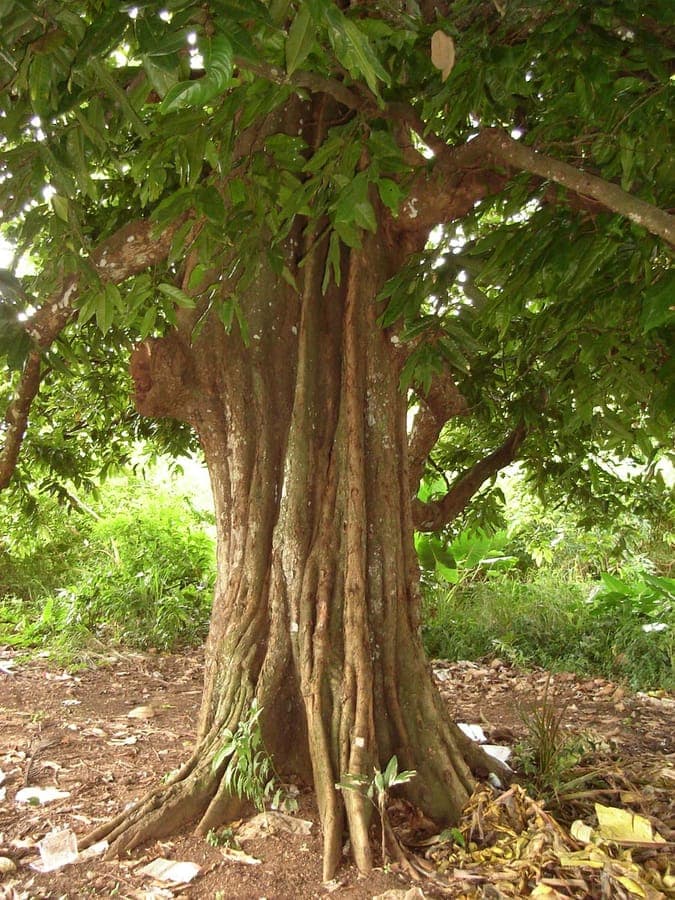
Tauʻolunga / CC BY-SA 3.0, via Wikimedia Commons
Inocarpus fagifer: complete guide
Inocarpus fagifer
Want to see Inocarpus fagifer: complete guide in your garden?
1 minute, no credit card
Overview
Inocarpus fagifer, better known as Tahitian Chestnut or Polynesian Chestnut, is a spectacular tropical tree from Oceania and Southeast Asia. Despite its tropical natural habitat, this tree is fascinating and unique enough to merit inclusion in this guide.
In the Netherlands, you can only cultivate this tree in heated glasshouse spaces, but for exotic plant enthusiasts it is worthwhile. The tree can even produce fruit and yield edible chestnuts!
Appearance and growth
Tahitian Chestnut grows as an elegant, upright tree reaching 15-25 meters in its natural tropical habitat, but much smaller in a pot (1-3 meters). The leaves are large, compound (pinnate), glossy green with fine linear leaflets.
Flowers are small, yellowish-green and inconspicuous, but they transform into brown, chestnut-sized fruits with one large seed inside. These nuts are not only decorative but also edible - they are eaten in Polynesia.
Ideal location
For this tree: warm and bright. Minimum 25-30 degrees Celsius constant, so only suitable for heated growing space or glasshouse. Brightness is crucial - minimum 6-8 hours indirect strong light, preferably more. With too little light, the tree will shoot and grow thin.
Very suitable for warm windowsill, glasshouse, or growing space under grow lights.
Soil
Well-draining, nutrient-rich potting soil. A mix of garden compost, peat and perlite (3:1:1) works excellently. This tree loves nutrition but not wateriness.
Use large pots (minimum 20-30 liters) with many drainage holes. Regularly upsize pots as the tree grows.
Free design
Want to see Inocarpus fagifer: complete guide in your garden? Make a free design now.
Watering
Water regularly during growing season (spring/summer), but allow top 2-3 centimeters of potting soil to dry between waterings. The tree cannot tolerate wet feet and will get root rot if over-watered.
In winter (in warm growing space) water less, but never completely dry. Spraying with water helps especially in dry heating.
Pruning
In the glasshouse you will need to prune regularly to keep the tree compact. Prune in early spring, just before new growth appears. Remove long branches to encourage branching.
Remove dead leaves and branches anytime. Regular pruning keeps the tree manageable.
Maintenance calendar
March-April: Prune for shape. Repot if needed. May-September: Growing period, regular water and feeding. October-December: Reduce feeding, less water. January-February: Rest, minimal feeding.
Winter hardiness
Not winter-hardy outdoors in the Netherlands - this tree dies at temperatures below 15 degrees. Ensure constant warmth (minimum 18 degrees, ideally 25+).
For tropical effect: the warmer the better. At 25-30 degrees the tree grows explosively.
Companion plants in glasshouse
Combine with other tropical plants: banana trees, passion fruit, taro. Tropical growing space requires closed system with warmth and humidity control.
For humidity lovers: place close to other plants or evaporate water regularly.
Final thoughts
Tahitian Chestnut is for dedicated plant enthusiasts willing to tackle tropical cultivation challenges. It is not easy in Dutch climate, but absolutely possible in heated glasshouse. If it works, you are rewarded with a special tree that can even produce fruit.
Seeds or young plants are difficult to obtain in the Netherlands - you will need to search online or contact tropical plant specialists. Start small and build up your tropical growing knowledge!
Want to see Inocarpus fagifer: complete guide in your garden? Make a free design now.
Upload a photo, pick a style, and get a photorealistic design with plant list in under a minute.
No credit card required


Similar plants
Tall Silky Lupine: complete guide
Lupinus elatus
Tall silky lupine is a fast-growing Californian perennial with silvery foliage and blue-purple flower spikes, ideal for a prairie-style garden.
Garfield Lupine: complete guide
Lupinus garfieldensis
The Garfield lupine is a rare, fast-growing American perennial for alkaline, dry grassland gardens, with striking blue flower spikes.
Lupinus elegans: complete guide
Lupinus elegans
Lupinus elegans, the elegant lupine, is a spectacular blooming plant from Mexico with blue flower spikes. Care, cultivation and garden use.