
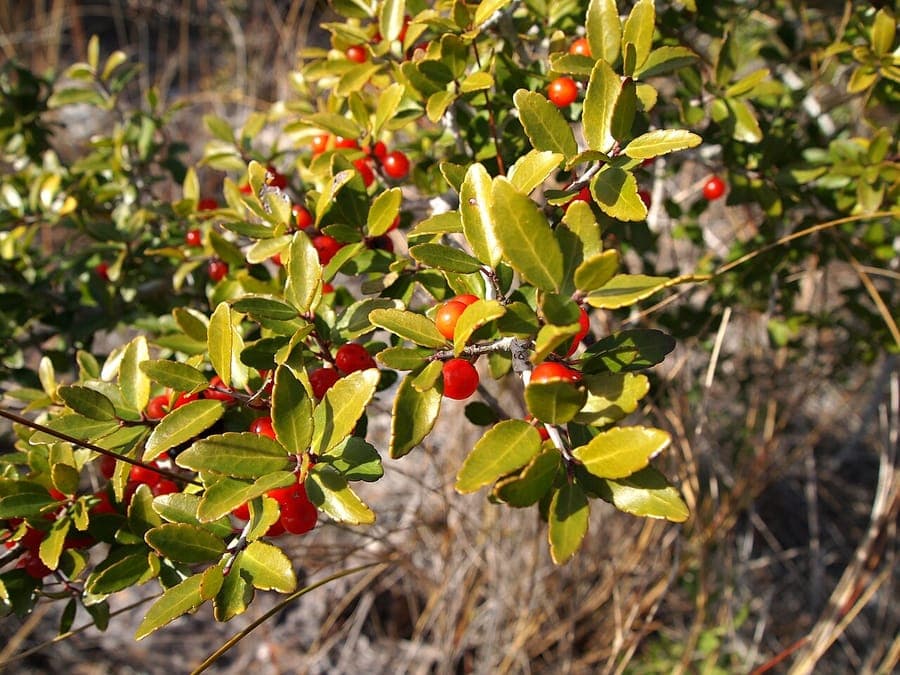
Luteus / CC BY 3.0, via Wikimedia Commons
Ilex vomitoria: complete guide
Ilex vomitoria
Want to see Ilex vomitoria: complete guide in your garden?
1 minute, no credit card
Overview
Yaupon holly, scientifically known as Ilex vomitoria, is a native North American shrub-tree from the southeastern United States to Mexico. This member of the Aquifoliaceae family is renowned for its compact growth habit, glossy green leaves and particularly for its spectacular red berries persisting long on branches.
In its natural habitat, yaupon forms dense thickets in dry, sandy and moist lowland zones. In gardens, it performs as a reliable, hardy shrub attracting wildlife and providing year-round visual interest.
Appearance and Bloom
Yaupon holly grows into a compact, branching shrub, usually 1 to 4 metres tall. The leaves are small, oval-shaped, glossy dark green with subtly serrated margins. This compact form and glossy foliage give the plant its characteristic appearance.
In spring (March to April), small white flowers appear - inconspicuous but present. After pollination, female plants produce spectacular red berries persisting until January-February. These berries are highly conspicuous and attract bird species.
Ideal Location
Yaupon holly performs optimally in full sun to partial shade. It is highly drought-tolerant once established, making it ideal for coastal gardens, drier zones and areas with limited moisture availability.
It is adaptable to various locations, from sunny borders to shaded garden corners. In gardenworld.app designs, it offers possibilities for both moisture gardens and drier landscaping.
Soil
Yaupon holly is highly adaptable and grows on diverse soils. The pH preference ranges from 4.5 to 7.0, thus thrives in both acidic and neutral soils. The plant accepts poor soils, sandy substrates and even alkaline soils.
Good drainage is more important than fertility. In container culture, use standard potting compost.
Free design
Want to see Ilex vomitoria: complete guide in your garden? Make a free design now.
Watering
Yaupon holly is extremely drought-tolerant once established. During the first year, water regularly; afterwards, minimal supplemental watering in normal conditions.
It also accepts wet terrain, though it dislikes permanent waterlogging. This plant is highly flexible regarding moisture needs.
Pruning
Yaupon holly tolerates pruning well. Spring pruning (March to April) helps maintain a compact form. The plant can even be pruned into formal shapes.
To maintain rich berry production, prune gently and prefer natural forms.
Maintenance Calendar
March - April: Spring pruning for form. Begin growth season.
May - September: Enjoy flowering and berries. Minimal care needed. Water only during severe drought.
October - December: Berries mature. Birds feed on berries. Minimal maintenance.
January - February: Remaining berries persist. Prepare for spring.
Winter Hardiness
Yaupon holly is excellently winter-hardy, resistant to -15 to -20 degrees Celsius. It thrives throughout the Netherlands, Belgium and much of Europe. Highly suitable for continental winters.
Even in severe frosts, this plant feels at home.
Companion Species
Other North American Ilex species offer comparable benefits. Ilex verticillata (winterberry) is deciduous with long-persisting red berries. Ilex opaca (American holly) is larger and evergreen.
Closing
Yaupon holly is a versatile, winter-hardy shrub that enlivens both dry and moist zones. With its compact form, glossy leaves and long-lasting red berries, it is a valued addition to gardens seeking year-round interest. On gardenworld.app, it fits perfectly into diverse designs, from naturalistic to formal. Source this robust plant from Intratuin or Gamma.
Want to see Ilex vomitoria: complete guide in your garden? Make a free design now.
Upload a photo, pick a style, and get a photorealistic design with plant list in under a minute.
No credit card required


Similar plants
Clustered holly: complete guide
Ilex aggregata
Clustered holly (Ilex aggregata) is a rare Andean holly with glossy foliage and bright red berry clusters, perfect for a sheltered, partly shaded corner.
Farges's holly: complete guide
Ilex fargesii
Farges's holly (Ilex fargesii) is an evergreen Chinese holly with glossy, spine-free foliage and bright red winter berries, ideal as a specimen or hedge.
Japanese Winterberry: complete guide
Ilex serrata
Discover Japanese winterberry: a deciduous holly with bright red berries that bring color to the garden deep into winter.