
Clustered holly: complete guide
Ilex aggregata
Want to see Clustered holly: complete guide in your garden?
1 minute, no credit card
Overview
Clustered holly (Ilex aggregata) is a rare, evergreen holly from the holly family (Aquifoliaceae), native to the Andean cloud forests of Peru and Bolivia. The species name aggregata, meaning "clustered" or "bundled," refers to the dense clusters of flowers and later berries that form along the branches, unlike the more scattered fruit of the familiar European holly (Ilex aquifolium).
This holly grows naturally at 2000 to 3500 meters elevation in cool, humid mountain forests, sheltered under a dense canopy from harsh sun and drying winds. In European gardens, clustered holly is a genuine rarity, prized by collectors of unusual evergreen plants. If you want to design a sheltered, partly shaded corner with unusual hollies using gardenworld.app, this Andean holly makes a striking talking point.
Appearance and bloom
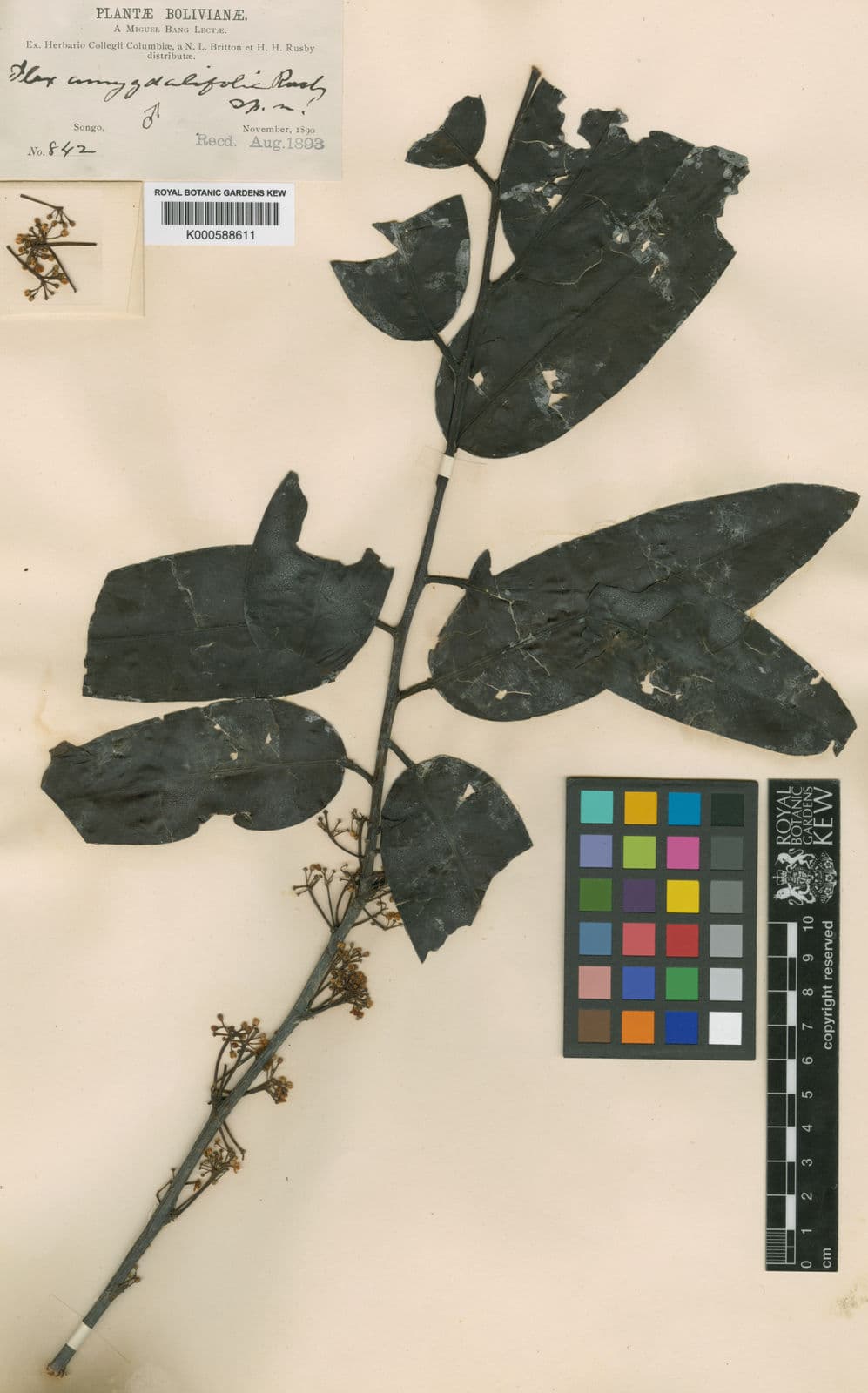
Clustered holly grows as a shrub or small tree, reaching 1.5 to 4 meters in cultivation, although wild specimens in their natural habitat can grow taller. The leaves are leathery, glossy dark green, oval to elliptical in shape and usually 4 to 8 centimeters long, with smooth to slightly toothed margins, lacking the sharp spines of common holly.
In late spring to early summer small, whitish to greenish flowers appear in dense clusters along the branches. Like most hollies, clustered holly is dioecious: male and female flowers grow on separate plants, so a male specimen nearby is needed for a good berry set. After pollination, small bright red to orange-red berries form in the autumn, packed tightly in clusters, which gave the plant its botanical name.
Ideal location
As a cloud-forest plant, clustered holly likes a sheltered, partly shaded spot with an evenly cool and humid microclimate. Full, harsh midday sun is too intense; a spot with morning sun and afternoon shade, or filtered light under taller trees, best mimics its natural growing conditions.
Because the species comes from a mild, largely frost-free mountain climate, clustered holly is not fully winter hardy in open ground across most of northern Europe. The plant does best on a sheltered patio, in an orangery, or as a large potted specimen that can move to a frost-free space in winter. Use the design tool on gardenworld.app to figure out which corner of your front garden offers enough shelter and filtered light for this unusual holly.
Also protect the plant from cold, drying winter wind, which can damage the sensitive foliage just as much as harsh sun. A spot against a south- or west-facing wall, or tucked among other taller planting, provides the necessary shelter without shading the roots too much.
Soil
Clustered holly grows best in airy, humus-rich soil that holds moisture without becoming waterlogged, similar to the forest floor of its native habitat. A slightly acidic pH between 5.0 and 6.5 is recommended, as with most holly species.
When planting, mix in plenty of compost, leaf mold or a peat-free soil improver to boost moisture retention and structure. In container culture, a mix of rhododendron or azalea compost with some perlite for extra drainage works well. Avoid chalky, strongly alkaline soil, since it can trigger leaf yellowing caused by iron deficiency.
Free design
Want to see Clustered holly: complete guide in your garden? Make a free design now.
Watering
Clustered holly likes evenly moist soil and tolerates drying out far worse than common European holly. Water regularly during the growing season, especially in warm, dry weather, and never let the top layer of soil dry out completely.
In containers the plant needs water more often than in open ground, since the root ball dries out faster; check moisture at least two to three times a week during summer. During its winter rest period, when the plant overwinters indoors or in a cold greenhouse, you can cut back significantly on watering, but never let the root ball dry out entirely.
Pruning
Clustered holly needs very little pruning to keep an attractive shape. Light formative pruning in early spring, before new growth starts, keeps the shrub compact and removes any winter damage.
Remove dead, damaged or inward-growing branches with clean, sharp pruning shears. Because the plant grows relatively slowly, heavy pruning is rarely needed; over-pruning can further reduce the already modest flowering and berry set. In container culture you can trim the roots every two to three years during repotting to keep the plant compact.
Maintenance calendar
March: Light formative pruning; check for winter damage. April-May: New growth appears; first careful feeding. June-July: Flowering period with small clusters of whitish flowers. August-September: Berries begin to form on pollinated female plants. October-November: Berries turn bright red to orange-red; last outdoor care before winter. December-February: Dormant period; potted plants overwinter frost-free with reduced watering.
Winter hardiness
Clustered holly is not naturally adapted to severe frost and generally only tolerates light night frost down to about -5 to -8 degrees Celsius, corresponding to USDA zone 9 to 10. This makes the species unsuitable for unprotected open ground across most of northern Europe.
In mild coastal regions the plant may survive in open ground with adequate shelter, but elsewhere container culture with overwintering in a frost-free greenhouse, garage or orangery is the safest choice. Bring the pot indoors in autumn, well before the first night frost, and move the plant back outside once the risk of hard frost has passed.
Companion plants
In a sheltered, partly shaded border, clustered holly combines beautifully with other cloud-forest and mountain-loving plants such as Rhododendron, Camellia and ferns. The glossy, dark green leaves make an attractive backdrop for flowering species with lighter colors.
For an exotic, botanical atmosphere you can pair the holly with Fuchsia species and Andean Salvias, which share similar growing conditions. Check gardenworld.app to see how you can build a sheltered, exotic corner in your front garden around unusual plants like this Andean holly.
Like other hollies, the glossy berried branches make attractive cut foliage for Christmas and winter arrangements. Because clustered holly is rare, it's best to harvest only a few branches per season, so the plant doesn't exhaust itself and next year's flowering isn't put at risk.
Closing
Clustered holly is a rare, evergreen beauty for fans of unusual, less common garden plants. With its glossy leaves and dense berry clusters, this Andean holly deserves a place in the collection of any plant enthusiast with a sheltered garden or greenhouse.
Because the species is not widely distributed, you'll find clustered holly mainly through specialist botanical nurseries and seed banks; general potting soil, perlite and garden tools are easy to pick up at any garden center. Design your sheltered garden corner with gardenworld.app and discover exactly where this unusual holly thrives best in your own particular situation.
Want to see Clustered holly: complete guide in your garden? Make a free design now.
Upload a photo, pick a style, and get a photorealistic design with plant list in under a minute.
10,000+ gardens designed already
No credit card required


Similar plants
Farges's holly: complete guide
Ilex fargesii
Farges's holly (Ilex fargesii) is an evergreen Chinese holly with glossy, spine-free foliage and bright red winter berries, ideal as a specimen or hedge.
Japanese Winterberry: complete guide
Ilex serrata
Discover Japanese winterberry: a deciduous holly with bright red berries that bring color to the garden deep into winter.
Ilex yunnanensis: complete guide
Ilex yunnanensis
Discover the Yunnan Holly, an elegant Asian shrub with glossy foliage perfect for shady spots. Full care guide, tips, and companion planting.