Forest & Kim Starr / CC BY 3.0, via Wikimedia Commons
Polka dot plant: care guide
Hypoestes phyllostachya
Want to see Polka dot plant: care guide in your garden?
Full design in HD: €7.99
Look after your Polka dot plant with the GardenWorld app
Identify plants with your camera and get a care calendar with reminders for this plant.


Overview
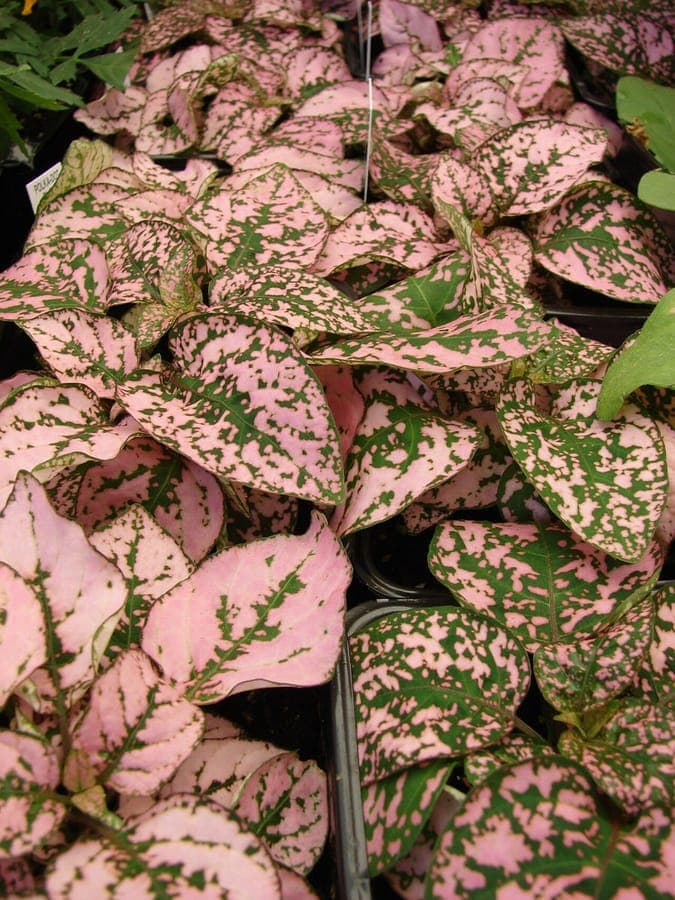
The polka dot plant (Hypoestes phyllostachya) is a cheerful foliage plant from the acanthus family (Acanthaceae) whose leaves look as though they have been flicked with paint. Pink, red or white spots and splashes lie on a green background, sometimes so densely that the green almost disappears. The species comes from Madagascar, where it grows as a small, soft-stemmed shrub in the dappled shade of forest edges. Other common names include freckle face and measles plant, and the RHS also lists flamingo plant.
It is inexpensive, quick and colourful, which makes it a popular first plant. It is not a long-lived companion like a Chinese evergreen, though: after a year or two it often becomes leggy and untidy, especially once it has flowered. Fortunately, new plants are easy to raise from cuttings or seed. In summer you can also use it outdoors as a splash of colour in shady pots and containers. If you want your indoor and outdoor planting to work together, you can have a garden design made at gardenworld.app for your patio or balcony.
Appearance and flowering
As a houseplant, Hypoestes phyllostachya usually stays 20 to 40 cm tall; planted out in warm climates it grows larger. The stems are soft and branch well if you pinch them regularly. The leaves are opposite, oval with a pointed tip and 5 to 8 cm long. The best-known varieties belong to series such as 'Splash Select' and 'Confetti', with pink, red, white or wine-red markings.
The photo shows a nursery bench full of young plants in black pots: pale pink leaves with dark green veins and blotches, some plants pinker than others. A plant label pokes up between the leaves.
In late summer and autumn small, lilac to pale purple, two-lipped flowers appear in loose spikes at the shoot tips. They are not especially decorative, and once the plant starts flowering it puts less energy into new leaves. The spots shrink and the stems stretch. If you want to keep the plant compact for as long as possible, pinch out the flower buds as soon as you see them.
Where to put it indoors
Give it a warm, bright spot free from draughts. An east- or west-facing windowsill is ideal, or a table close to a south window with a sheer curtain in between. A bright bathroom or kitchen, where the air is a little more humid, also suits it well. Small plants do nicely in an open terrarium or glass bowl, but bear in mind they soon outgrow it.
Light
Light decides the colour. In bright, indirect light with a little morning or evening sun, the spots stay large and vivid. In too little light the spots shrink, green takes over and the plant leans towards the window. Strong midday sun through glass, on the other hand, scorches the leaf edges and fades the pink. Turn the pot a quarter turn each week so it grows evenly.
Humidity
Hypoestes phyllostachya likes humidity of around 50 %. In dry, heated air the leaves develop brown, crispy edges, and spider mites and whitefly attack more readily. Group it with other plants, stand the pot on a tray of wet clay pebbles or run a humidifier in winter. In a bathroom with natural light you rarely need to worry about it.
Potting mix and repotting
An ordinary good-quality houseplant compost with some extra perlite for drainage is all it needs. The pot must have a drainage hole. Repot in spring into a pot 2 to 3 cm larger once roots appear through the base. Because the plant is often replaced after a few years, repotting matters less than with other houseplants: sometimes a fresh cutting in new compost is the best rejuvenation.
Free preview
Want to see Polka dot plant: care guide in your garden? Make a free preview of your design.
Watering and feeding
Keep the compost evenly moist but not wet. Hypoestes reacts quickly to drought: the leaves hang limply over the pot. After a drink it usually recovers within a few hours, but letting it dry out too often costs leaves. Water as soon as the top centimetre is dry and do not leave water in the saucer. In winter water more sparingly.
From April to September, feed every two weeks with liquid houseplant fertiliser at half strength. Too much nitrogen makes the plant leggy and can blur the markings. Do not feed in winter.
Cuttings and sowing
Pinching out is the most important job: nip out the growing tips regularly and the plant branches and stays full. The pinched-out tips make ready-made cuttings. Take a tip cutting of 5 to 8 cm, remove the lower leaves and place it in water or moist cutting compost. At 20 to 22 °C roots form within two weeks.
You can also sow from February to April. Scatter the fine seed over moist seed compost, press it in lightly and cover it barely, if at all. Under a clear lid at about 21 °C it germinates in one to two weeks. The first true leaves already show the spots.
Maintenance calendar
February-April: Sow or take cuttings. Repot older plants and start feeding.
May-June: Pinch out regularly. From late May, once nights stay above 10 °C, plants can go outside in shady pots.
July-August: Water and feed regularly. Check for spider mites and whitefly.
September-October: Pinch out flower buds. Bring outdoor plants in before the first cold nights, or take cuttings from them.
November-January: Quiet period. Move the plant to the brightest spot and water less. To keep track of everything, add watering, pinching and cuttings to the planting calendar on gardenworld.app.
Temperature and winter care
Room temperature between 18 and 24 °C is ideal. Below about 13 °C the plant struggles, and it will not survive frost. Outdoors you can therefore use it only as a summer plant, from late May until some point in September. If you want to keep an outdoor plant, take cuttings in August and overwinter them on a bright windowsill; that works better than bringing a large, flowered-out plant indoors. In some warm regions outside Europe the species has escaped from gardens and naturalised, but in our climate that is not an issue, since it cannot survive winter outdoors.
Toxicity to pets
The ASPCA, the American animal welfare organisation that keeps a database of toxic and non-toxic plants, lists Hypoestes phyllostachya as non-toxic to dogs, cats and horses. An animal that eats a good deal of it may still get a mild stomach upset, with vomiting or diarrhoea. So keep the plant out of reach of nibbling cats where you can. Do not confuse it with Begonia maculata, another plant with spotted leaves that is harmful to pets. No toxicity to people is known.
Companion plants
Indoors, pair Hypoestes phyllostachya with other foliage plants that want the same bright, indirect light. A Tradescantia zebrina with its silver and purple, a Begonia rex with large patterned leaves or a green Chlorophytum comosum make a colourful group together. Pink forms of Syngonium podophyllum or Aglaonema commutatum echo the pink of the spots. In summer it looks lovely outdoors in a shady container with ferns and busy lizzies. Bear in mind that not all of these partners are pet friendly. Begonia, Syngonium and Aglaonema are harmful to dogs and cats, so in a home with animals choose a spot they cannot reach.
Final thoughts
Hypoestes phyllostachya is the plant for anyone who wants colour quickly. Give it plenty of indirect light, evenly moist compost and a regular trim, and it will stay compact and brightly spotted. Pinch out the flowers, root a few new cuttings each spring and you can enjoy this cheerful plant for years, on the windowsill and, in summer, outside in a shady pot as well.

See it in your garden
See Polka dot plant in your garden
One photo of your garden and a few questions. You see the result in about a minute.
Try it with a photoIdentify this plant in your own garden. Identify a plant
Similar plants
Tradescantia zebrina (Inchplant): complete guide
Tradescantia zebrina
Master Inchplant cultivation: colors, growth habits and stunning displays. Complete care guide for this tropical beauty.
King Begonia: complete guide
Begonia rex
The painted-leaf begonia, Begonia rex, is a spectacular foliage plant with incredible leaf patterns in silver, red, pink, and purple. Discover everything about care, propagation, and enjoying this prima donna of the plant world.
Chlorophytum comosum: complete guide
Chlorophytum comosum
Discover everything about Chlorophytum comosum (spider plant). Learn care requirements, propagation, location and maintenance for thriving indoor plants.
