
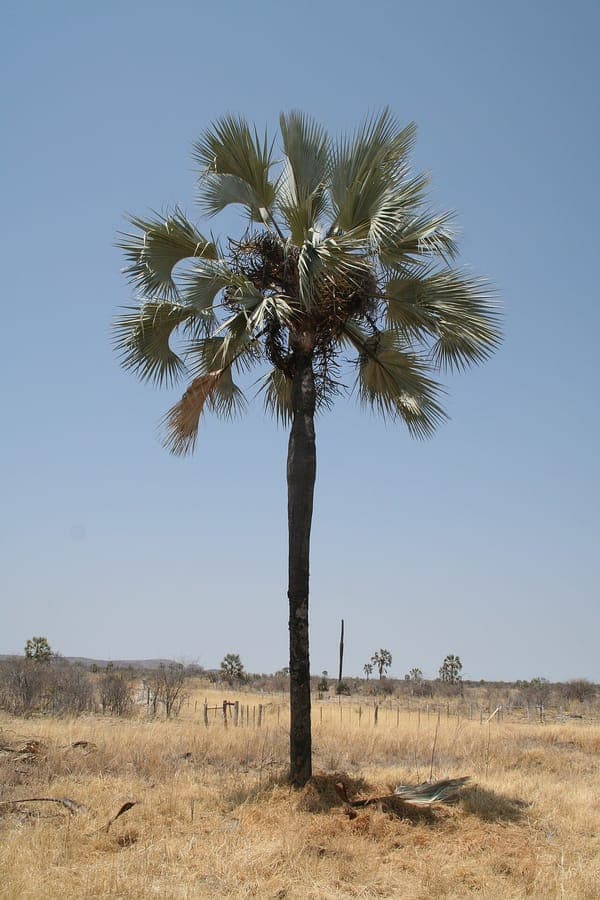
Marco Schmidt[1] / CC BY-SA 3.0, via Wikimedia Commons
Hyphaene petersiana: complete guide
Hyphaene petersiana
Want to see Hyphaene petersiana: complete guide in your garden?
1 minute, no credit card
Overview
Hyphaene petersiana, better known as Makalani palm or Ilala, is an impressive palm tree native to Southern Africa. This plant belongs to the Arecaceae family and naturally grows in Tanzania, Namibia, Botswana, Zambia, Zimbabwe, and other Southern African countries. The plant is also known as Northern Ilala palm, Real fan palm, or Vegetable-ivory palm.
The Makalani palm is exceptional for its distinctive branched growth form - unlike most palms that have a single, straight trunk, this palm grows outward in multiple branches, giving it a very unique, almost candelabra-like silhouette.
In warm climates (Southern Europe, southern Spain, southern Portugal, warm parts of southern France), this palm can be grown outdoors. In colder climates, it can only be grown in a greenhouse or conservatory.
Appearance and Bloom
Hyphaene petersiana is a medium to large palm that can grow 6 to 10 meters tall in its natural habitat, although in containers it remains much smaller. The most characteristic feature is its growth form: instead of a single, vertical trunk, the plant grows outward in multiple branch-like trunks that branch from the base. These branches can themselves branch further, giving the whole a very decorative, candelabra-like appearance.
Each trunk bears a crown of large, very large, fan-shaped leaves that can be 1 to 1.5 meters wide. The leaves are gray-green in color and have sharp, tooth-shaped segments around the edges. These leaves are truly spectacular.
The plant produces yellow flowers in rather inconspicuous flower clusters, followed by large, round fruits approximately 5 to 8 centimeters in diameter. These fruits are dark brown to black and contain a hard, ivory-colored kernel - hence the name "vegetable ivory palm." These kernels were historically used for buttons, counters, and small craft items.
Ideal Location
Hyphaene petersiana requires very bright light and sunlight. In warm climates, the plant can be planted outdoors in full sun. In less warm conditions, a protected, very sunny spot is needed, preferably against a south wall or in a sunny greenhouse.
The plant does not tolerate shaded conditions well and will grow poorly in partial shade.
The plant appreciates protection from strong winds, which can damage the large leaves.
Free design
Want to see Hyphaene petersiana: complete guide in your garden? Make a free design now.
Soil
Hyphaene petersiana grows best in well-drained, sandy-loamy soils. Mix garden soil with approximately 30-40% coarse sand or perlite for optimal drainage. The plant tolerates drought better than wet conditions.
Perfect drainage is critical - the plant does not tolerate waterlogged soils.
Watering
During growing and warm seasons, water regularly to keep the soil evenly moist. During winter periods (especially in colder climates), water much less.
Excessive watering can cause root rot. Always test the soil before watering.
Pruning
Hyphaene petersiana requires minimal pruning. You can carefully remove dead or damaged leaves when they are completely dead. Do not leave leaf stems, cut flush against the trunk.
Providing the plant form through pruning is not recommended - this can cause injury that allows disease.
Maintenance Calendar
March-May: Growing season begins. Increase watering. June-August: Intense growing season. Regular water. Protect from intense sun in very hot climates. September-October: Growth slows. Gradually reduce watering. November-February: Resting period. Minimal watering. Plant in greenhouse can experience cooler temperatures.
Winter Hardiness
Hyphaene petersiana is not frost-resistant and cannot tolerate temperatures below approximately 5-10 degrees Celsius. In warmer climates (Spain, Southern Portugal, southern France), it can grow outdoors if protection from frost is guaranteed.
In cold climates (Netherlands, Belgium, Germany), the plant must overwinter indoors in a warm greenhouse or conservatory.
Young plants are extra sensitive and must grow indoors until they are larger.
Companion Plants
Hyphaene petersiana combines nicely with:
- Other palms with contrasting leaf forms
- Large-leaved plants such as Ricinus (castor bean plant)
- Mediterranean plants in warm conditions
- Low-growing underplanting such as Tradescantia
- Rock wall climbing plants
Conclusion
Hyphaene petersiana is a spectacular palm for those with sufficient warmth and space. With its distinctive, branched, candelabra-like growth form and enormous fan-shaped leaves, it is a true showstopper. The plant requires patience, warmth, and good drainage, but for those with the right conditions, it is a beautiful long-lived specimen.
Buy Hyphaene petersiana plants from specialized growers of exotic plants and palms.
Want to see Hyphaene petersiana: complete guide in your garden? Make a free design now.
Upload a photo, pick a style, and get a photorealistic design with plant list in under a minute.
No credit card required


Similar plants
Needle palm: complete guide
Rhapidophyllum hystrix
Everything about the needle palm: the world's hardiest palm, suitable for gardens in temperate climates down to USDA zone 7b.
Saw palmetto: complete guide
Serenoa repens
A complete guide to saw palmetto (Serenoa repens), the iconic fan palm from Florida and the southeastern United States, prized for its toughness.
Puerto Rican hat palm: complete guide
Sabal causiarum
Grow Puerto Rican hat palm successfully. A majestic fan palm with tropical presence suited to sheltered Mediterranean-style gardens.