
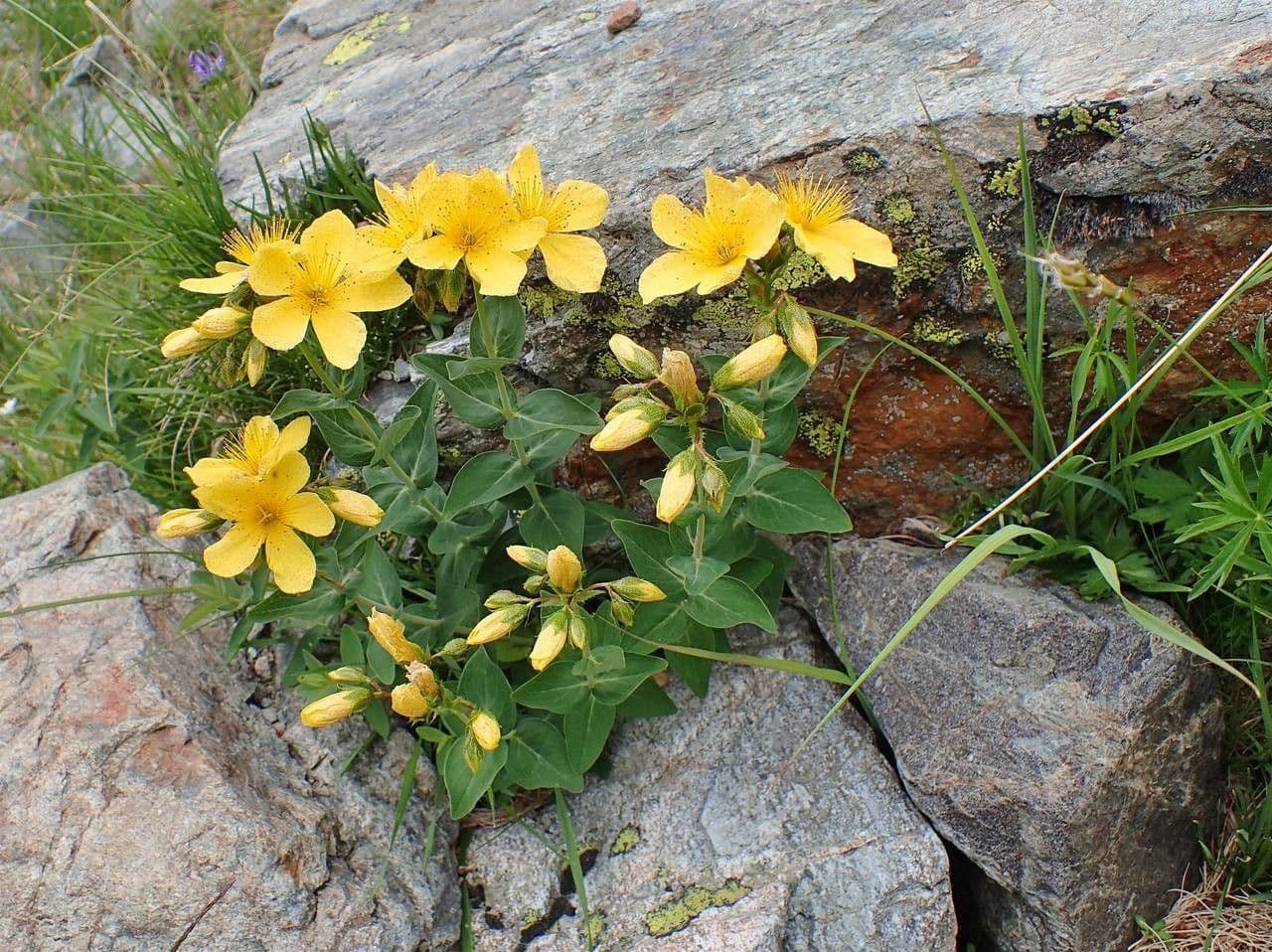
Hypericum richeri: complete guide
Hypericum richeri Vill.
Want to see Hypericum richeri: complete guide in your garden?
1 minute, no credit card
Overview
Hypericum richeri, commonly known as Richer's St John's-wort or alpine hypericum, is a robust mountain plant native to the Pyrenees, Alps, and Balkan ranges. This compact perennial grows naturally on rocky cliffs and alpine habitats. With its resilient character and bright yellow flowers, it forms a valued element in alpine and rock gardens.
Appearance and Bloom
Hypericum richeri forms compact, resilient clumps reaching approximately 30-40 centimeters in height. Leaves are small, grey-green, and densely set. The plant blooms abundantly from July through August with bright yellow star-like flowers covering the entire plant. These blooms create a spectacular display and attract butterflies.
Ideal Location
This alpine plant thrives optimally in warm, sunny locations receiving at least 6-8 hours of direct sunlight daily. Mountain conditions with excellent drainage are essential. The plant tolerates wind well. Avoid low-lying, moist spots with poor ventilation.
Soil Requirements
Hypericum richeri demands lean, extremely well-draining soil. Heavy clay is unsuitable. A mix of gravel, sand, and minimal compost is ideal. A pH between 5.5 and 7.0 is tolerated. Preference for poor soils prevents excessive nitrogen.
Watering
As a mountain plant, Hypericum richeri has modest water requirements. After establishment, the plant relies primarily on rainfall. Water only during very dry periods. Excessive moisture promotes unwanted lush growth. In pots, ensure thorough drainage.
Free design
Want to see Hypericum richeri: complete guide in your garden? Make a free design now.
Pruning
Pruning is minimally required. After blooming, spent flower clusters can be removed to promote compactness. In spring, very old or damaged stems can be carefully cut back to ground level. Caution in pruning is advisable to avoid disturbing form.
Maintenance Calendar
May-June: Growth begins, no intervention required. July-August: Blooming period, no supplemental watering. September-October: Flowers fade, plant prepares for winter. October-November: Plant dies back to ground as winter preparation. March-April: Regrows from underground roots.
Winter Hardiness
Hypericum richeri is exceptionally winter hardy, tolerating temperatures to -30 degrees Celsius. The plant dies back to ground level in winter but regrows from underground roots in spring. Excessive winter moisture can be more problematic than cold.
Companion Plants
Hypericum richeri combines beautifully with other alpine plants like Acaena, Sempervivum, and Sedum species. Low grasses like Festuca ovina provide textural contrast. Other mountain flowers like Achillea alpestris and Dianthus alpinus harmonize nicely. Avoid large, vigorous neighbors.
Conclusion
Hypericum richeri deserves recognition as essential for those wanting to develop alpine or arid gardens. With its robust growth, beautiful flowers, and extreme winter hardiness, it is a true gem for mountain gardeners. Once established, it tolerates decades without care.
Retailers
Specialized alpine plant nurseries carry H. richeri. Not all garden centers stock this specialist. International alpine plant catalogues typically offer adapted specimens. GardenWorld.app helps locate suitable suppliers.
Want to see Hypericum richeri: complete guide in your garden? Make a free design now.
Upload a photo, pick a style, and get a photorealistic design with plant list in under a minute.
No credit card required


Similar plants
Hypericum coris: complete guide
Hypericum coris
Complete guide to Hypericum coris, the heath-leaved St John's wort from the Alps: location, soil, watering and rock gardens.
St. Peter's-wort: complete guide
Hypericum crux-andreae
St. Peter's-wort is a low-growing North American shrub with yellow flowers, ideal for acidic, damp soil and naturalistic borders.
Hypericum densiflorum: complete guide
Hypericum densiflorum
Hypericum densiflorum is a dense-flowering American shrub with bright yellow summer blooms, well suited to damp gardens, rain gardens, and pollinator borders.