
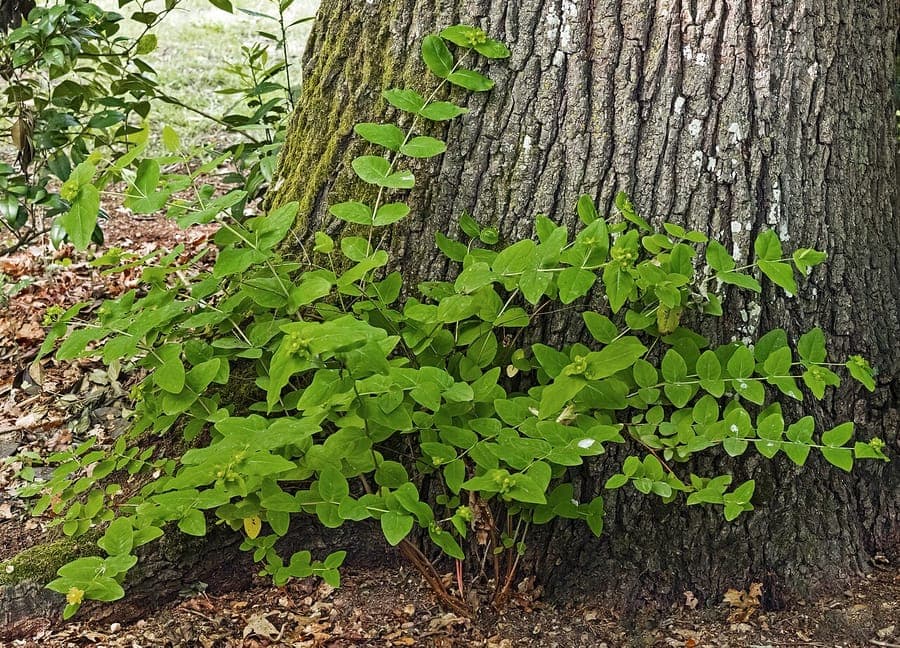
Tinker's-penny (Hypericum anagalloides): complete guide
Hypericum anagalloides
Want to see Tinker's-penny (Hypericum anagalloides): complete guide in your garden?
1 minute, no credit card
Overview
Tinker's-penny, scientifically Hypericum anagalloides, is a small creeping species in the St. John's-wort family. This compact plant originates from southwestern North America, ranging from California to Mexico. Despite its diminutive stature, it is a striking garden addition thanks to its continuous tiny yellow flowers.
The plant is primarily valued as a groundcover and is ideal for between stones, in borders, and in containers. It is extremely low-maintenance and tolerates dry conditions exceptionally well.
Appearance and Bloom
Tinker's-penny grows as a compact, creeping plant, usually no taller than 15-30 centimeters. The foliage is small, round, and green, creating a subtle backdrop for flowers.
Flowers are small yet abundant, bright yellow and star-shaped, appearing from June to October. This extended flowering period makes it valuable for gardens desiring continuous color. Flowers attract bees and other pollinators.
Following bloom, inconspicuous brownish seed pods form. The plant spreads slowly via runners, making it suitable for managed growth in borders.
Ideal Location
Tinker's-penny performs best in locations receiving at least 6 hours of direct daily sunlight. It succeeds in partial shade but flowers most abundantly in fuller sun.
This plant tolerates wind well and requires no protection. Position in a draining location without water accumulation.
Soil
Tinker's-penny is exceptionally flexible regarding soil type. It grows in both acidic and neutral soils and even tolerates well-draining sandy soils. Heavy clay soils can work if well-drained.
Add sand or gravel to heavy soils to improve drainage. Thick mulching is unnecessary but can help retain moisture in drier soils.
Watering
Water regularly after planting until established. Once mature, tinker's-penny is remarkably drought-tolerant and can survive months without supplemental water. Regular watering promotes more aggressive growth.
In extreme drought, light watering is beneficial. However, this plant is exceptionally suited to dry gardens and xeriscaping projects.
Pruning
Tinker's-penny requires minimal pruning. Dead or damaged portions can be removed at any time. To maintain a more compact form, vigorous runners can be trimmed back.
Light spring pruning helps maintain a neater appearance.
Maintenance Calendar
Spring (March-April): Light pruning for form. Check for winter damage.
Summer (May-July): Peak flowering period. Minimal intervention needed.
Autumn (August-October): Continued flowering. Remove dead material.
Winter (November-February): Dormancy. Virtually no maintenance required.
Winter Hardiness
Tinker's-penny is moderately winter hardy, tolerating temperatures to approximately minus 10 degrees Celsius. In cold climates, protection may be needed in severe winters.
The plant may die back in very harsh winters but typically regrows from seed the following season.
Companion Plants
Tinker's-penny works well as a groundcover with other low-growing plants such as sedum, sempervivum, and creeping phlox. Combination with larger groundcover shrubs is also effective.
It fits beautifully in alpine gardens and between stones.
Propagation
Tinker's-penny is easy to propagate using several methods. The fastest approach is dividing the creeping mats in early spring (March) or autumn (September). Dig up a section of the spreading mat, including roots, and divide it into pieces 10 to 15 centimeters wide. Replant these immediately in the desired location and keep the soil moist for the first few weeks to encourage establishment.
Cuttings from the creeping stems also root easily. Take pieces 8 to 10 centimeters long with a few leaf pairs, remove the lower leaves, and place the cutting in a well-draining sand-perlite mix. Roots typically form within 3 to 4 weeks at temperatures of 18 to 22 degrees Celsius.
Seed propagation is also possible; the plant often self-seeds spontaneously under suitable conditions. Collect the seed pods in autumn once they turn brown and surface-sow the fine seed without covering, since light stimulates germination.
Free design
Want to see Tinker's-penny (Hypericum anagalloides): complete guide in your garden? Make a free design now.
Pests and Diseases
Tinker's-penny is generally a remarkably pest-free plant, contributing to its popularity as a low-maintenance groundcover. Rust can occasionally appear on the foliage, recognizable as orange-brown pustules on the leaf undersides, particularly in humid, poorly ventilated conditions with limited air circulation. Remove affected leaves and ensure adequate spacing between plants.
Leaf spot disease can occur sporadically when foliage remains wet for extended periods; water at the base rather than overhead to prevent this. Slugs may nibble young shoots in spring, especially in moist gardens; a thin layer of grit or crushed shells around the plant usually keeps them at bay.
Root rot can develop in persistently wet, poorly drained soil. Always ensure excellent drainage, particularly in heavy clay soils.
Garden Design and Cultivars
Tinker's-penny is an ideal choice for growing between paving stones, along pathways, in rock gardens, and on green roofs where a low, low-maintenance cover is desired. Space plants 20 to 30 centimeters apart for a closed carpet within one to two growing seasons.
Although Hypericum anagalloides itself is rarely sold under a specific cultivar name, the same genus offers some well-known, larger St. John's-wort cultivars that pair beautifully in the same garden, such as Hypericum 'Hidcote' with large golden flowers on a compact shrub, or Hypericum calycinum 'Brigadoon' with golden-yellow spring foliage. These larger relatives create a lovely contrast with low-growing tinker's-penny as underplanting.
In August and September, during peak bloom, tinker's-penny forms a striking yellow carpet that pairs well with blue or purple late bloomers such as lavender or aster. Garden centers regularly stock suitable companion plants for dry, sunny borders.
Frequently Asked Questions
Is tinker's-penny invasive? In most gardens, no, though the plant can gradually spread via runners over several years. Remove unwanted runners easily with a spade or sharp knife to keep growth within desired bounds.
Can tinker's-penny grow between paving tiles? Yes, its creeping growth habit and tolerance for compacted soil make it suitable for joints between tiles 2 to 5 centimeters wide, provided enough light reaches the joint and it is not fully sealed with mortar.
How do you combine tinker's-penny with succulents? Sedum and sempervivum share the same preference for well-draining, sunny soil and, together with tinker's-penny, form a varied, low carpet with contrasting leaf shapes and bloom times spread across the season.
When do the first flowers appear? The first small yellow flowers typically appear in June, peaking in July and August, followed by a secondary flush that can continue into October during a mild autumn.
Conclusion
Tinker's-penny is an underappreciated gem for dry garden environments. With its yellow flowers, drought and low-maintenance nature, it offers effortless beauty throughout the growing season. Whether you need groundcover or a compact accent plant, tinker's-penny deserves a place in your garden.
Visit garden centers for plant material. For more inspiration and design tips, explore gardenworld.app. Design your entire garden on gardenworld.app!
Want to see Tinker's-penny (Hypericum anagalloides): complete guide in your garden? Make a free design now.
Upload a photo, pick a style, and get a photorealistic design with plant list in under a minute.
10,000+ gardens designed already
No credit card required


Similar plants
Hypericum coris: complete guide
Hypericum coris
Complete guide to Hypericum coris, the heath-leaved St John's wort from the Alps: location, soil, watering and rock gardens.
St. Peter's-wort: complete guide
Hypericum crux-andreae
St. Peter's-wort is a low-growing North American shrub with yellow flowers, ideal for acidic, damp soil and naturalistic borders.
Hypericum densiflorum: complete guide
Hypericum densiflorum
Hypericum densiflorum is a dense-flowering American shrub with bright yellow summer blooms, well suited to damp gardens, rain gardens, and pollinator borders.