
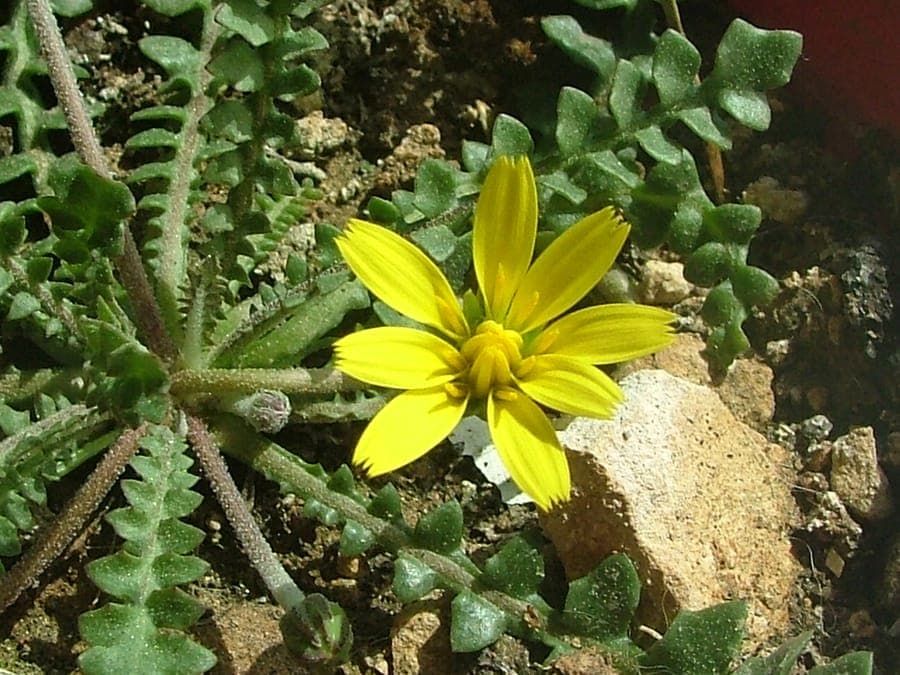
Jeffrey Sciberras / CC BY 3.0, via Wikimedia Commons
Perennial hyoseris: complete guide
Hyoseris radiata
Want to see Perennial hyoseris: complete guide in your garden?
1 minute, no credit card
Overview
Hyoseris radiata, also called perennial hyoseris or radiating chicory, is a Mediterranean wildflower from the Asteraceae family (daisy family). A perennial or annual plant native to Mediterranean regions from North Africa to Southern Europe, it deserves attention from gardeners who appreciate wild flora and low-maintenance gardening.
The plant forms low rosettes of toothed leaves and produces yellow flowers from May through October. Belonging to the same family as chicory and lettuce, it demonstrates the hardiness and drought tolerance lacking in its cultivated cousins. This makes it perfect for permaculture gardens, dry borders, and Mediterranean schemes where water is precious.
Appearance and bloom
Hyoseris radiata grows in low rosettes, typically 15-30 cm tall. The leaves are elongated and deeply toothed, resembling chicory foliage but more elegant. In early growth stages, young leaves can be harvested - they taste mildly bitter, like chicory greens.
Flowers appear on thin, branched stems from May through October in brilliant yellow. The blooms attract bees and butterflies and characteristically close at sunset. After flowering, seeds develop with feathery, parachute-like dispersal structures - a remarkable detail.
Ideal location
Hyoseris radiata demands full sun - at least 6 hours of direct daily light. More sun means fuller flowering. In partial shade it survives but blooms sparsely.
Windy sites are actually preferable - this plant evolved on exposed Mediterranean rocks. Perfect for urban gardens, balconies, and exposed situations. It tolerates salt-laden soil well - ideal for coastal gardens.
Soil
Hyoseris radiata accepts virtually any soil provided it drains well. Sand, gravel, clay - all work. However, it thrives best in nutrient-poor, dry soils. Add organic matter minimally; overly rich soil encourages leaf growth without flowers.
pH between 6.5 and 8 is ideal, though it tolerates slightly acidic and alkaline conditions.
Free design
Want to see Perennial hyoseris: complete guide in your garden? Make a free design now.
Watering
Once established, Hyoseris radiata is remarkably drought-tolerant. Water once weekly during the first 6 weeks, then you can largely stop. The plant accesses deeper soil moisture via its root system.
Even in Mediterranean summers without rain, it thrives. Waterlogging is fatal - ensure perfect drainage, especially in winter when rain is frequent.
Pruning
Pruning is unnecessary. You can deadhead faded flowers for neatness, but the plant won't bloom longer from it. Leave some flowers to set seed - this encourages natural self-seeding.
In spring, remove old rosettes with shriveled leaves, making space for fresh growth.
Maintenance calendar
March-April: New leaves emerge; growth from rosettes.
May-June: Flowering begins; yellow blooms open.
July-August: Peak bloom; numerous flowers daily.
September-October: Flowering continues at slower pace; seeds ripen.
November-January: Winter dormancy; leaf rosettes persist.
February: Season preparation; remove old debris.
Winter hardiness
Hyoseris radiata is hardy to approximately -10 C (USDA zone 8-10). In colder climates, above-ground parts may die but regrow from roots in spring.
In Mediterranean climates where winter temperatures rarely drop below 0 C, foliage stays evergreen and growth is nearly continuous. In colder regions, treat as an annual - plant in May and enjoy through October.
Companion plants
Hyoseris radiata pairs beautifully with other Mediterranean drought-tolerant plants:
- Senecio species: silvery foliage, yellow flowers
- Thistles (Carduus, Onopordum): architectural forms, purple blooms
- Lavender: purple flowers, fragrant foliage
- Sage: gray foliage, purple or red flowers
This combination creates an authentic Mediterranean dry garden.
Closing
Hyoseris radiata is for gardeners embracing alternatives to conventional plantings. It is a modest yet fascinating Mediterranean native, remarkably drought-tolerant, and suited to low-maintenance gardens. Young leaves are edible; flowers feed bees; it remains interesting year-round. Perfect for permaculture and sustainable gardening.
Difficult to find in commercial nurseries; seeds are widely available online.
Discover more drought-tolerant plants on gardenworld.app.
Want to see Perennial hyoseris: complete guide in your garden? Make a free design now.
Upload a photo, pick a style, and get a photorealistic design with plant list in under a minute.
No credit card required


Similar plants
Calendula stellata: complete guide
Calendula stellata
Complete guide to Calendula stellata, the star-flowered marigold from Sicily: location, soil, watering and companion planting tips.
Korean chrysanthemum: complete guide
Chrysanthemum x rubellum
Chrysanthemum x rubellum is a hardy autumn perennial with single pink to copper flowers from August to November. Care and combinations.
Helianthus divaricatus: complete guide
Helianthus divaricatus
Helianthus divaricatus is a North American woodland sunflower with yellow summer blooms, ideal for naturalistic borders and shady edges.