
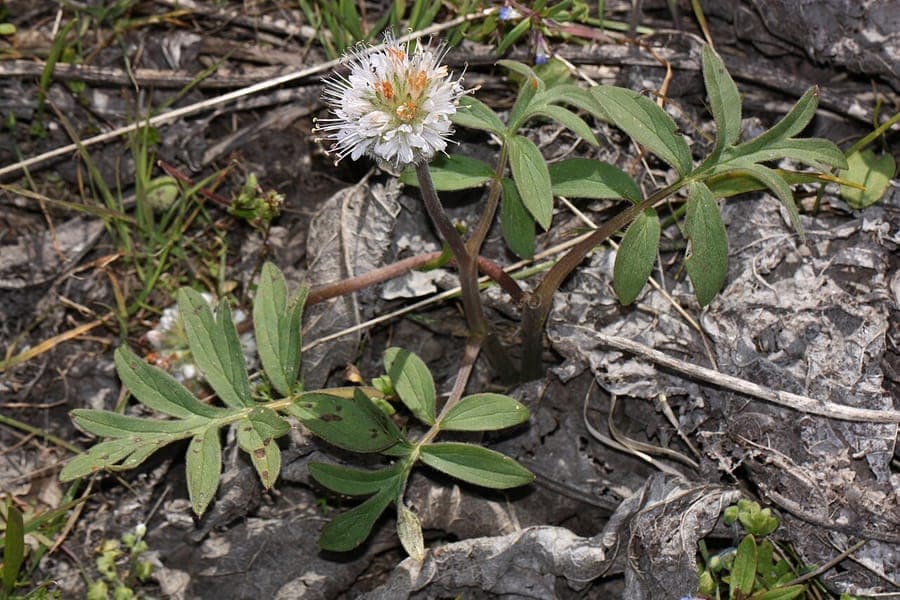
Walter Siegmund (talk) / CC BY-SA 3.0, via Wikimedia Commons
Ballhead waterleaf: complete guide
Hydrophyllum capitatum
Want to see Ballhead waterleaf: complete guide in your garden?
1 minute, no credit card
Overview
Hydrophyllum capitatum, commonly called ballhead waterleaf or woollen-breeches, is a low-growing herbaceous perennial in the Boraginaceae family. Native to the Rocky Mountain regions and Pacific Northwest of North America, it grows wild across Oregon, Washington, Idaho, Montana, Wyoming, Colorado, Utah, and extending north into British Columbia and Alberta. In European gardens it remains a specialist's plant, but its early purple flowers, handsome divided leaves, and tolerance of shade make it well worth seeking out.
The species name 'capitatum' refers to the characteristic ball-shaped flower clusters that appear in spring, often before the leaves have fully expanded. In nature the plant colonises moist, humus-rich soils beneath deciduous trees and along stream banks, growing in the dappled light of forest edges. This habitat tells you a great deal about what the plant needs in a garden setting: moisture, organic matter, and protection from harsh afternoon sun.
Growing to around 20-40 cm in height, Hydrophyllum capitatum spreads steadily by both seed and rhizomes to form attractive colonies under trees and large shrubs. It is an excellent choice for naturalising in a woodland garden or for filling the shaded area beneath a garden hedge. Its value extends beyond the ornamental: the flowers are a rich source of early-season nectar for bumblebees, solitary bees, and other pollinators.
Appearance & bloom cycle
The foliage of Hydrophyllum capitatum is among its most striking features. The leaves are deeply pinnately lobed, with five to nine distinct segments, and bright to yellow-green in colour. In young leaves, pale silvery-green blotches are often visible between the veins, a characteristic shared across the Hydrophyllum genus and the origin of the common name 'waterleaf'. Individual leaves reach 15-25 cm in length and create a lush, bold texture in the shade border.
Flowering begins in April and continues through May and into June. The flowers themselves are small and individually unremarkable, but they are clustered in dense, rounded heads held on stems 15-30 cm tall. The colour ranges from pale lavender to blue-purple, and the long, prominent stamens give each cluster a delicate, pin-cushion appearance. Against the coarse-textured backdrop of the leaves, these airy flower heads create a charming contrast.
After flowering, small round fruits develop containing one to two seeds. In favourable conditions the plant self-seeds modestly, allowing a colony to establish over several years. By midsummer the foliage yellows and the plant retreats underground completely, entering dormancy until the following spring. The planting gap this leaves can be filled with later-emerging perennials or summer bulbs.
Ideal location
Hydrophyllum capitatum thrives in part shade to full shade. In its natural habitat it grows under the canopy of deciduous trees, benefiting from filtered light and protection from direct midday sun. In the garden, plant it beneath light-canopied trees such as birch (Betula), hawthorn (Crataegus), or dogwood (Cornus), or on the north or east side of a building or dense hedge.
Full shade is less ideal than dappled or part shade: two to four hours of direct sunlight per day, combined with bright indirect light throughout the rest of the day, produces the best flowering. In full sun positions the plant dries out rapidly and flower quality declines noticeably. Shelter from cold, desiccating winds is also beneficial, particularly during the early spring growth period.
In the front garden, Hydrophyllum capitatum works well as a ground cover beneath larger ornamental shrubs, or as a filler plant in a mixed shade border. Visit gardenworld.app for personalised planting plans that incorporate shade-loving perennials like this one.
Soil requirements
This plant performs best in moist, humus-rich soil with good drainage. The acceptable pH range is 6.4 to 7.8, meaning the plant tolerates slightly acidic to mildly alkaline conditions. On heavy clay soils, incorporate generous amounts of well-rotted compost and coarse grit to improve structure and prevent waterlogging. On sandy soils, added organic matter is essential for moisture retention.
Apply a mulch layer of 5-8 cm of leaf mould or wood chip around the plants to maintain soil moisture, suppress weeds, and provide a steady supply of nutrients as the mulch breaks down. At planting time, mix well-rotted compost into the top 20 cm of soil. This initial investment in soil preparation pays dividends over the life of the planting.
Avoid sites where water pools in winter. Although the plant needs consistent moisture during its active growing season, prolonged waterlogging during dormancy can rot the rhizomes. A gently sloping site with good infiltration is preferable to a low-lying area with impeded drainage.
Free design
Want to see Ballhead waterleaf: complete guide in your garden? Make a free design now.
Watering
Hydrophyllum capitatum requires consistent moisture, particularly during the flowering period from April through June and during dry summer spells. Water in the morning or evening, allowing leaves to dry before nightfall to reduce the risk of fungal disease.
During the growing and flowering season, water once or twice weekly depending on rainfall and soil type. Drip irrigation is ideal as it delivers water directly to the root zone without wetting the foliage. Check soil moisture regularly by pressing a finger into the soil: at 5 cm depth it should feel lightly moist but never saturated or sodden.
Once the plant enters dormancy in midsummer and the foliage has died back, reduce watering significantly. During winter, natural rainfall and residual soil moisture are sufficient for the dormant rhizomes. In a dry spring, before the new growth emerges, an additional thorough watering can encourage stronger, earlier shoots and better flowering.
Pruning
Hydrophyllum capitatum is a fully herbaceous plant and requires minimal pruning. The foliage dies back completely each autumn, and the dead stems can either be cut back after the first frost or left in place through winter. Leaving the stems provides shelter for overwintering insects and gives a small amount of frost protection to the crown.
In spring, when new shoots begin to emerge, remove any remaining debris from the previous season. This is also the time to thin out the colony if it has spread beyond its intended area: carefully lift and remove excess rhizomes using a hand fork.
Do not remove spent flower heads too hastily: they provide seed for natural spreading and are a food source for small birds. If you wish to limit self-seeding, deadhead as soon as the flowers fade.
Maintenance calendar
January-February: Plant is fully dormant. Check that mulch layer is intact over the crowns.
March: First shoots emerge. Remove previous year's debris. Apply a light top-dressing of well-rotted compost.
April: Growth accelerates, flowering begins. Increase watering if dry. Watch for early-season pollinators visiting the blooms.
May-June: Peak flowering period. Maintain consistent moisture, watering once to twice weekly. Check for leaf spots or signs of excess humidity.
July: Foliage yellows and plant enters dormancy. Reduce watering. Top up mulch layer to 5-8 cm.
August-September: Plant has retreated underground. Mulch layer should be maintained.
October-November: Final die-back. Cut stems if desired. Check mulch before winter frosts.
December: No maintenance required. Plant rests safely underground.
Winter hardiness
Hydrophyllum capitatum is an excellent performer in cold climates, withstanding temperatures down to -20 °C. The plant is rated for USDA hardiness zones 4 to 7, meaning it will overwinter without protection across the Netherlands, Belgium, France, and Germany. The rhizomes in the ground are frost-resistant as long as soil does not freeze deeply and persistently.
In severe winters with little snow cover, a light mulch of leaf mould or chopped bark provides useful insulation for the early buds. In mild coastal regions, no additional winter protection is needed. The plant is reliably perennial and will re-emerge year after year from its established root system.
Companion plants
Hydrophyllum capitatum associates naturally with other shade-loving and woodland-edge perennials. Effective garden combinations include:
- Mertensia virginica (Virginia bluebells): shares a similar ephemeral growth cycle and blooms at the same time; the blue and purple tones complement each other beautifully.
- Dicentra spectabilis (bleeding heart): the feathery foliage of Dicentra provides a strong contrast to the bold leaves of Hydrophyllum, and both go dormant by midsummer.
- Pulmonaria officinalis (lungwort): an evergreen companion that flowers in early spring and fills the gap when Hydrophyllum has not yet emerged.
- Polygonatum multiflorum (Solomon's seal): the arching stems of Solomon's seal create an elegant backdrop for the lower-growing waterleaf.
- Astrantia major (masterwort): blooms slightly later, extending the season of interest after Hydrophyllum has gone dormant.
- Helleborus niger (Christmas rose): an evergreen ground cover that ornaments the site during the winter months when Hydrophyllum is absent.
For a tailored shade border planting plan, visit gardenworld.app where you can explore custom garden designs built around your specific site conditions and plant preferences.
Closing
Hydrophyllum capitatum is an underused gem for shaded gardens. Its early purple flower clusters, bold divided foliage, and generous value for pollinators make it a genuinely rewarding plant for any woodland-style planting or shaded front garden. It asks for little more than moisture, organic-rich soil, and a position out of harsh afternoon sun.
Whether you are creating a naturalistic woodland garden or simply looking for something different to fill the shade beneath a hedge or tree, Hydrophyllum capitatum is well worth growing. Explore more plant ideas and design inspiration at gardenworld.app.
Want to see Ballhead waterleaf: complete guide in your garden? Make a free design now.
Upload a photo, pick a style, and get a photorealistic design with plant list in under a minute.
10,000+ gardens designed already
No credit card required


Similar plants
Western waterleaf: complete guide
Hydrophyllum occidentale
Full growing guide for western waterleaf (Hydrophyllum occidentale): shade tolerance, soil needs, watering, winter hardiness and naturalistic garden use.
Limestone phacelia (Phacelia affinis): complete guide
Phacelia affinis
Full guide to Phacelia affinis, the limestone phacelia: sowing tips, purple-blue bee flowers, drought tolerance and uses in dry or wildlife gardens.
Pyrenean viper's bugloss: complete guide
Echium asperrimum
Echium asperrimum is a striking biennial from the western Mediterranean with rough bristly stems and vivid blue flowers. A magnet for bees and a bold border plant.