
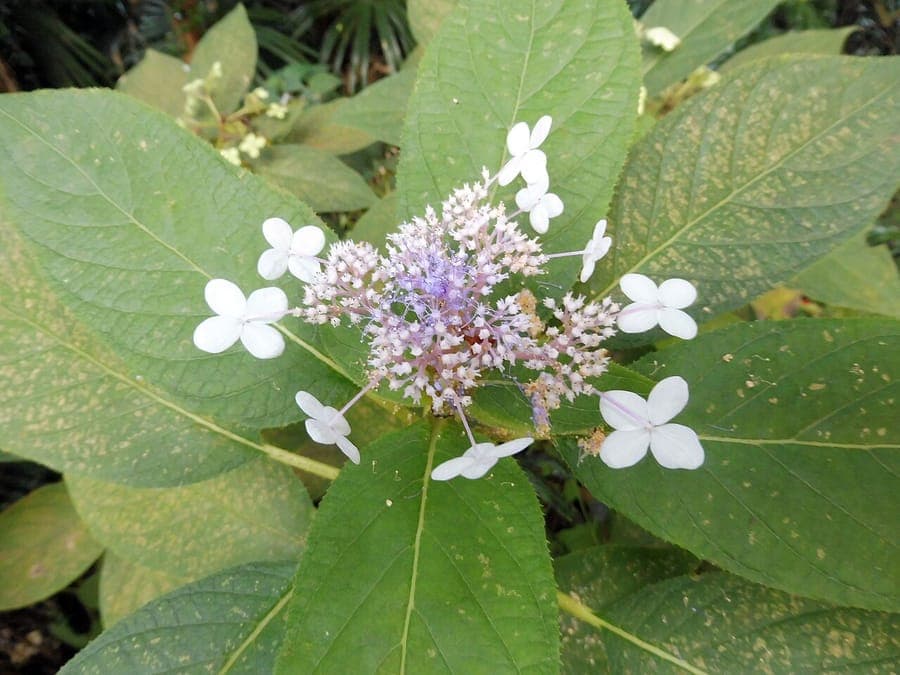
Mason Brock (Masebrock) / Public domain, via Wikimedia Commons
Hydrangea involucrata: complete guide
Hydrangea involucrata
Want to see Hydrangea involucrata: complete guide in your garden?
1 minute, no credit card
Overview
Hydrangea involucrata, better known as Tama-ajisai or Japanese Mountain Hydrangea, is an elegant flowering shrub from the Hydrangeaceae family. This plant is naturally at home in Japan (particularly eastern Honshu and the Nansei islands) and makes a refined addition to semi-shaded gardens in temperate climates.
The plant is actually quite rare in European gardens, which makes it extra attractive for plant collectors and hydrangea enthusiasts. The double flowers and characteristic bracts give it a unique, refined appearance.
Appearance and bloom
Hydrangea involucrata is a graceful flowering shrub that grows about 1.5-2.5 meters tall. The plant has a compact, elegant silhouette with well-branched stems. The leaves are oblong to elliptical, about 8-15 centimeters long, with distinct venation and fine serrated margins.
The truly unique characteristics are the flowers. They appear from July to September in round to undulating flower clusters at the tops of stems. What makes Hydrangea involucrata special is that many of the decorative flowers are actually large, leaf-like bracts (involucra - hence the name!) that are white or light green. These bracts give the plant its characteristic name and add much visual value.
The actual fertile flowers are small, bluish-white to light purple, and appear in the center of the flower clusters. Together with the bracts, this creates a very elegant effect that looks like tiny artificial flowers.
Ideal location
Hydrangea involucrata grows best in partial shade to full shade, with some filtered sunlight. The plant can also grow in full sun but prefers protection from the hottest afternoon sun.
The ideal spot is under deciduous trees where the plant gets morning sun but afternoon shade. This mimics its natural mountain environment.
Ensure the plant is protected from strong winds. In windy gardens, place it against a wall or hedge. Protection from harsh drafts is important.
Soil
Hydrangea involucrata requires moist, well-draining soils with plenty of organic material. The plant grows in nature in mountain forests with deep, humus-rich soil. This is essential; dry soils can cause problems.
Add plenty of compost or leaf mold when planting. The plant feels at home in slightly acidic soils with pH around 5.5-6.5. If your soil is neutral or alkaline, provide extra feeding with acidifying fertilizer or add peat.
Good drainage is important; even the moisture-loving Hydrangea involucrata can't grow in compacted soils. Ensure proper drainage.
Free design
Want to see Hydrangea involucrata: complete guide in your garden? Make a free design now.
Watering
Hydrangea involucrata is a moisture-lover that needs regular water. During the growing period (May-October), water regularly so the soil stays constantly moist. Ensure water drains well.
In very dry periods, daily watering may be needed. The plant doesn't tolerate dry feet. Mulch the area around the plant with 5-10 centimeters of leaf mold; this helps retain moisture.
In winter, water less, but don't let the soil dry out completely. Hydrangea drops its leaves in very cold winters and needs less water when leaf drop occurs.
Pruning
Hydrangea involucrata requires minimal pruning. As a young plant, you can carefully pinch the top to encourage branching, but this isn't always necessary.
Each winter or early spring (February-March), you can remove dead branches. Make sure you don't cut off too many of last season's flower clusters; new flowers form on the tops of young stems.
Carefully remove damaged or diseased leaves. Use sharp, clean tools to prevent infection.
Maintenance calendar
- January-February: Prune dead branches. Reduce water if needed.
- March-April: Growing period starts. Begin regular watering. This is the best planting time.
- May-July: Full growth. Water regularly. Adding mulch helps.
- July-September: Blooming and bract formation. Continuous watering is essential.
- October-November: Growth begins to slow. Reduce watering gradually.
- December: Preparation for winter. Protect against extreme frost.
Winter hardiness
Hydrangea involucrata is moderately winter hardy. The plant can tolerate temperatures down to about -15 to -20 degrees Celsius, but prefers milder winters. In countries with severe winters, provide protection by:
- A thick layer of leaf mold around the base
- Protection from harsh wind
- Consider possible protection in extreme frost
In very cold regions (such as Germany and Belgium), winter protection can be very helpful. The plant may lose its above-ground parts in extreme winters but will usually sprout again from the roots in spring.
Companion plants
Hydrangea involucrata blends nicely with:
- Other shade hydrangeas
- Azaleas and rhododendrons (similar preferences)
- Hostas (for texture contrast)
- Helleborus (Christmas rose)
- Brunnera
- Liriope (for low growth)
Create a shade garden composition with different height variations and bloom seasons.
Closing
Hydrangea involucrata is perfect for plant collectors who want something different from the very common blue and pink hydrangeas. The double flowers and bracts add much refinement.
Although rare in European gardens, the plant grows well in temperate climates with proper care. Start with young plants from Japanese nurseries or plant collectors. Discover more on gardenworld.app.
Want to see Hydrangea involucrata: complete guide in your garden? Make a free design now.
Upload a photo, pick a style, and get a photorealistic design with plant list in under a minute.
No credit card required


Similar plants
Cliff fendlerbush: complete guide
Fendlera rupicola
Everything about Fendlera rupicola, the rare rocky-slope shrub with fragrant white spring flowers that thrives on lean, dry, calcareous soils.
Fivepetal cliffbush: complete guide
Jamesia americana
Everything about Jamesia americana, the fivepetal cliffbush: rocky sites, white blooms, autumn colour, winter hardiness and garden care.
Deutzia parviflora: complete guide
Deutzia parviflora
Discover Deutzia parviflora, an elegant flowering shrub with white blossoms. Growing guide with tips for sunny placement, fertile soil, and regular pruning.