
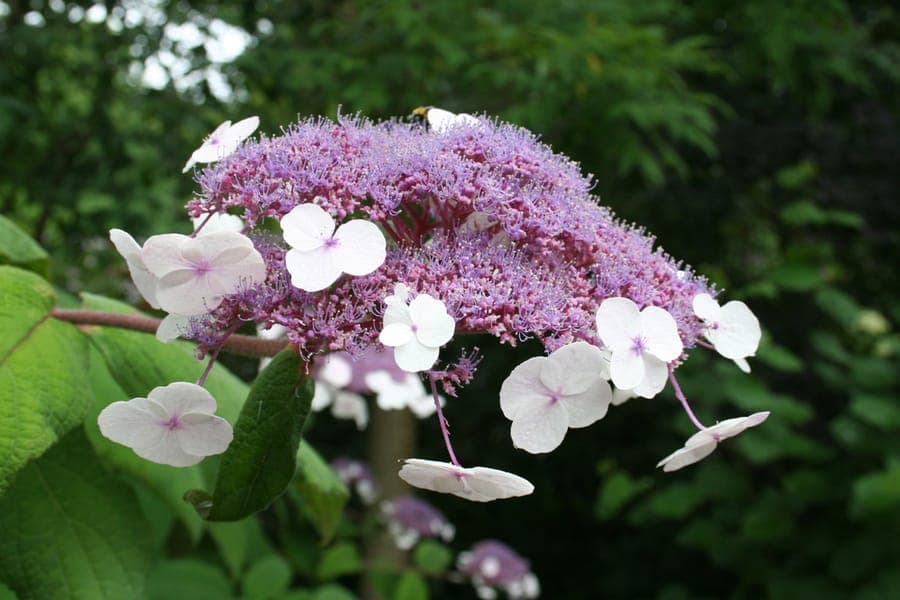
Mutante / CC BY-SA 3.0, via Wikimedia Commons
Rough-leaf hydrangea: complete guide
Hydrangea aspera
Want to see Rough-leaf hydrangea: complete guide in your garden?
1 minute, no credit card
Overview
Rough-leaf hydrangea (Hydrangea aspera) is an elegant shrub native to the Himalayas, China, and Indochina. Famous for its delicate, lacy blue flowers with prominent stamens creating an airy, cloud-like appearance, this species differs from typical hydrangeas in thriving in dappled shade. This is a slower grower reaching 1.5-2 meters eventually, forming a broad, sophisticated shrub that blooms almost continuously from July through September.
For gardeners seeking refined, wispy flowers rather than the showy mophead forms, rough-leaf hydrangea is the premier choice. It brings elegance to shaded gardens where many ornamentals struggle.
Appearance and bloom
The leaves are large (to 20 cm), stiff, and distinctly rough to the touch - hence the common name. They are dark green with prominent venation creating an interesting texture even when not flowering. This textural quality makes the plant visually interesting year-round.
Flowers develop in lacecap corymbs where marginal florets (with 4 sepals) dwarf the tiny central flowers. Color ranges from white to soft blue depending on soil chemistry and variety. Acidic soils produce deeper blue; neutral soils retain white-cream tones. The bloom period extends July through October, making this plant invaluable for extended autumn color.
Ideal location
Rough-leaf hydrangea thrives in dappled shade, receiving 3-4 hours of indirect daily sunlight. In southern regions it tolerates deeper shade. Full sun can cause leaf scorch during hot summers. A west-facing wall location or beneath a light tree canopy is ideal.
Protection from strong winds is desirable - the stiff branches can snap under gusts, especially when laden with flowers. Plant against a wall or among other shrubs for shelter.
Soil
Rough-leaf hydrangea demands humus-rich, well-draining soil with pH 5.5-7. Amend heavily when planting with compost or leafmould (25-30% of soil mix). This shrub dislikes dry feet and thrives in heavier, consistently moist soils better than typical panicle hydrangeas.
Regularly add organic matter during the growing season (mulch May-June with 5 cm compost) to retain moisture and encourage flowering.
Free design
Want to see Rough-leaf hydrangea: complete guide in your garden? Make a free design now.
Watering
Rough-leaf hydrangea is more drought-sensitive than many garden plants. Keep soil consistently moist from May through September without waterlogging. Hot summers may require watering twice weekly.
Newly planted specimens (first year) need weekly deep watering (20 liters). Even established plants benefit from supplemental watering during dry spells. Ensure water drains well - root rot threatens in waterlogged soil.
In regions with heavy rainfall, supplemental watering is less critical.
Pruning
Rough-leaf hydrangea requires minimal pruning. In March, remove dead, damaged, or very old branches (over 3 years) back to healthy buds. This promotes new, floriferous wood.
Be cautious: this hydrangea flowers on terminal buds. Excessive pruning reduces blooming. Wait until after flowering (October-November) for major pruning work.
Tip: Leave faded flowers until March for winter decoration.
Maintenance calendar
March-April: Prune and remove old wood; apply mulch.
May-June: New growth emerges; water regularly.
July-August: Peak flowering; dark green foliage, blue or white flowers.
September-October: Flowering fades; blooms transition to cream-brown.
November-January: Winter rest; faded flowers provide decoration.
February: Prepare for season; check for pests/diseases.
Winter hardiness
Rough-leaf hydrangea is hardy to approximately -15 C (USDA zone 8-9). In harsher climates, protect with 10 cm mulch in November. First-year plants may be more tender - mulch thoroughly.
Mild regions where winter temperatures rarely drop below -10 C are ideal. In colder areas, planting against masonry provides extra protection.
Companion plants
Rough-leaf hydrangea combines beautifully with:
- Lacecap hydrangea (Hydrangea serrata): even finer flowers, white tones
- Rhododendrons: matching soil preferences, purple May flowers
- Astilbe: fine flower plumes, similar shade preferences
- Heuchera: interesting leaf colors in shade, ground-level foliage
This combination creates an elegant, naturalistic structure in semi-shaded spaces.
Closing
Rough-leaf hydrangea is for discerning gardeners who embrace botanical refinement over bombast. It offers months of shade-compatible flowering, interesting texture, and sophisticated beauty. With proper placement and patient watering, this becomes a jewel in any shaded garden.
Available at garden centers as young specimens (60-80 cm) and established shrubs.
Design your shade plantings with gardenworld.app.
Want to see Rough-leaf hydrangea: complete guide in your garden? Make a free design now.
Upload a photo, pick a style, and get a photorealistic design with plant list in under a minute.
No credit card required


Similar plants
Cliff fendlerbush: complete guide
Fendlera rupicola
Everything about Fendlera rupicola, the rare rocky-slope shrub with fragrant white spring flowers that thrives on lean, dry, calcareous soils.
Fivepetal cliffbush: complete guide
Jamesia americana
Everything about Jamesia americana, the fivepetal cliffbush: rocky sites, white blooms, autumn colour, winter hardiness and garden care.
Deutzia parviflora: complete guide
Deutzia parviflora
Discover Deutzia parviflora, an elegant flowering shrub with white blossoms. Growing guide with tips for sunny placement, fertile soil, and regular pruning.