
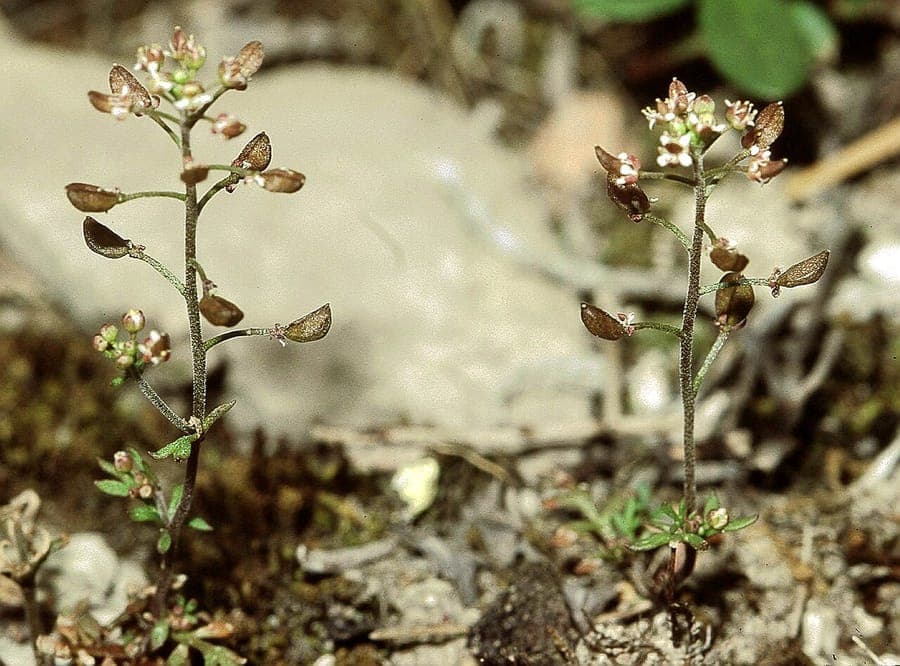
Wikimedia Commons / CC BY-SA 3.0, via Wikimedia Commons
Hutchinsia: complete guide
Hornungia petraea
Want to see Hutchinsia: complete guide in your garden?
1 minute, no credit card
Overview
Hutchinsia petraea, commonly known as Hutchinsia, is a diminutive yet resilient annual in the Brassicaceae family. Don't let its size fool you – this plant brings quiet charm to dry, stony areas where few others thrive. Reaching just 5 to 10 cm in height, it forms a creeping mat of fresh green foliage, later carpeted with delicate white flowers in spring. Native to rocky regions across Southeastern Europe, it's now naturalised in parts of Central and Western Europe, including Belgium and the Baltic states.
While not a common sight in UK or North American gardens, Hutchinsia fits perfectly in naturalistic planting schemes, gravel gardens, or as a filler in dry stone walls. It's ideal for gardeners seeking low-maintenance, drought-tolerant species that don't demand rich soil or constant attention. On gardenworld.app, you can design a garden layout that highlights Hutchinsia's strengths, placing it exactly where it will flourish.
Appearance & bloom cycle
Hutchinsia has small, rounded, light green leaves that grow close to the ground. The stems trail gently outward, with slender flower stalks rising just above the foliage. The flowers are classic crucifers: four white petals in a cross shape, each only 3 to 5 mm wide. Blooming occurs from April through May, depending on local climate and exposure.
In milder regions or with light pruning after bloom, a secondary flush may appear in early autumn. After flowering, the plant produces small silicles – seed pods that split open to scatter seed. This self-seeding habit means Hutchinsia often returns year after year in the same spot, provided conditions are right.
Ideal location
Plant Hutchinsia in full sun to light shade. It performs best with at least 6 hours of direct sunlight daily. Ideal spots include rock crevices, gaps in dry stone walls, gravel paths, or raised beds with minimal competition. It appreciates reflected heat from stone or gravel, which helps dry out the soil quickly.
Avoid damp, shaded corners – these promote fungal issues and weaken the plant. It's a natural fit for Mediterranean-style gardens, alpine beds, or urban courtyards with limited soil depth. Use gardenworld.app to visualise how Hutchinsia can enhance your current garden design with minimal effort.
Soil requirements
Hutchinsia thrives in well-drained, sandy, or gravelly soils. It tolerates poor, low-fertility ground – in fact, overly rich soil can lead to leggy growth and fewer blooms. The ideal pH range is 6.0 to 7.5 (slightly acidic to neutral). Avoid heavy clay or water-retentive substrates.
In containers, use a mix of standard potting soil and coarse sand or perlite (2:1 ratio). Ensure pots have drainage holes. In the ground, amend compacted soil with grit or fine gravel to improve porosity.
Free design
Want to see Hutchinsia: complete guide in your garden? Make a free design now.
Watering
This plant is drought-tolerant and rarely needs supplemental watering. Only irrigate during prolonged dry spells in spring, especially if flowering is underway. Water at the base to avoid wetting foliage, which can encourage mildew. Rainwater is preferable – Hutchinsia can be sensitive to high lime content in tap water.
Potted plants dry out faster, so check weekly. But remember: overwatering is the fastest way to kill it. Once every two to three weeks is usually enough, even in dry summers.
Pruning
No formal pruning is required, but cutting back lightly after flowering encourages tidiness and may promote a second bloom. Trim spent flower stems just above the leaf rosette using clean, sharp scissors. This also helps manage self-seeding if you want to limit spread.
If you'd like the plant to reappear next year, leave a few seed pods intact. Their natural dispersal ensures next season's generation.
Maintenance calendar
- January: Dormant. No action needed.
- February: Clear any lingering debris. Watch for early seedlings.
- March: Loosen soil around emerging plants. Thin if overcrowded.
- April: Blooming begins. Water only if unusually dry.
- May: Peak bloom. Deadhead lightly after flowering.
- June: Seedlings appear. Replant or thin as desired.
- July–September: Dormant period. Minimal care, except in extreme drought.
- October: New seedlings may emerge. Leave in place for next year.
- November–December: No maintenance. Plant survives as seed.
Winter hardiness
As an annual, mature plants die after setting seed. However, Hutchinsia reliably reappears via self-seeding. Seeds overwinter in the soil, germinating when temperatures rise in spring. It's hardy in USDA zones 6 to 9, meaning it survives winter cold in most temperate regions.
In areas with wet, freezing winters, seed germination may be spotty. A thin mulch of dry leaves or straw can help, but remove it early in spring to prevent rot.
Companion plants
Pair Hutchinsia with other low-growing, drought-tolerant species like Thymus serpyllum, Sedum acre, or Aubrieta. It also works well with early spring bulbs such as Chionodoxa or small crocuses. Avoid aggressive spreaders like Cerastium or mint family plants that could smother it.
In rock gardens, plant between limestone or sandstone fragments. The white flowers contrast beautifully with silvery foliage from Stachys or Artemisia. On gardenworld.app, you can explore companion planting combinations that match Hutchinsia's needs.
Closing
Hutchinsia may not grab attention like showy perennials, but it earns its place through resilience and subtle beauty. It asks for little – just sun, sharp drainage, and space to seed. Over time, it becomes a quiet constant in the garden. Find Hutchinsia seeds or young plants at garden centres, especially those specialising in alpine or rock garden species. With a little planning on gardenworld.app, you can create a low-effort, high-character planting scheme where Hutchinsia thrives year after year.
Want to see Hutchinsia: complete guide in your garden? Make a free design now.
Upload a photo, pick a style, and get a photorealistic design with plant list in under a minute.
No credit card required


Similar plants
Brassica cretica: complete guide
Brassica cretica
Brassica cretica, the Cretan cabbage, grows wild on Aegean cliffs. Discover how to grow this drought-tolerant, yellow-flowered Mediterranean perennial.
Corsican cabbage: complete guide
Brassica insularis
Corsican cabbage is a rare Mediterranean rock cabbage with white flowers and blue-green leaves. Location, soil and winter protection.
Prostrate cabbage: complete guide
Brassica procumbens
Prostrate cabbage is a creeping North African cliff plant with yellow flowers. Discover location, soil type and winter protection.