
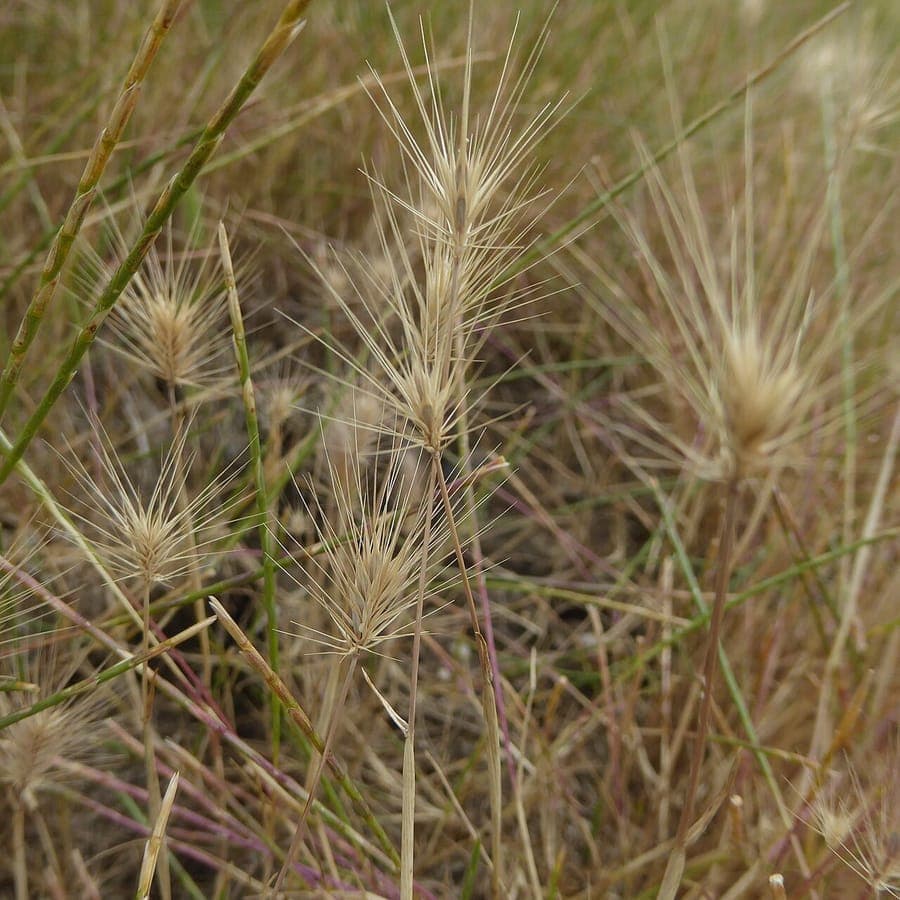
E Wusk / CC BY-SA 4.0, via Wikimedia Commons
Sea barley: complete guide
Hordeum marinum
Want to see Sea barley: complete guide in your garden?
1 minute, no credit card
Overview
Sea barley, scientifically known as Hordeum marinum, is a slender, graceful grass species that thrives naturally on salty coastal edges, dry embankments and sandy patches near the sea. As one of the few grasses that tolerate saline conditions, it's an excellent choice for gardens in coastal areas or spots where winter de-icing salt creates challenges. In the wild, you might spot it on neglected industrial sites or along roadsides where salt is regularly applied in winter.
With its soft grey-green foliage and delicate, upright flower spikes, Sea barley brings subtle elegance to any garden aiming for a natural, windswept look. It forms tight clumps reaching 30 to 50 cm in height and spreads slowly through self-seeding, but never aggressively. On gardenworld.app, you can design a garden layout that perfectly complements Sea barley's low-maintenance nature and airy charm.
Appearance & bloom cycle
Sea barley features fine, strap-like leaves with a silvery-grey sheen, which stand out clearly next to darker green neighbors. The leaves are long and narrow-up to 25 cm long but barely 3 mm wide-growing densely to form full, gently rustling tufts. From late May through June, the plant produces its signature short, bristly spikes that rise just above the foliage.
The flowers are green and develop into upright, slightly spiky seed heads. After blooming, these mature to a warm golden-brown by late summer, adding subtle texture and warmth to the garden from August through September. While the plant has no strong scent, its soft rustle in the breeze makes it ideal for peaceful garden corners. Seeds are dispersed by wind or small animals but usually don't travel far from the parent plant.
Ideal location
Sea barley needs full sun-ideally a 9 out of 10 on the light scale. This means it performs best in open, sunny spots that get sunlight all day, especially south or southwest-facing areas. In shadier conditions, growth becomes leggy, clumps weaken, and flowering reduces significantly.
It's perfect for dry, sandy or gravelly areas-think coastal gardens, gravel beds, dry slopes, or neglected corners where other plants struggle. It also does well near walls or steps where salt runoff occurs. On gardenworld.app, you can simulate how Sea barley would look and behave in your specific garden space before planting.
Soil requirements
The soil must be well-draining. Sea barley thrives in sandy, low-organic soils with a pH between 7.5 and 8.0-making it ideal for chalky or saline ground, common in coastal regions. It's highly sensitive to waterlogged, heavy clay soils, especially in winter. In such conditions, root rot becomes a real threat.
Avoid compost or rich organic fertilizers; this plant is adapted to poor soils and reacts poorly to excess nutrients. If planting in a garden bed, mix in coarse sand or gravel to improve drainage. In containers, a mix of cactus soil and horticultural sand works well.
Free design
Want to see Sea barley: complete guide in your garden? Make a free design now.
Watering
Sea barley is extremely drought-tolerant. Once established, it rarely needs supplemental watering. During the first few months after planting (May to July), water weekly during prolonged dry spells. After that, occasional deep watering is more than sufficient.
Overwatering weakens the plant and promotes rot. In winter, wet feet are deadly. The plant handles summer drought with ease, but winter moisture is its biggest weakness. No irrigation needed during wet seasons.
Pruning
Sea barley requires almost no pruning. After flowering (from August onwards), leave the seed heads standing for winter interest. The plant maintains structure and visual appeal through cold months, with dry foliage and seed spikes catching frost or light snow.
In late winter or early March, cut back old foliage to about 10 cm above ground. This encourages fresh spring growth without damaging the crown. Avoid cutting too low-new growth emerges from the base.
Maintenance calendar
- January: no action needed
- February: begin removing old foliage
- March: cut back to 10 cm; check for weeds
- April: monitor for seedlings; thin if needed
- May: first spikes appear; no fertilizing
- June: full bloom; keep soil dry
- July: water only in extreme drought
- August: leave seed heads; no pruning
- September: observe seed dispersal
- October: let plant rest; no intervention
- November: leave standing for structure
- December: no action
Winter hardiness
Sea barley is hardy in USDA zones 7 to 10 and survives typical UK and northern European winters if drainage is good. In poorly drained soils, winter wetness can kill it. In containers, raise pots on bricks or move to sheltered spots to protect roots from prolonged saturation.
The plant remains semi-evergreen in milder climates, retaining its silvery clumps through winter. This provides valuable texture and form when most other garden plants have died back.
Companion plants
Choose drought-tolerant, sun-loving species with similar soil needs. Good companions include Sedum spectabile, Echinops ritro, Stachys byzantina, and Thymus vulgaris. These create a low-water, low-maintenance planting scheme that thrives in gravel or sandy beds.
Avoid moisture-loving plants like Astilbe or Hosta-they'll either outcompete Sea barley or create overly damp conditions that harm it.
Closing
Sea barley is an underappreciated grass that excels where others fail. It's ideal for coastal gardens, salt-prone areas or low-maintenance designs with a wild, natural aesthetic. With its modest size and minimal feeding needs, it fits seamlessly into modern garden styles focused on simplicity and resilience.
In the UK, Sea barley isn't common in mainstream garden centres, but you may find it at specialist growers or online nurseries. Check occasionally at garden centres with a good grass selection. Use gardenworld.app to visualize how Sea barley can elevate your garden's year-round appeal and structure.
Want to see Sea barley: complete guide in your garden? Make a free design now.
Upload a photo, pick a style, and get a photorealistic design with plant list in under a minute.
No credit card required


Similar plants
Sporobolus pungens: complete guide
Sporobolus pungens
Sporobolus pungens is a stoloniferous Mediterranean coastal grass with outstanding salt and drought tolerance, perfect for seaside and dry gardens.
Mediterranean aegilops: complete guide
Aegilops biuncialis
Everything about Aegilops biuncialis, a Mediterranean annual grass with ornamental spikes and outstanding drought tolerance for dry gardens.
Silver bluestem: complete guide
Bothriochloa saccharoides
Full guide to Bothriochloa saccharoides (silver bluestem): site, soil, watering, winter hardiness, pruning, and garden companions.