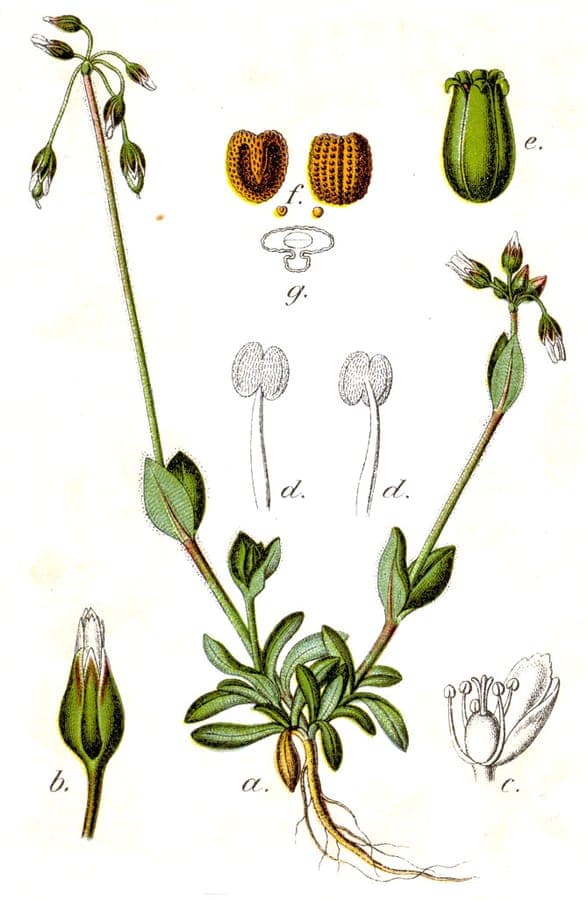
Johann Georg Sturm, Painted by Jacob Sturm; published by Kurt Stüber / Public domain, via Wikimedia Commons
Holosteum umbellatum: complete guide
Holosteum umbellatum
Want to see Holosteum umbellatum: complete guide in your garden?
Full design in HD: €7.99
Look after your Holosteum umbellatum with the GardenWorld app
Identify plants with your camera and get a care calendar with reminders for this plant.


Overview
Jagged chickweed (Holosteum umbellatum), also known as Umbellate chickweed, is a small, elegant wildflower from Europe, North Africa, and Asia. This compact plant grows only 10-30 cm tall and is especially celebrated for its white star-shaped flowers that grow in unique umbrella-shaped (umbella) clusters. It's a very early bloomer (March-April) and perfect for front garden rock gardens on gardenworld.app.
Appearance and Bloom
Holosteum umbellatum is a delicate, low-growing plant with hairy, lance-shaped leaves. The plant forms compact rosettes about 10-30 cm tall. The flowers are small (about 3-5 mm), white with very fine petals, and grow in characteristic umbrella-shaped flower clusters (umbella) with sometimes 6-10 flowers per cluster. The blooming period is very early: March to April, sometimes until May depending on climate. This is one of the earliest blooming wildflowers after winter.
Ideal Location
Jagged chickweed thrives best in sunny to partially shaded locations with well-draining soil. In your front garden rock garden or alpine garden on gardenworld.app, a spot with 4-6 hours of sunlight and well-draining stony soil is ideal. The plant tolerates partial shade but blooms most profusely in full sun.
Soil
This plant prefers well-draining, somewhat poor soil. It works well in stony, sandy soils or coarse gravel. In heavy clay soils, sand and gravel must be added for good drainage. pH can range from slightly acidic to alkaline (pH 6-8). This plant grows well in nutrient-poor soil - excessive feeding can cause excessive vegetative growth at the expense of flowering.
Free preview
Want to see Holosteum umbellatum: complete guide in your garden? Make a free preview of your design.
Watering
Once established, jagged chickweed is very drought-tolerant. Water only during the first growing season. After establishment, no additional water is needed. The plant tolerates dry periods well.
Pruning and Maintenance
After blooming, you can remove wilted flower stems to stay neat. This is a plant that self-seeds, so allowing seed heads to mature ensures self-seeding next spring. Remove dead leaves in autumn.
Maintenance Calendar
- January-February: Signs of growth
- March-May: Blooming period, peak in April
- May-June: Seed formation
- June-August: Seed ripening and drying
- August-January: Dormant period
Winter Hardiness
Holosteum umbellatum is completely hardy to -15°C (USDA zone 5-6). The plant overwinters without problems in Dutch and Belgian front garden rock gardens. Ensure well-draining soil - stagnant moisture is worse than frost danger.
Companion Plants
Pairs well with:
- Draba species: simultaneous blooming
- Pulsatilla: slightly later blooming
- Other alpine wildflowers: Saxifraga species
- Stonecrops: contrasting texture
- Small grasses: structure
Keep distance from moisture-loving species.
Closing Thoughts
Jagged chickweed is an enchanting small jewel for alpine and rock gardens on gardenworld.app. With its elegant umbrella-shaped flower clusters, very early blooming after winter, and minimal care requirements, this is an indispensable plant. Plant this in well-draining stony soil, full to partial sun, and enjoy one of the earliest heralds of spring in your front garden.
Want to furnish your front garden with early-blooming wildflowers? Discover gardenworld.app for more inspiration and personalized garden advice.
Frequently asked questions about Holosteum umbellatum
Is Holosteum umbellatum winter hardy?
Holosteum umbellatum is completely hardy to -15°C (USDA zone 5-6). The plant overwinters without problems in Dutch and Belgian front garden rock gardens.
When and how do you prune Holosteum umbellatum?
After blooming, you can remove wilted flower stems to stay neat. This is a plant that self-seeds, so allowing seed heads to mature ensures self-seeding next spring.
How much water does Holosteum umbellatum need?
Once established, jagged chickweed is very drought-tolerant. Water only during the first growing season.
Where does Holosteum umbellatum grow best?
Jagged chickweed thrives best in sunny to partially shaded locations with well-draining soil. In your front garden rock garden or alpine garden on gardenworld.app, a spot with 4-6 hours of sunlight and well-draining stony soil is ideal.
What soil does Holosteum umbellatum need?
This plant prefers well-draining, somewhat poor soil. It works well in stony, sandy soils or coarse gravel.

See it in your garden
See Holosteum umbellatum in your garden
One photo of your garden and a few questions. You see the result in about a minute.
Try it with a photoIdentify this plant in your own garden. Identify a plant
Similar plants
Dianthus karami: complete guide
Dianthus karami
Dianthus karami is a rare Lebanese mountain pink with fringed pink blooms on limestone cliffs, ideal for rock gardens and troughs.
Sicilian pink: complete guide
Dianthus siculus
Discover Dianthus siculus, an elegant purple bloomer from Sicily. Cultivation, June-September flowering and garden combinations.
Alpine mouse-ear chickweed: complete guide
Cerastium pedunculatum
Full growing guide for Cerastium pedunculatum: ideal location, soil, watering, winter hardiness, and companion plants for rock gardens.
