
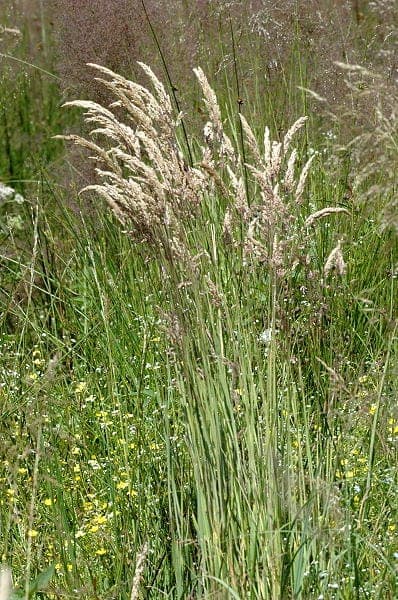
James K. Lindsey / CC BY-SA 3.0, via Wikimedia Commons
German velvet grass: complete guide
Holcus mollis
Want to see German velvet grass: complete guide in your garden?
1 minute, no credit card
Overview
Holcus mollis, commonly known as German velvet grass, is a perennial grass native to much of central and western Europe, including the UK. It thrives in woodland edges, hedgerows, and shaded banks where the soil stays moist but well-drained. This grass spreads slowly by rhizomes, forming soft, dense clumps that make excellent ground cover in naturalistic or wildlife-friendly gardens. While it can be weedy in lawns, it's a valuable species when used intentionally in informal planting schemes.
On gardenworld.app, you can design a garden layout that incorporates German velvet grass in shaded zones, balancing its spread with compatible companions.
Appearance & bloom cycle
German velvet grass grows to a height of 40–70 cm, with a spread of 30–50 cm per clump. The foliage is soft, pale green, and covered in fine, velvety hairs - giving it a distinctive tactile quality. From June through September, airy panicles of white to silvery-white flowers emerge, floating above the foliage like wisps of smoke. The blooms are delicate, not showy, but add texture and movement to the garden, especially in breezy spots.
Growth starts in early May with fresh green shoots. Flowering begins in mid-June and continues into late September. By October, the above-ground parts die back, but the rhizomes remain alive underground, ready to resprout in spring.
Ideal location
This grass prefers partial shade (light level 5/10), making it ideal for dappled light under deciduous trees or along the north side of structures. Full sun is acceptable only if the soil stays consistently moist. In dry, sunny locations, the plant will brown and thin out. Avoid hot, reflective surfaces. A woodland edge, shady border, or wildflower meadow corner are all excellent placements.
German velvet grass pairs especially well with spring ephemerals, as it fills in after they fade.
Soil requirements
It demands acidic to moderately acidic soil, with a pH between 4.5 and 5.0. The ideal substrate is humus-rich loam or sandy clay that retains moisture without becoming waterlogged. Avoid alkaline soils or those amended with lime, as these will stunt growth. If your soil is too neutral, amend with pine compost or leaf mould to lower the pH.
A mulch of leaf litter in autumn improves soil structure and mimics natural woodland conditions.
Free design
Want to see German velvet grass: complete guide in your garden? Make a free design now.
Watering
During the first growing season, water weekly during dry spells, especially from May to July. Once established, Holcus mollis is moderately drought-tolerant but performs best with consistent moisture. In prolonged dry periods, give a deep soak every 10–14 days. Avoid overhead watering if possible - a soaker hose or watering can at the base is better.
No irrigation system is needed; hand-watering suffices.
Pruning
No pruning is required for flowering, but cutting back dead foliage in late winter (February–March) improves appearance and encourages fresh growth. Use secateurs or shears to trim old leaves to about 10 cm above ground. If the clump becomes too large, divide the rhizomes in early spring or autumn. Replant divisions 40–50 cm apart to allow room.
Never compost unwanted rhizome fragments - they can regrow and spread.
Maintenance calendar
- Jan: check for frost heave
- Feb: cut back old growth
- Mar: divide overcrowded clumps
- Apr: monitor for new shoots
- May: apply light organic feed if needed
- Jun: flowering begins, check moisture
- Jul: maintain consistent watering
- Aug: leave seed heads for birds
- Sep: collect seeds or remove to prevent spread
- Oct: apply leaf mulch
- Nov: reduce watering unless dry
- Dec: leave plant intact for winter interest
Winter hardiness
German velvet grass is hardy to USDA zones 6–9 (-20°C to -1°C). The foliage dies back in winter, but the rhizomes survive under a protective mulch. In milder regions, some green leaves may persist. No special winter protection is needed, even in harsh conditions.
In colder zones (6 and 7), a thin layer of leaf mould helps insulate the crown.
Companion plants
This grass combines beautifully with:
- Wood anemone (Anemone nemorosa)
- Bluebell (Hyacinthoides non-scripta)
- Ferns (Dryopteris and Polystichum spp.)
- Foxglove (Digitalis purpurea)
- Wild thyme (Thymus serpyllum)
Avoid aggressive ground covers like ground ivy or mint, which can overwhelm its slow spread.
Using the plant pairing tool on gardenworld.app, you can find species that match Holcus mollis in moisture, light, and soil needs.
Closing
German velvet grass isn't a flashy garden star, but it's a reliable, low-effort performer in shady, moist corners. It adds soft texture, supports biodiversity, and blends naturally into wild-style planting. Don't expect a manicured look - this grass thrives in informality.
You can buy Holcus mollis at garden centres across the UK. Look for potted 9 cm plants at local nurseries or online. Plant in autumn or early spring, space 40 cm apart, and let it settle in with minimal fuss.
Want to see German velvet grass: complete guide in your garden? Make a free design now.
Upload a photo, pick a style, and get a photorealistic design with plant list in under a minute.
No credit card required


Similar plants
Sporobolus pungens: complete guide
Sporobolus pungens
Sporobolus pungens is a stoloniferous Mediterranean coastal grass with outstanding salt and drought tolerance, perfect for seaside and dry gardens.
Mediterranean aegilops: complete guide
Aegilops biuncialis
Everything about Aegilops biuncialis, a Mediterranean annual grass with ornamental spikes and outstanding drought tolerance for dry gardens.
Silver bluestem: complete guide
Bothriochloa saccharoides
Full guide to Bothriochloa saccharoides (silver bluestem): site, soil, watering, winter hardiness, pruning, and garden companions.