
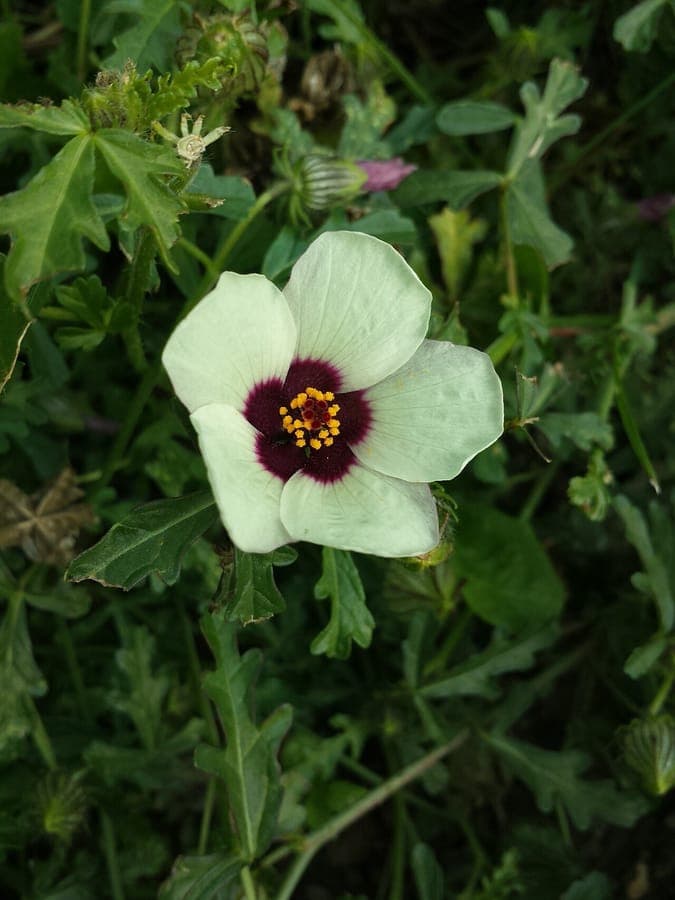
American187 / CC BY-SA 4.0, via Wikimedia Commons
Flower-of-an-hour: complete guide
Hibiscus trionum
Want to see Flower-of-an-hour: complete guide in your garden?
1 minute, no credit card
Overview
Hibiscus trionum, commonly known as Flower-of-an-hour, is a slender annual forb that brings delicate charm to cottage gardens and naturalistic plantings. Native to southern Europe and western Asia, it thrives in temperate climates like those across the UK and northern Europe. Despite its fleeting individual blooms - each lasting just a few hours - the plant produces flowers continuously from early summer to first frost, creating a prolonged display of pale yellow, maroon-centered blossoms.
Reaching heights of 30 to 60 cm, it has an upright, slightly branched habit with triangular, slightly hairy leaves. It's best suited to informal garden styles where self-seeding is welcome. On gardenworld.app, you can design a planting scheme that integrates self-sowing annuals like Flower-of-an-hour into a dynamic, evolving border.
Appearance & bloom cycle
Each flower opens in the morning, typically lasting only 3 to 6 hours - hence the name. But new buds open daily from June through October, ensuring a steady show. The blooms are about 2.5 to 3 cm wide, with five pale yellow petals and a striking dark maroon to purplish central eye that adds contrast. The calyx is ribbed and cup-shaped, turning brown as the flower fades.
After pollination, the plant forms an inflated, lantern-like seed capsule about 1 cm in diameter. When mature, these capsules burst open to scatter small, dark seeds - a natural dispersal method that ensures next year's generation. The foliage is light green, three-lobed, and slightly downy, giving the plant an airy texture.
Ideal location
Flower-of-an-hour prefers a light to semi-shaded spot with a light score of 6 out of 10. That means 4 to 5 hours of indirect sunlight daily - perfect for dappled shade under trees or along the edge of shrub borders. Avoid deep shade, which leads to leggy growth, and full afternoon sun, which can scorch the flowers and dry the soil too quickly.
It adapts well to urban gardens, container edges, or wildflower meadows. On gardenworld.app, use the sun exposure planner to map out daily light patterns in your garden and place this plant where it gets just enough light without stress.
Soil requirements
This hibiscus isn't fussy about soil, as long as it drains well. A sandy or loamy soil with a pH between 6.5 and 7.0 is ideal. Heavy clay soils should be amended with grit or compost to improve drainage. Avoid overly rich soils - excessive nutrients lead to lush foliage at the expense of blooms.
No fertiliser is needed. In fact, Flower-of-an-hour performs better in average to poor soils, mimicking its natural habitat in disturbed ground and field margins.
Free design
Want to see Flower-of-an-hour: complete guide in your garden? Make a free design now.
Watering
Keep the soil evenly moist, especially during dry spells in summer. Water at the base when the top 2 cm of soil feels dry - roughly twice a week in warm weather. Avoid overhead watering to reduce the risk of fungal issues like powdery mildew.
Once established, it has moderate drought tolerance, but prolonged dryness can shorten the blooming period. Rainwater is preferred, as tap water with high lime content may affect long-term soil pH.
Pruning
No formal pruning is required since it's an annual. However, deadheading spent flowers can help maintain a tidy look and prevent unwanted self-seeding in formal beds. If you want a bushier plant, pinch back the tips when the stems reach 20 cm. This encourages lateral branching and a fuller form.
Remove seed capsules before they mature if you're managing spread. Otherwise, leave them for birds or to reseed naturally.
Maintenance calendar
- March–April: Sow seeds directly outdoors when soil reaches 10°C, or start indoors 4–6 weeks before last frost.
- May: Transplant seedlings after risk of frost has passed (typically late May in USDA zones 7–8).
- June–August: Monitor moisture, deadhead if needed, watch for aphids on new growth.
- September–October: Enjoy final blooms. Allow some seed pods to ripen if self-sowing is desired.
- November: Plants die back after frost. Clear debris or leave for winter habitat.
Winter hardiness
Flower-of-an-hour is not winter-hardy. It completes its life cycle in one season and dies with the first hard frost. However, it reliably self-seeds in mild climates. Seeds can remain dormant in the soil over winter and germinate the following spring when temperatures rise.
In colder zones (USDA 5–6), seeds may need protection under leaf litter or mulch to survive. For controlled regrowth, collect and store seeds in a cool, dry place until spring sowing.
Companion plants
Pair with other light-loving annuals and perennials that tolerate partial shade: sweet alyssum, baby's breath, dwarf cosmos, or forget-me-nots. It blends well in cottage-style plantings with foxgloves, campanulas, and yarrow.
Avoid aggressive spreaders like mint or bindweed that can outcompete it. Also steer clear of dense groundcovers that block light and airflow.
Available as seed packets in most garden centres across the UK and Ireland. Look for wildflower mixes that include native-friendly species - often stocked alongside nectar-rich plants for pollinators.
Closing
The Flower-of-an-hour may not last long each day, but its season is long, and its charm undeniable. With minimal care and a natural flair, it brings movement and surprise to the garden. It's a plant for those who appreciate spontaneity - where a few unexpected seedlings aren't a problem, but a delightful bonus. Let it weave through borders, pop up near pathways, or fill gaps in a summer display. With its soft structure and eye-catching blooms, it earns its place in any relaxed, living garden design. Plan its role using gardenworld.app to visualise how self-sowing annuals can evolve over seasons.
Want to see Flower-of-an-hour: complete guide in your garden? Make a free design now.
Upload a photo, pick a style, and get a photorealistic design with plant list in under a minute.
No credit card required


Similar plants
Crimean linden: complete guide
Tilia × euchlora
Crimean linden is an elegant, fast-growing shade tree ideal for large gardens. Discover cultivars, spacing, maintenance tips and winter hardiness.
California flannelbush: complete guide
Fremontodendron californicum
Everything about California flannelbush (Fremontodendron californicum): sunny placement, drainage, pruning and care for this spectacular yellow-flowering shrub.
Hairy rose mallow: complete guide
Hibiscus moscheutos subsp. lasiocarpos
Full growing guide for hairy rose mallow (Hibiscus moscheutos subsp. lasiocarpos): location, soil, watering, winter hardiness and garden design tips.