
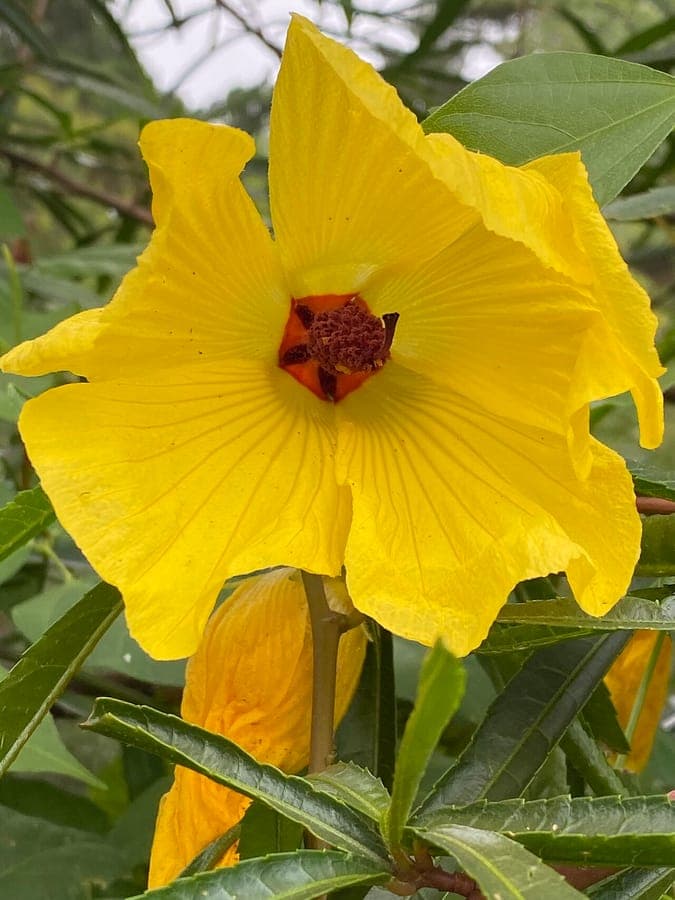
Allthingsnative / CC BY-SA 4.0, via Wikimedia Commons
Queensland-sorrel: complete guide
Hibiscus heterophyllus
Want to see Queensland-sorrel: complete guide in your garden?
1 minute, no credit card
Overview
Queensland-sorrel (Hibiscus heterophyllus) is a robust shrub native to Australia. This hardy species is renowned for its bright yellow flowers and vigorous growth. In its homeland, it grows wild in subtropical forests and bushland, tolerating both drought and occasional waterlogging.
Queensland-sorrel is an ideal choice for gardeners in warm climates seeking a long-flowering, independent shrub. With minimal maintenance and maximum floral reward, it's a smart choice.
Appearance and bloom
Queensland-sorrel grows as a compact to medium-sized shrub, typically 2-4 meters tall and wide. Leaves are variable in shape - hence "heterophyllus" (diverse leaves) - some lance-shaped, others broadly oval. Foliage averages 5-15 cm long, green and smooth.
Flowers are the star: bright golden-yellow, sometimes with a red center, roughly 5-8 cm across. They bloom prolifically from May through October, often longer in warm areas. Flowers attract bees and birds.
Ideal location
Queensland-sorrel loves full sun to part shade. Plant where it receives at least four hours of direct sunlight daily. More sun equals more flowers. In part shade, it grows but flowers less abundantly.
Provide wind protection when young. While the plant tolerates wind, it grows fuller with gentle air movement.
Soil
Queensland-sorrel is not fussy about soil. It grows in virtually all soil types as long as drainage is good. It tolerates sand, clay, and rocky ground. It actually grows just as well in poor soil as in rich soil.
Good drainage is far more important than soil fertility. Avoid pure clay or locations where water pools.
Free design
Want to see Queensland-sorrel: complete guide in your garden? Make a free design now.
Watering
Once established, Queensland-sorrel is very drought-tolerant. Water regularly during initial establishment (first two months) until roots develop fully. Thereafter, minimal watering is necessary - only during extended dry spells.
The plant actually blooms better with some drought stress. Excessive water can cause vegetative growth with fewer flowers.
Pruning
Pruning helps keep the plant full and compact. Cut back after flowering to maintain shape. You can also prune gently in spring. This stimulates branching and more blooms.
Remove dead stems and yellowed foliage. If the plant becomes too large, bold pruning causes no harm - it regrows quickly.
Maintenance calendar
Spring: Plant after frost danger. Water regularly. Begin moderate feeding as growth starts.
Summer: Minimal care. Enjoy the profusion of blooms. Water only in extreme drought.
Autumn: Gradually reduce watering. Feed until September, then cease.
Winter: Virtually no care in warm areas. In cold regions, bring indoors or protect.
Winter hardiness
Queensland-sorrel is hardy to approximately -5 degrees Celsius. In temperate regions, it can overwinter in protected microclimates (against a warm south-facing wall). It may overwinter outdoors in warmer regions.
In colder climates, it's better to overwinter in a warm conservatory or indoors.
Companion plants
Queensland-sorrel pairs beautifully with other Australian or drought-loving plants:
- Banksia for contrasting texture
- Other hibiscus species for bloom contrast
- Leptospermum for fine foliage
- Grevillea for bird-attracting flowers
- Lavender for purple color
Final thoughts
Queensland-sorrel is a perfect plant for gardeners in warmer climates. With its robust nature, drought tolerance, and profusion of blooms, it's a top choice. In warm gardens, containers, and protected locations, it grows into a spectacular flowering specimen. GardenWorld can help you incorporate this Australian gem into your garden.
Want to see Queensland-sorrel: complete guide in your garden? Make a free design now.
Upload a photo, pick a style, and get a photorealistic design with plant list in under a minute.
No credit card required


Similar plants
Crimean linden: complete guide
Tilia × euchlora
Crimean linden is an elegant, fast-growing shade tree ideal for large gardens. Discover cultivars, spacing, maintenance tips and winter hardiness.
California flannelbush: complete guide
Fremontodendron californicum
Everything about California flannelbush (Fremontodendron californicum): sunny placement, drainage, pruning and care for this spectacular yellow-flowering shrub.
Hairy rose mallow: complete guide
Hibiscus moscheutos subsp. lasiocarpos
Full growing guide for hairy rose mallow (Hibiscus moscheutos subsp. lasiocarpos): location, soil, watering, winter hardiness and garden design tips.