
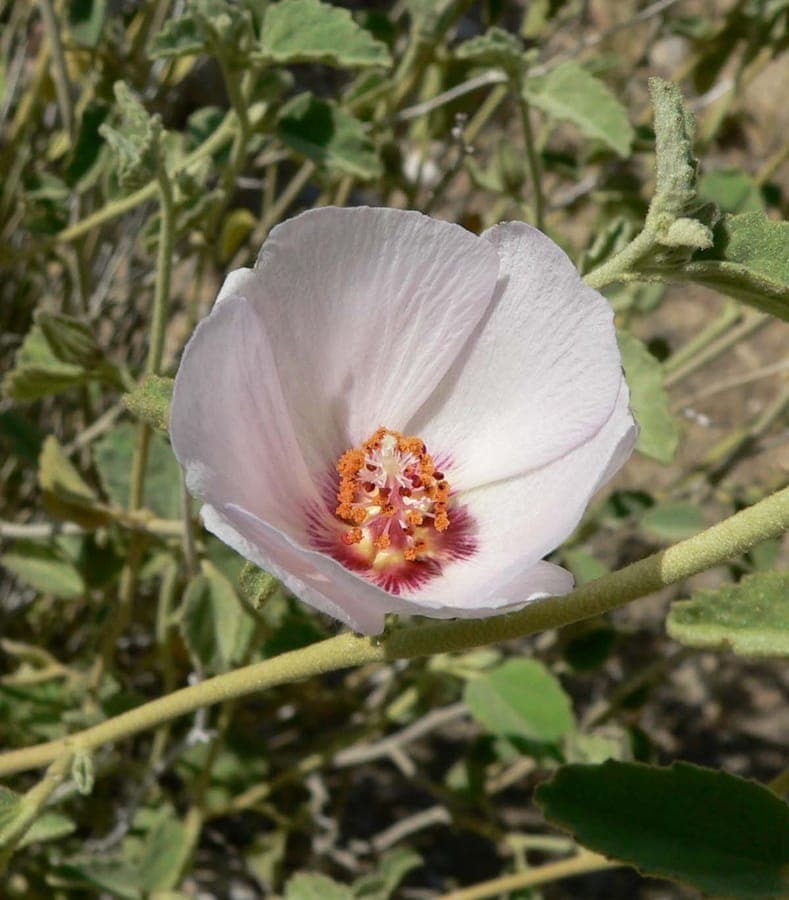
Stan Shebs / CC BY-SA 3.0, via Wikimedia Commons
Hibiscus denudatus: complete guide
Hibiscus denudatus
Want to see Hibiscus denudatus: complete guide in your garden?
1 minute, no credit card
Overview
Hibiscus denudatus, commonly called pale-face hibiscus or rock hibiscus, is a compact shrub belonging to the Malvaceae family. Native to the southwestern United States and northern Mexico, this species thrives in arid mountain regions with minimal water availability. Its delicate pink flowers and fine foliage make it an excellent choice for xeriscaping and water-conscious gardens.
The plant is renowned for exceptional drought tolerance, capable of surviving extended periods without supplemental water. This makes it ideal for homeowners seeking to add color while conserving water. Despite its rugged nature, pale-face hibiscus produces abundant blooms from June through October, providing reliable seasonal interest.
Appearance and Bloom
Hibiscus denudatus forms a small, graceful shrub reaching 24-48 inches (60-120 cm) in height. Its foliage consists of narrow, lance-shaped leaves with a grayish-green tone, imparting a refined, delicate texture. The flowers are the true showstoppers: soft pink to white, roughly 1.2-1.6 inches (3-4 cm) across, featuring a conspicuous dark center.
Each flower opens in the morning and closes by evening, typical of hibiscus species. Throughout the flowering season, successive blooms create continuous color. The plant assumes a natural, graceful form without requiring aggressive pruning or shaping.
Ideal Location
Pale-face hibiscus thrives in full sun. Provide at least six to eight hours of direct sunlight daily. In very hot climates, afternoon shade may be tolerated, but full sun is essential for optimal flowering in moderate zones.
The plant tolerates windy locations well, as wind is a natural part of desert environments. However, place it away from extremely exposed wind tunnels that could stress growth. Coastal plantings work exceptionally well.
Position the plant where you can appreciate its delicate flowers up close. The subtle pink and white palette rewards closer inspection. Placing it against a light background enhances its visual impact.
Soil
Well-draining soil is non-negotiable. Heavy, clay-rich soils lead to root rot. Instead, amend garden soil with sand (30-40%), gravel, or perlite. Optimal pH is neutral to slightly acidic (6.0-7.5).
Drainage is crucial. Ensure water does not pool around roots. In wet climates, plant on raised beds or mounds to improve drainage and soil temperature. Stagnant moisture is this plant's primary enemy.
For container cultivation, use cactus or succulent potting mix, adding extra perlite. This plant prefers lean soil over rich, fertile amendments.
Free design
Want to see Hibiscus denudatus: complete guide in your garden? Make a free design now.
Watering
While drought-tolerant, newly planted specimens benefit from regular watering during establishment. Water deeply once to twice weekly for the first season, allowing roots to develop fully.
Once established (after 6-12 months), the plant can endure extended dry periods. In arid climates, supplemental watering may be unnecessary. For optimal flowering, water only when foliage begins to wilt slightly.
In temperate zones with regular rainfall, supplemental watering may be entirely unnecessary. Monitor soil moisture and reduce watering frequency if conditions remain consistently moist.
Pruning
Minimal pruning is needed. The plant naturally maintains an attractive, compact form. Should you prune:
Conduct light pruning in early spring before growth resumes. Remove dead wood and crossing branches. Thin by 20-30% of annual growth to maintain compactness.
Avoid harsh pruning, which weakens the plant. The natural form is inherently attractive. Deadheading spent flowers may encourage continued blooming in warm climates, though this is secondary.
Maintenance Calendar
Spring (March-May): Prune dead wood, water during establishment, apply balanced fertilizer lightly.
Summer (June-August): Regular watering during heat, monitor for pests.
Fall (September-October): Reduce fertilizing, decrease watering as temperatures drop.
Winter (November-February): Minimal feeding, very limited watering.
Winter Hardiness
Hibiscus denudatus is hardy to approximately 23-14 Fahrenheit (-5 to -10 Celsius). In northern zones, this marginal cold hardiness requires winter protection. Young plants are less frost-tolerant than mature specimens.
In cold climates, grow in containers and relocate indoors during winter, or protect outdoor plants with burlap or straw. Prolonged freezing below 14 Fahrenheit (-10 Celsius) causes dieback.
Companion Plants
Pair with other drought-tolerant species:
- Salvia greggii: Matching water needs, complementary purple or red flowers
- Lavandula species: Classic desert combination, aromatic
- Artemisia species: Fine silvery foliage provides textural contrast
- Echinacea species: Wildflower character, matching drought tolerance
- Ornamental grasses: Texture and movement with minimal water needs
Closing Thoughts
Hibiscus denudatus is invaluable for water-conscious gardeners in dry climates. With excellent drainage, full sun placement, and sparse watering, this hibiscus delivers years of reliable blooms. This elegant shrub truly demonstrates that xeriscape gardens need not sacrifice beauty.
Want to see Hibiscus denudatus: complete guide in your garden? Make a free design now.
Upload a photo, pick a style, and get a photorealistic design with plant list in under a minute.
No credit card required


Similar plants
Crimean linden: complete guide
Tilia × euchlora
Crimean linden is an elegant, fast-growing shade tree ideal for large gardens. Discover cultivars, spacing, maintenance tips and winter hardiness.
California flannelbush: complete guide
Fremontodendron californicum
Everything about California flannelbush (Fremontodendron californicum): sunny placement, drainage, pruning and care for this spectacular yellow-flowering shrub.
Hairy rose mallow: complete guide
Hibiscus moscheutos subsp. lasiocarpos
Full growing guide for hairy rose mallow (Hibiscus moscheutos subsp. lasiocarpos): location, soil, watering, winter hardiness and garden design tips.