
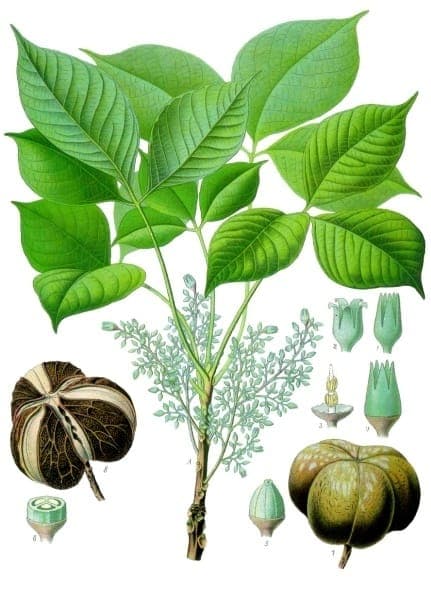
Franz Eugen Köhler, Köhler's Medizinal-Pflanzen / Public domain, via Wikimedia Commons
Hevea brasiliensis: complete guide
Hevea brasiliensis
Want to see Hevea brasiliensis: complete guide in your garden?
1 minute, no credit card
Overview
Hevea brasiliensis, better known as Para rubber tree or Seringa tree, is a fascinating tropical tree from the Euphorbiaceae family. This tree is naturally at home in the Amazon region of Brazil and Peru, where it has been used by indigenous peoples for centuries. In Europe, the tree is less well-known than its historical importance warrants, but for plant collectors and lovers of tropical plants, it is a very interesting addition.
Hevea brasiliensis is actually the source of almost all natural rubber produced in the world. The tree was historically of enormous importance to the world economy, but today in Europe it is primarily interesting as a houseplant or conservatory plant due to its beautiful foliage.
Appearance and bloom
Hevea brasiliensis is a large tree that can reach 40 meters tall in its natural habitat. In containers and households, it remains much smaller, usually 2-3 meters. The tree has a striking silhouette with grey bark and graceful, undulating branches.
The leaves are the most attractive feature. They are purple-stalked (usually three) and reach up to 20 centimeters in length. The leaves are glossy green, oval to elliptical, with fine venation that is very decorative. The leaves may show red or purple tones in new growth, making the plant extra interesting.
The flowers are small and inconspicuous, yellow-white to reddish in color. They appear in clusters and are not particularly pretty. What is interesting about the flowers is that they have a very fragrant aroma.
After flowering, characteristic ball-shaped seeds form in threefold moisture-fruits of approximately 5 centimeters diameter. These fruits are very characteristic of the plant.
Ideal location
Hevea brasiliensis prefers very sunny locations with direct sunlight. The tree grows in nature under equatorial conditions where it has sun almost year-round. In Europe, you should try to provide at least 6-8 hours of sunlight daily.
The tree is very sensitive to drafts and cold winds. A sheltered location without drafts is essential. In cooler climates, you must absolutely keep the plant indoors in containers so it can be protected during winter.
In very warm, southern parts of Europe (southern Portugal, southern Spain, Malaga, southern Italy), the tree could potentially grow outdoors with frost protection.
Soil
Hevea brasiliensis requires rich, well-draining soils. In its natural habitat, it grows on deep tropical rainforest soil with abundant organic material. Use a rich potting soil mix with plenty of compost.
A good mix is approximately 30% potting soil, 20% compost, 20% coarse sand or perlite, 20% leaf mold, and 10% perlite or vermiculite. This ensures good drainage without drying out.
The pH should be slightly acidic (6.0-6.5). Add feeding monthly during the growing period.
Free design
Want to see Hevea brasiliensis: complete guide in your garden? Make a free design now.
Watering
Hevea brasiliensis should be watered regularly and well. The tree originates from tropical rainforests where it rains almost daily. Keep the soil constantly moist but not waterlogged.
During the growing period (May-October), you will probably need to water 2-3 times per week, depending on temperature. In containers, regular watering is essential. Ensure water drains well; stagnation leads to root rot.
In winter (October-April), significantly reduce watering, but don't let the soil dry out completely. Tropical plants can't tolerate dry winter growing seasons well.
Use lukewarm water without chlorine. Rainwater is ideal.
Pruning
Hevea brasiliensis grows fast and can develop long stems. Prune regularly to maintain a compact, tubular silhouette. Pinch the top of young plants to encourage branching.
In containers, you can cut the tree back to desired shape each spring (March-April). Also remove dead or damaged leaves.
The tree produces growth buds very well after pruning. This helps maintain a thick, full plant.
Maintenance calendar
- January-February: Reduce water. Place in brightest possible location. Check for insects.
- March-April: Active growth starts. Prune if needed. Begin regular feeding.
- May-October: Summer time. Water regularly and well. Feed monthly.
- June-September: Peak growing season. Moisture needs are high.
- October-November: Growth begins to slow. Reduce feeding.
- November-December: Preparation for rest period. Reduce watering gradually.
Winter hardiness
Hevea brasiliensis is not winter hardy in any Northern European country. The tree cannot tolerate temperatures below 15 degrees Celsius and will suffer damage if exposed to frost. Even temperatures around 10 degrees Celsius cause growth interruption and leaf drop.
The tree must absolutely stay indoors in containers in all European countries except the warmest coasts. A bright room with a minimum of 18-20 degrees Celsius is ideal. A conservatory or bright office is perfect.
Provide good ventilation; tropical plants easily develop fungal problems in still, humid environments.
Companion plants
Such a large tropical tree doesn't blend well with traditional garden plants. But if you keep it in a conservatory or glasshouse, you can combine it with:
- Other tropical foliage plants
- Passiflora (passion fruits) for contrasting foliage
- Smaller tropical shrubs
- Anthuriums
Ensure all plants share the same preference for warmth, humidity, and brightness.
Closing
Hevea brasiliensis is a fascinating plant for plant collectors who want to grow something special and historical. However, the tree requires considerable care and optimal conditions. This is not a plant for casual gardeners or cold rooms.
The beautiful foliage and historical significance make it very valuable for those attracted to tropical plants. Start small, with young plants in containers, and build from there. Discover more on gardenworld.app for garden design inspiration.
Want to see Hevea brasiliensis: complete guide in your garden? Make a free design now.
Upload a photo, pick a style, and get a photorealistic design with plant list in under a minute.
No credit card required


Similar plants
Woolly mercury: complete guide
Mercurialis tomentosa
All about Mercurialis tomentosa, the woolly mercury from southwestern Europe: site, soil, watering, care and garden design tips.
Shurur: complete guide
Euphorbia fruticosa
Everything about Shurur: cultivation in dry climates, xeriscaping, care and tips for drought-resistant gardens in warm climates
Glary spurge: complete guide
Euphorbia glareosa
Everything about glary spurge: cultivation, maintenance, frost hardiness and use in Mediterranean and mountain-inspired gardens