
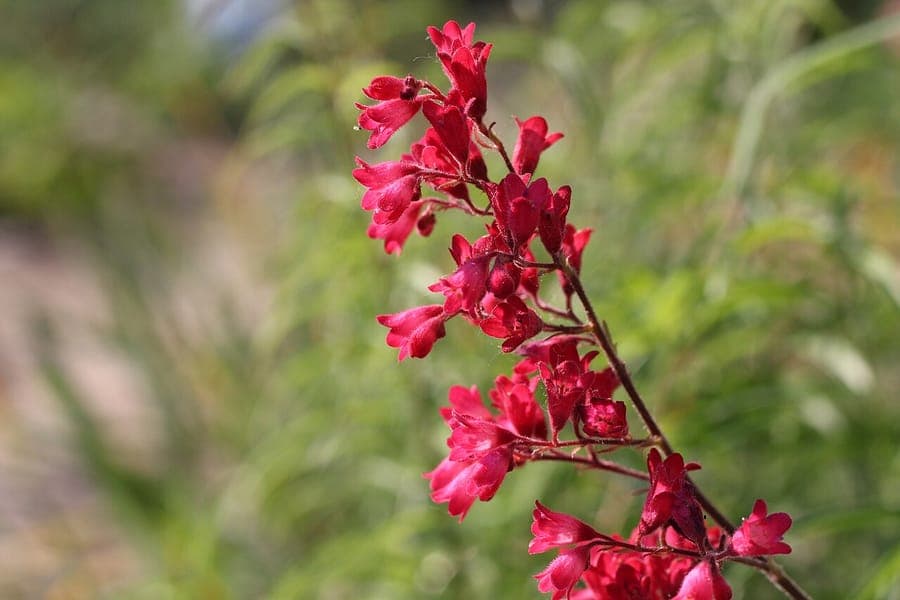
Przemek P / CC BY-SA 3.0, via Wikimedia Commons
Coralbells: complete guide
Heuchera sanguinea
Want to see Coralbells: complete guide in your garden?
1 minute, no credit card
Overview
Heuchera sanguinea, commonly known as Coralbells, is a standout perennial for gardeners who want reliable colour and texture in shady spots. Native to Arizona, northwestern Mexico, and New Mexico, it thrives in USDA hardiness zones 4 to 9, making it perfectly suited to most temperate climates, including the UK and much of the US. In the garden, it forms compact mounds of foliage, reaching 20–30 cm in height, with slender flower spikes rising to 45–60 cm in summer. The plant grows slowly, spreads gently, and won't take over – a real asset in a well-balanced border.
One of the best things about Coralbells is its year-round presence. While it peaks in summer, the foliage often persists through winter, especially in milder regions. The evergreen or semi-evergreen habit means it adds structure when little else is happening. On gardenworld.app, you can design a shade garden layout that highlights Coralbells alongside other foliage stars for maximum visual impact.
Appearance & bloom cycle
The leaves are rounded to heart-shaped, with a slightly crinkled surface and rich green to bronze tones. They emerge fresh in spring and hold their colour well through summer. From June to August, airy coral-pink flowers rise on fine, wiry stems. These aren't showy like peonies, but they have a delicate charm that attracts hoverflies and hummingbirds – a bonus for any wildlife-friendly garden.
After flowering, cut back the spent spikes to the base. This keeps the plant tidy and redirects energy into root development. You won't need to deadhead daily, but a single cleanup session in late summer keeps things looking neat.
Ideal location
Coralbells loves dappled or partial shade. A spot with morning sun and afternoon shade is ideal – it gives enough light for healthy growth without scorching the leaves. In deep shade, the plant survives but stretches and blooms poorly. In full sun, especially in warmer zones, the foliage burns quickly unless the soil stays consistently moist.
Avoid hot, dry, south-facing borders unless you're committed to frequent watering. Woodland edges, north-facing beds, or under light-canopy trees are perfect. If you're planting in containers, place them on an east-facing patio for gentle light. On gardenworld.app, you can simulate light patterns to find the best placement for your Coralbells.
Soil requirements
This plant is adaptable but demands good drainage. It tolerates pH from 5.2 to 8, so both slightly acidic and alkaline soils are fine. What it hates is soggy roots. Heavy clay soils need amending with compost, leaf mould, or grit to improve structure. A humus-rich, well-drained mix is ideal.
When planting, dig a hole twice as wide as the root ball and mix in organic matter. Don't plant too deep – the crown should sit level with the soil surface. Mulch lightly with leaf litter or fine bark to retain moisture and suppress weeds.
Free design
Want to see Coralbells: complete guide in your garden? Make a free design now.
Watering
Water regularly in the first growing season, especially in containers or dry spells. Once established, Coralbells is moderately drought-tolerant but performs best with even moisture. Water at the base to avoid wetting the foliage, which can encourage fungal issues.
In summer, check the soil weekly. If the top 5 cm feels dry, give a thorough soak. Avoid daily light sprinklings – they encourage shallow roots. In winter, reduce watering unless the ground is frozen and dry for weeks.
Pruning
Pruning is minimal. In early spring (March–April), remove any winter-damaged or tatty leaves with clean secateurs. Cut them close to the base to encourage fresh growth. After flowering (late August–September), snip off the old flower stems. That's it – no heavy cutting back needed.
Never prune into old wood; Heuchera regenerates from the crown, so keep that area intact. Use sharp, sterilised tools to prevent disease spread.
Maintenance calendar
- January–February: Monitor for frost damage. Leave alone unless leaves are slimy or black.
- March–April: Clean up old foliage. Add a thin layer of compost around the base.
- May–June: Water if dry. Watch for slugs on new growth.
- July–August: Flowering period. Deadhead spent spikes. Water during dry spells.
- September–October: Reduce watering. Remove final stems. No feeding.
- November–December: Let the plant rest. Protect container plants with hessian or bubble wrap if severe frost is expected.
Winter hardiness
Coralbells is hardy in zones 4–9. In zone 8 and above, it usually overwinters without issue. The key is dry soil in winter – wet, frozen roots are fatal. In colder zones, a light mulch of straw or leaves helps, but don't smother the crown. Container-grown plants are more vulnerable; move them to a sheltered spot or wrap the pots.
Companion plants
Coralbells works well in naturalistic plantings. Pair it with:
- Astilbe – for feathery contrast
- Hosta 'Blue Angel' – for bold leaf texture
- Epimedium – for spring flowers and ground cover
- Ferns like Dryopteris erythrosora – for soft green backdrop
The mix of fine flowers and bold foliage creates layered interest. Avoid aggressive spreaders like mint or bindweed that could overwhelm it.
Closing
Coralbells is a low-maintenance, high-reward perennial that brings elegance to shady areas. With the right spot, decent soil, and minimal care, it'll return year after year. Plant it in spring or early autumn, and you'll see results fast. You'll find healthy stock at garden centres in spring, often potted in 1-litre containers. Whether you're designing a woodland garden or a modern courtyard, Coralbells fits right in – and on gardenworld.app, you can visualise exactly how.
Want to see Coralbells: complete guide in your garden? Make a free design now.
Upload a photo, pick a style, and get a photorealistic design with plant list in under a minute.
No credit card required


Similar plants
Korean astilbe: complete guide
Astilbe grandis
Discover Korean astilbe (Astilbe grandis): a tall shade plant with elegant flower plumes for pond edges and borders.
Heuchera pilosissima: complete guide to seaside alumroot
Heuchera pilosissima
Seaside alumroot (Heuchera pilosissima), an elegant North American dwarf perennial with hairy red-tinged foliage and red flower spikes.
Starry saxifrage: complete guide
Micranthes stellaris
Full guide to Micranthes stellaris, the starry saxifrage: location, soil, blooming and garden use. A tough alpine plant for moist, shady rock faces and pond margins.