
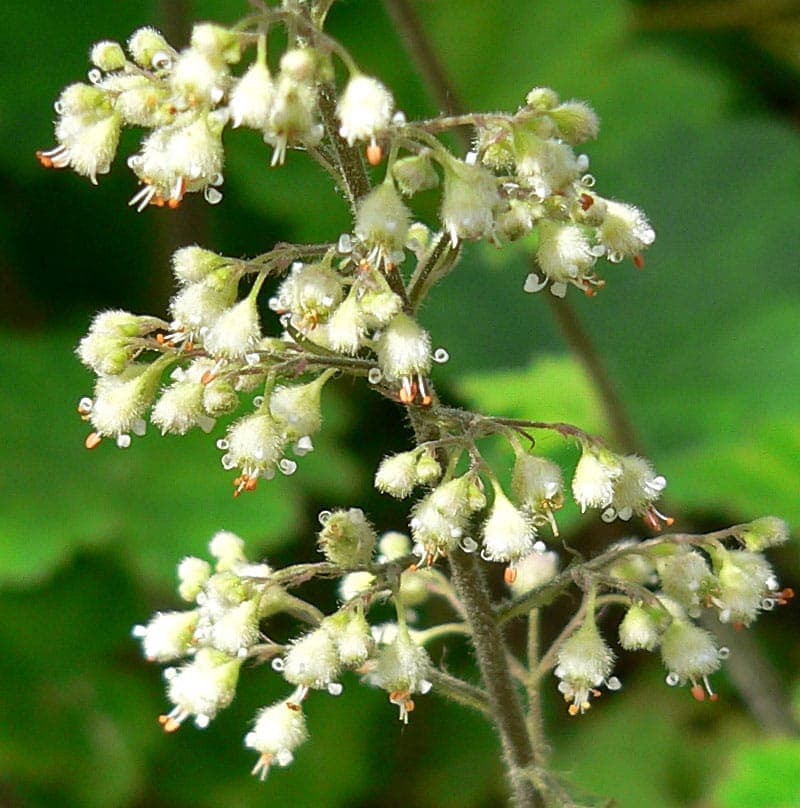
Stan Shebs / CC BY-SA 3.0, via Wikimedia Commons
Heuchera maxima: complete guide
Heuchera maxima
Want to see Heuchera maxima: complete guide in your garden?
1 minute, no credit card
Overview
Heuchera maxima, commonly known as Island Alumroot or Jill of the Rocks, is an impressive foliage plant from California, specifically from islands off the northern California coast. This is an elegant evergreen perennial that, despite its modest flowers, is primarily noted for its spectacular leaves. With its large, glossy blue-green foliage forming an architectural accent in borders and gardens.
This evergreen is particularly valuable for garden designers because it offers year-round interest: beautiful foliage in all seasons, delicate flowers in spring, and a compact, mounded form that fits perfectly into modern gardens.
Appearance and bloom
Heuchera maxima forms a dense rosette of large, heart-shaped leaves that can reach 30 centimetres wide. The leaves are deep green to blue-green, with interesting texture and ruffling. Many cultivars also display beautiful red or purple tints, especially in better light or in winter.
Flowers appear in late spring to early summer (May-June) on thin, upright stems rising above the leaf mass. Flowers are small but very elegant: soft pink to red bells growing in loose spikes. These flowers attract hummingbirds (in America) and are bird food plants.
Following blooming, characteristic seed capsules form. Although many Heucheras are deadheaded, the seed itself can be interesting if you permit self-seeding.
The plant reaches approximately 30-50 centimetres height, with a spread of 40-60 centimetres at maturity.
Ideal location
Heuchera maxima grows best in partial shade to full sun. In warm, dry areas, it prefers shade, especially afternoon shade. In temperate climates, this plant can tolerate full sun, especially if soil moisture is adequate.
Ideal is a location with morning sun and afternoon shade. This promotes the most beautiful foliage colouring without drying the plant.
Gardenworld.app recommends using Heuchera maxima in the front of borders or as edging, where its foliage is well visible. It also works beautifully in containers on terraces.
Soil
Heuchera maxima grows best in well-draining, humus-rich soil. Add plenty of compost or leaf mould when planting. The plant prefers slightly acidic soil, so pH between 5.5 and 6.5 is ideal.
Heavy clay should be improved with sand and organic material. The plant grows reasonably well in poor soil, but blooms better and grows fuller in well-enriched fertile soil.
Drainage is important: prevent waterlogging, especially in winter. In areas with heavy winter rain, provide some elevation or raised beds.
Free design
Want to see Heuchera maxima: complete guide in your garden? Make a free design now.
Watering
Heuchera maxima requires regular watering when growing, especially in its first season after planting. Keep the soil moist, but not soggy.
Once established (after 1-2 years), the plant is reasonably drought-tolerant, especially in temperate climates with regular rainfall. However, supplemental watering may be needed during dry summers.
In winter, when foliage remains green, caution is needed with watering. Too much moisture combined with cold can cause rot. Ensure good drainage.
Prefers consistently moist (not wet) soil during the growing season.
Pruning
Heuchera maxima requires little pruning. The natural rosette form is already attractive and does not need drastic adjustment.
Remove only dead or damaged leaves as soon as noticed. This helps prevent diseases. In autumn, when foliage begins to fade, you can gently remove old, brown leaves.
Many gardeners also choose to remove flower stems after blooming, directing energy to foliage growth. This is optional.
Maintenance calendar
March-April: Check for winter damage. Add a layer of compost as mulch (not touching heart). Begin watering as growth starts.
May-June: Flowering appears. Regular watering. Deadheading flowers is optional.
July-September: Low-maintenance period. Ensure adequate water in dry summers. Monitor for insect pests.
October-November: Add extra mulch before frost arrives. Gradually reduce watering. Old foliage can be partially removed.
December-February: Minimal watering. Plant mostly dormant. Check for disease in moist conditions.
Winter hardiness
Heuchera maxima is well-hardy in temperate European climates. Temperatures to -15 degrees Celsius are no problem. This makes it suitable for almost all parts of the Netherlands, Belgium, and northern France.
In very harsh winters (below -20 degrees), foliage can be damaged, but the plant typically recovers from the heart rosette.
Large leaves can cause problems in wet, frosty winters (leaf rot). Ensure good drainage and avoid placement in waterlogged areas.
Snow cover provides extra protection in severe winters.
Companion plants
Heuchera maxima pairs beautifully with:
- Other Heuchera cultivars: Compatible water needs, different foliage colours
- Low grasses: Hakonechloa, Carex, Festuca for textural contrast
- Other foliage plants: Tiarella, Astilbe, hostas for interesting leaf combinations
- Flowering partners: Helleborus, Brunnera, Pulmonaria
- Small shrubs: Buxus, Sarcococca for structure
Gardenworld.app recommends placing this plant in groups or clusters for maximum effect, rather than solitary plantings.
Closing
Heuchera maxima is a truly distinctive plant for modern garden designs. With its large, glossy foliage, soft flowers, and year-round interest, it offers versatility that is hard to match. This California beauty will give your front garden elegance and structure without much maintenance effort. Whether you create a minimalist design or a bohemian garden, Heuchera maxima will play a beautiful role.
Want to see Heuchera maxima: complete guide in your garden? Make a free design now.
Upload a photo, pick a style, and get a photorealistic design with plant list in under a minute.
No credit card required


Similar plants
Korean astilbe: complete guide
Astilbe grandis
Discover Korean astilbe (Astilbe grandis): a tall shade plant with elegant flower plumes for pond edges and borders.
Heuchera pilosissima: complete guide to seaside alumroot
Heuchera pilosissima
Seaside alumroot (Heuchera pilosissima), an elegant North American dwarf perennial with hairy red-tinged foliage and red flower spikes.
Starry saxifrage: complete guide
Micranthes stellaris
Full guide to Micranthes stellaris, the starry saxifrage: location, soil, blooming and garden use. A tough alpine plant for moist, shady rock faces and pond margins.