
Hans Hillewaert / CC BY-SA 3.0, via Wikimedia Commons
Musk orchid: complete guide
Herminium monorchis
Want to see Musk orchid: complete guide in your garden?
1 minute, no credit card
Overview
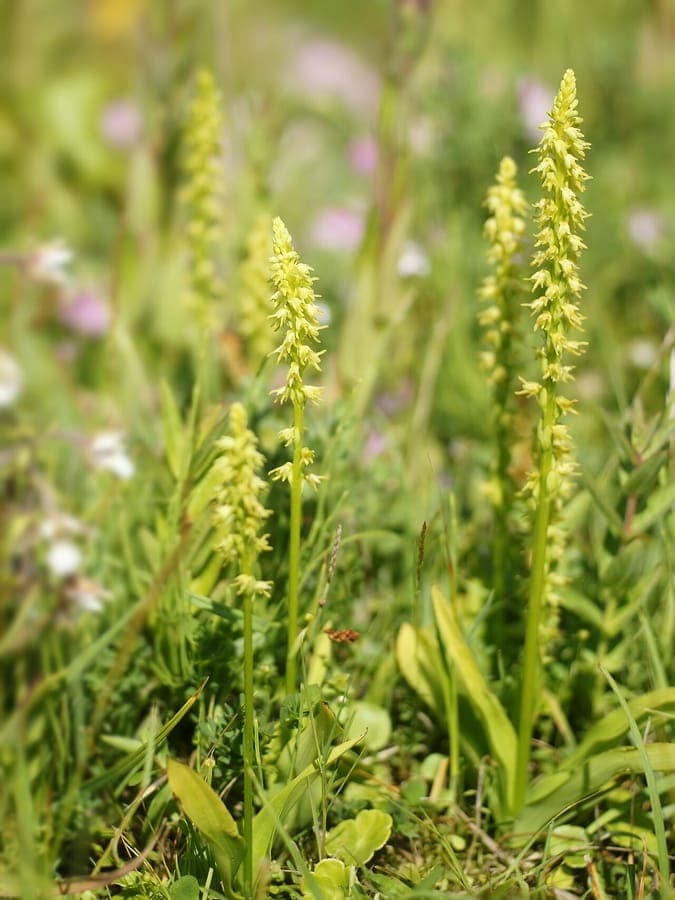
The musk orchid (Herminium monorchis) is a modest yet enchanting member of the Orchidaceae family, native to a wide stretch of Europe and temperate Asia, from Austria to Amur. Unlike flashier orchids, this species thrives in subtle conditions-dappled shade, moist calcareous soil, and quiet corners of woodland gardens. Standing 10–25 cm tall, it blooms from May through August, peaking in June, with a spike of tiny yellow flowers that emit a faint musky scent in the afternoon sun.
For gardeners aiming to create a naturalistic, low-maintenance planting scheme, the musk orchid fits beautifully. It's not a plant for containers or sunny borders, but for those willing to mimic its native habitat, it rewards with quiet elegance.
On gardenworld.app, you can design a planting plan that integrates musk orchids into shaded areas with compatible moisture and soil pH.
Appearance & bloom cycle
The musk orchid produces a slender, upright stem with 10–30 small, pale yellow flowers densely packed in a cylindrical spike. Each flower is only 4–6 mm across, with a distinct three-lobed lip that protrudes forward. The blooms have a faint musky fragrance, especially noticeable in the late afternoon, which attracts small pollinating insects like gnats and flies.
Leaves are narrow, lance-shaped, and appear in opposite pairs along the lower half of the stem. They're a soft green, often with a slightly waxy texture. The plant emerges in early spring, flowers mid-summer, and dies back completely by autumn, retreating into a single oval tuber underground.
This tuber allows the plant to survive dry spells and cold winters, making it surprisingly resilient despite its delicate appearance.
Ideal location
Musk orchids need dappled to partial shade-think open woodland, edges of deciduous forests, or under light-canopy trees like birch, hazel, or alder. Full sun, especially afternoon sun, will scorch the leaves and dry out the soil too quickly. A north- or east-facing slope with morning light is ideal.
Light requirement is around 7 out of 10: they need brightness but not direct exposure. Avoid planting under dense evergreens or in deep shade where little light penetrates. A spot near a pond edge or damp part of the garden with natural leaf litter works well.
On gardenworld.app, use the garden planner to overlay sun patterns and moisture zones to find the perfect microclimate for your musk orchids.
Soil requirements
This orchid demands calcareous, moisture-retentive but well-drained soil. Ideal pH is neutral to slightly alkaline (6.8–7.8). Heavy clay with some organic matter is acceptable if it doesn't waterlog. Sandy soils can work if amended with leafmould and crushed limestone to retain moisture and raise pH.
Never use compost or fertiliser-these plants are adapted to nutrient-poor conditions. Rich soils encourage competing grasses and weeds while stressing the orchid. A light mulch of fallen leaves is beneficial, mimicking natural forest litter.
Free design
Want to see Musk orchid: complete guide in your garden? Make a free design now.
Watering
In the garden, once established, musk orchids rely on natural rainfall and soil moisture. However, during dry springs or early summers (April–July), weekly deep watering with rainwater is recommended. Avoid tap water if it's high in chlorine or lime-rainwater is best.
If growing in pots, use a mix of loam, sand, and leafmould. Keep the mix moist but not soggy. Overwatering in containers is a common cause of tuber rot.
Pruning
No pruning is needed. Let the flower spike die back naturally. Cutting green stems or leaves reduces the plant's ability to photosynthesise and store energy for next year's growth. Only remove completely brown, dead material in late autumn if desired, but leaving it in place provides winter insulation.
Maintenance calendar
- March: Watch for emerging shoots. Protect from slugs.
- April: Water during dry spells. Ensure soil stays cool and moist.
- May – July: Peak bloom. Keep soil evenly moist. No feeding.
- August: Flowers fade. Continue light watering if dry.
- September – October: Plant goes dormant. Leave dead stems.
- November – February: Dormant underground. No care needed.
Winter hardiness
Hardy in USDA zones 5–8. The tuber survives temperatures down to -20°C when protected by leaf litter or soil. In areas with heavy winter rainfall, ensure good drainage to prevent rot. Raised beds or sloped areas help.
Potted plants should be moved to a sheltered spot or wrapped with hessian to avoid freeze-thaw cycles.
Companion plants
Pair musk orchids with other woodland species: wood anemone (Anemone nemorosa), lady's mantle (Alchemilla mollis), wild garlic (Allium ursinum), and sweet woodruff (Galium odoratum). Avoid aggressive groundcovers like ivy or periwinkle.
Plant in groups of 5–10 for a natural effect. Space them 15–20 cm apart among ferns, hostas, or low shrubs.
Closing
The musk orchid isn't flashy, but it brings a sense of wild authenticity to the garden. It's not for those seeking instant impact, but for patient gardeners who appreciate subtle beauty and ecological integrity.
Never collect from the wild-always buy nursery-propagated stock. Look for reputable suppliers at garden centres in the UK or through specialist nurseries. You'll find recommended sources through gardenworld.app's plant database, which links to ethical growers.
With the right conditions-moist, chalky soil, shade, and no competition-this quiet orchid will return year after year, a small but steady presence in your woodland corner.
Want to see Musk orchid: complete guide in your garden? Make a free design now.
Upload a photo, pick a style, and get a photorealistic design with plant list in under a minute.
No credit card required


Similar plants
Ram's-head lady's slipper: complete guide
Cypripedium arietinum
Everything you need to know about growing Cypripedium arietinum, a rare woodland orchid for cool, moist garden settings. Soil, care and planting tips.
Sparrow's-egg lady's slipper: complete guide
Cypripedium passerinum
Everything about growing Cypripedium passerinum, a cold-hardy subarctic orchid suited to cool, moist, shaded garden spots. Soil, care and companion plants.
Algerian Butterfly-orchid: complete guide
Platanthera algeriensis
Everything about Platanthera algeriensis, the rare Mediterranean orchid with greenish flowers native to Algeria, Morocco, Corsica and Spain.