
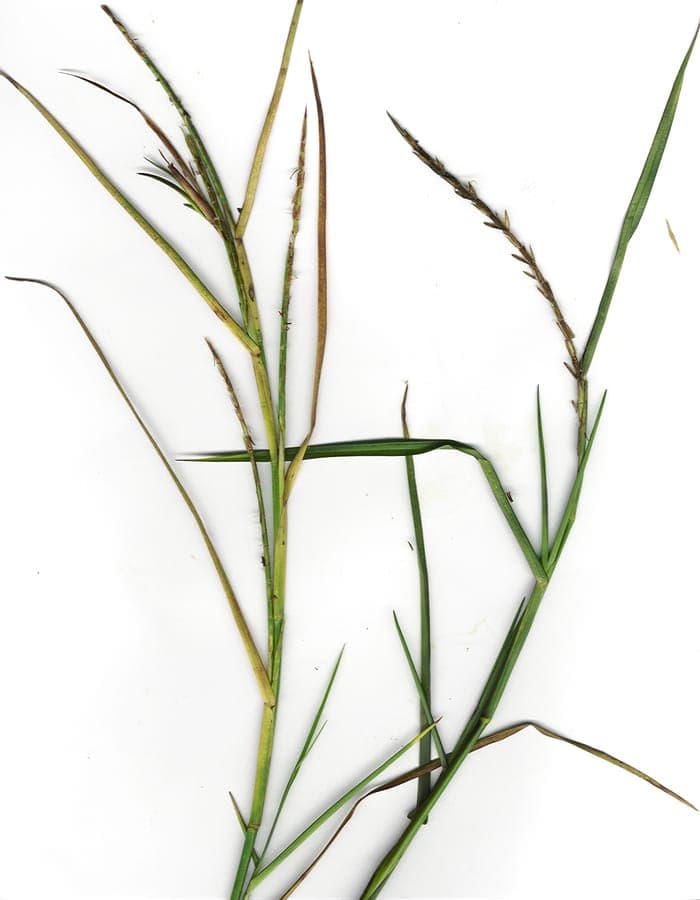
Forest & Kim Starr / CC BY 3.0, via Wikimedia Commons
Hemarthria altissima: complete guide
Hemarthria altissima
Want to see Hemarthria altissima: complete guide in your garden?
1 minute, no credit card
Overview
Hemarthria altissima, also known as African jointgrass, limpograss, or batavian quick grass, is a robust, graminoid plant from the Poaceae family. This plant originates from tropical and subtropical regions of Africa, Asia, and Australia, but is nowadays cultivated in many warmer parts of the world as a forage crop and for ground cover.
This grass is particularly interesting for garden and landscape applications because of its exceptional tolerance for wet soils. Unlike many decorative grasses that demand dry conditions, Hemarthria altissima thrives in moist, even periodically wet soils. The plant forms dense, rhizomatous growth that produces runners, making it excellent for ground cover, erosion control, and natural waterways.
The plant usually reaches a height of 0.5 to 1.5 meters, depending on growing conditions. In very nutrient-rich, wet soils it can grow even higher. The grass produces characteristic, toothed flower spikes that appear compound.
Appearance and Bloom
Hemarthria altissima differs strongly in appearance from many decorative grasses. The leaves are relatively wide for a grass, about 5 to 15 millimeters broad, with a coarse texture and usually dark green color. The leaves have a pronounced midvein that is very clearly visible.
The flower structure is quite unusual for a grass. Instead of typical plume-like panicles, this grass produces compact, two-jointed or three-compound spikelets that grow on a common axis. This structure is called "joint grass" because the spikelets are attached to joint-like points on the axis. The flower color is usually greenish to purplish, not particularly spectacular, but interesting.
Blooming period extends from August through October in temperate climates. In tropical settings, blooming can occur for much longer.
Ideal Location
Hemarthria altissima is unique among decorative grasses because it is moisture-tolerant. This grass grows best in locations that have at least periodically wet soils - such as along ponds, in low-lying meadows, along streams, or other water zones. The plant can also grow in water at depths up to about 30 centimeters.
However, important note: while the plant tolerates wet soils, it also grows well on regularly watered soils that are not continuously water-saturated. The plant tolerates both full sun and light shade, although full sun usually gives the most compact growth and densest stand.
The plant can handle wind well and is suitable for open areas. It can also be used in gardens where other grasses do not thrive due to wet soils.
Soil
Soil requirements of Hemarthria altissima are very tolerant. The plant grows in heavy clay, sand, loamy soils, and even very nutrient-rich, organic-rich soils. The only thing it does not tolerate is permanent flooding under more than about 30 to 60 centimeters of water.
The plant actually grows best in moderately nutrient-rich soils. Very poor soils may need nutrient support, but excessively rich soils can lead to floppy, structurally weak growth. A pH range of 5.5 to 7.5 is ideal.
Root penetration problems can be an issue in very compacted soils. In such cases, adding some sand or organic material helps.
Free design
Want to see Hemarthria altissima: complete guide in your garden? Make a free design now.
Watering
Watering is remarkably simple for Hemarthria altissima because this grass is moisture-tolerant. Once well-established, minimal supplemental watering is needed in moisture-tolerant soils or in regularly watered environments.
In normally watered gardens where it is not continuously wet, water regularly as the grass becomes established (first season), then minimally only during extremely dry periods.
In very dry climates, supplemental watering may be desirable for vigorous growth, but the grass can withstand considerable drought.
In water zones, no supplemental watering is needed - the grass obtains its moisture from the water.
Pruning
Pruning of Hemarthria altissima is primarily an aesthetic preference. The grass can be mowed or cut throughout the season, although preference is usually given to pruning in spring when the plant produces new foliage.
For large-scale applications (such as erosion control), regular mowing can prevent the plant from becoming too coarse and uncontrollable. For decorative applications, you can prune regularly to encourage neater, denser growth.
The plant regrows rapidly after pruning, so no caution is needed.
Maintenance Calendar
Spring (March-May): Begin mowing to control growth. Add moderate feeding in nutrient-poor soils if growth seems slow. Water regularly as temperatures rise.
Summer (June-August): Continue mowing if desired. Water regularly in normal climates. In tropical zones growth can be very vigorous.
Autumn (September-October): Blooming occurs. Minimal care. Water only if very dry.
Winter (November-February): In cold zones the grass may die back or wither. In mild zones it remains growing. No watering needed in wet climates.
Winter Hardiness
Hemarthria altissima is not winter hardy in cold zones. The grass can withstand temperatures to about -5 to -10 degrees Celsius, depending on soil conditions. In Zones 7 and colder, this plant is unlikely to be perennial outdoors.
In Zones 8 to 10, the grass can overwinter if rhizome systems are deep enough. In very warm climates, the grass is evergreen year-round.
In colder regions, Hemarthria altissima can be treated as an annual plant or container plant.
Companion Plants
Hemarthria altissima combines well with other moisture-tolerant plants in wetlands and wet soil scenarios:
- Iris laevigata and other water iris species
- Carex species (sedges)
- Acorus gramineus (Japanese sweet flag)
- Juncus species (rushes)
- Phragmites australis (common reed)
- Typha species (cattails)
- Pontederia cordata
- Thalia dealbata
These combinations form attractive waterside and wet ground plantings.
Closing Remarks
Hemarthria altissima is an exceptionally valuable grass for garden enthusiasts in warm climates with wet soils to tackle. Where other decorative grasses fail, this grass thrives. With its tolerance for waterlogged soils, easy maintenance requirements, and potential for erosion control, it deserves more attention in garden design. For plant material, consult specialized nurseries or check Gardenworld.app for help designing a waterside or wetland planting scheme centered on this grass. In warm zones where water features are part of your garden, this grass would certainly be worthy of trying.
Want to see Hemarthria altissima: complete guide in your garden? Make a free design now.
Upload a photo, pick a style, and get a photorealistic design with plant list in under a minute.
No credit card required


Similar plants
Sporobolus pungens: complete guide
Sporobolus pungens
Sporobolus pungens is a stoloniferous Mediterranean coastal grass with outstanding salt and drought tolerance, perfect for seaside and dry gardens.
Mediterranean aegilops: complete guide
Aegilops biuncialis
Everything about Aegilops biuncialis, a Mediterranean annual grass with ornamental spikes and outstanding drought tolerance for dry gardens.
Silver bluestem: complete guide
Bothriochloa saccharoides
Full guide to Bothriochloa saccharoides (silver bluestem): site, soil, watering, winter hardiness, pruning, and garden companions.