
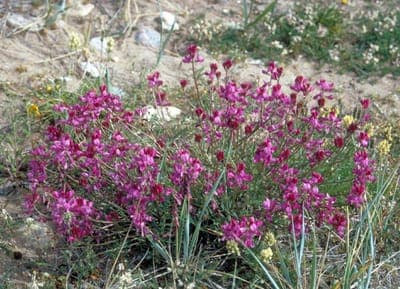
Corey L. Gucker / Public domain, via Wikimedia Commons
Alpine sweetvetch: complete guide
Hedysarum alpinum
Want to see Alpine sweetvetch: complete guide in your garden?
1 minute, no credit card
Overview
Alpine sweetvetch (Hedysarum alpinum) is a vigorous, rhizomatous perennial from the pea family Fabaceae, with one of the broadest natural distributions of any garden-worthy plant: it ranges from eastern Europe across Siberia to Korea and Japan, south to the Himalayas and Pakistan, and crosses into North America in Alberta, British Columbia, Montana, Wyoming, and the prairie states. This immense geographical spread is the best evidence of its adaptability. In gardens it remains largely overlooked, though naturalistically minded gardeners who grow it quickly become advocates. At gardenworld.app it is recommended for wildlife-friendly and naturalistic plantings where resilience and ecological value take priority. The genus Hedysarum is distinguished by its characteristic loment-type seed pods, which break apart at maturity into individual one-seeded segments, a neat mechanism for local seed dispersal. Alpine sweetvetch is the most widely distributed member of the genus and the one best suited to temperate European conditions.
Appearance and bloom cycle
The plant forms upright to slightly arching stems 30 to 60 cm tall, clothed in pinnate leaves composed of nine to seventeen elliptic leaflets of fine texture and soft, light green colour. The overall appearance is feathery and delicate, making a pleasing contrast with coarser-leaved border companions. The flowers appear in June and July in long, dense, one-sided racemes held above the foliage. They are a deep rose-purple to pink-violet, butterfly-shaped in the classic pea-flower style, and produced in generous numbers. The flowering period lasts four to six weeks under good conditions. After blooming, the diagnostic loment pods develop - segmented pods that dry to a pale straw colour and break apart in autumn, dispersing seeds locally. The plant has a rapid growth rate: young specimens sown in spring can reach flowering size within a single season.
Ideal location
Alpine sweetvetch is accommodating with regard to light, growing well in full sun through to light partial shade. In the wild it occupies a wide range of open habitats - riverside meadows, steppe, taiga clearings, alpine slopes, and forest margins - always in positions with good air circulation and no prolonged waterlogging. For garden use, a sunny to lightly shaded position suits it well. It is at home in a naturalistic or prairie-style border, on a dry bank, along a path edge, or in an open rock garden. It works equally well as part of a meadow planting or as a standalone specimen where its flower spikes can be appreciated close up. Avoid heavily shaded positions and any site where water drains slowly or pools after rain.
Soil
As a legume, alpine sweetvetch forms a symbiotic relationship with nitrogen-fixing bacteria (Rhizobium) in root nodules, allowing it to thrive in relatively poor soils without heavy feeding. It prefers moderately fertile, well-draining soil with a pH of 6 to 8. Sandy, loamy, or light clay soils are all suitable provided drainage is adequate. Rich, heavily manured soils tend to promote lush leafy growth at the expense of flowering. When planting into heavier ground, incorporate coarse horticultural grit or sharp sand to improve drainage. A surface mulch of composted bark or leaf mould helps moderate soil moisture without encouraging waterlogging. Routine fertilising is generally unnecessary; if soil is very poor, a single spring application of a balanced low-nitrogen fertiliser is adequate.
Watering
Once established, alpine sweetvetch is notably drought tolerant, an attribute that makes it valuable in the context of climate-resilient gardening. Its deep, spreading rhizomatous root system allows it to access soil moisture at depth even during dry spells. In the first growing season after planting, moderate but regular watering helps the root system establish. After that, established plants manage well on natural rainfall in most temperate climates. During prolonged summer drought, occasional deep watering at the base of the plant maintains good growth. Overwatering or poor drainage, particularly in winter, is more damaging than drought. The combination of drought tolerance and extreme cold hardiness makes this species an excellent choice for the low-input garden, as highlighted in the plant profiles at gardenworld.app.
Free design
Want to see Alpine sweetvetch: complete guide in your garden? Make a free design now.
Pruning
Very little active pruning is required. After flowering finishes in July or August, the spent flower stems can be cut back to keep the planting tidy and to prevent self-seeding if that is desired. If you want the plants to spread naturally or wish to collect seed, simply leave the pods to ripen on the plant. In autumn or early spring, the dead above-ground growth can be cut back to ground level; the rhizome overwinters reliably and pushes up fresh shoots in spring. After several years in the ground, well-established clumps can be divided in early spring by lifting the outer portions of the clump and replanting them elsewhere. Division is the most reliable method of vegetative propagation for this species.
Maintenance calendar
January - February: plant dormant underground; no action required. March: first shoots emerge from the rhizome; top up mulch if thin. April - May: active leafy growth; weed around the plant as needed. June: flowering begins; no intervention needed. July: peak flowering, rose-purple spikes at their best; watch for bumblebees visiting. August: blooming ends; cut back flower stems if a tidy appearance is preferred. September: seed dispersal if pods retained; rhizome recovery phase. October: above-ground growth beginning to die back naturally. November: cut back dead stems if desired; apply mulch if an exceptionally cold winter is predicted. December: plant fully dormant; no action required.
Winter hardiness
Alpine sweetvetch is exceptionally cold-hardy, surviving temperatures as low as -30 degrees Celsius or below - placing it in USDA zones 3 to 7. It grows wild in Siberia, Alaska, and the Canadian boreal zone, regions where temperatures of -40 degrees Celsius occur regularly in winter. For gardeners in north-west Europe, including the Netherlands, Belgium, Germany, and the United Kingdom, this plant needs no winter protection whatsoever. Even the most severe recent winters in those regions fall well within its tolerance range. The only genuine winter threat is prolonged waterlogging combined with frost, which can damage the roots. Excellent drainage eliminates this risk entirely. This makes it one of the most reliably hardy perennials available to European gardeners.
Companion plants
Alpine sweetvetch associates naturally with other steppe, meadow, and prairie species that share its preference for open, well-drained, moderately dry conditions. Salvia nemorosa and other ornamental sages offer a complementary blue-violet flower colour and identical cultural requirements. Hardy cranesbills (Geranium) work well alongside it in early summer, filling gaps in the border with their own attractive flowers. Achillea millefolium adds flat-topped white or yellow flower heads that contrast well with the upright Hedysarum spikes. Echinops (globe thistle) provides strong structural contrast with its metallic-blue spherical heads in mid-summer. Ornamental grasses such as Stipa or Festuca woven through a naturalistic planting tie the composition together. In a rock garden, small Sedum species and Dianthus cultivars make effective low companions.
Closing
Alpine sweetvetch is an underrated perennial that delivers outstanding value for minimal effort. Its rose-purple flower spikes in June and July are magnets for bumblebees and other long-tongued pollinators, its extreme cold-hardiness means zero winter worry, and its drought tolerance suits it well to the drier summers that are becoming more common in north-west Europe. Look for it at specialist perennial nurseries; it may not be found at every mass-market retailer, but online specialist suppliers list it regularly. Give it a well-drained, moderately lean soil in a sunny or lightly shaded spot, and it will reward you season after season with a generous, wildlife-rich floral display that requires almost no maintenance. Visit gardenworld.app for garden design inspiration that features resilient perennials like this one.
Want to see Alpine sweetvetch: complete guide in your garden? Make a free design now.
Upload a photo, pick a style, and get a photorealistic design with plant list in under a minute.
10,000+ gardens designed already
No credit card required


Similar plants
Northern sweet-vetch: complete guide
Hedysarum boreale
Complete guide to growing Hedysarum boreale: soil, location, watering, pruning, and companion planting for this tough prairie perennial.
White sweetvetch: complete guide
Hedysarum sulphurescens
Full growing guide for Hedysarum sulphurescens: site, soil, watering, pruning, and companion plants for this elegant cream-flowered prairie perennial.
Sainfoin: complete guide
Onobrychis viciifolia
Discover sainfoin (Onobrychis viciifolia), a nutrient-rich fodder crop and stunning bloomer from Central and Southeast Europe. Ideal for meadows and natural gardens.