
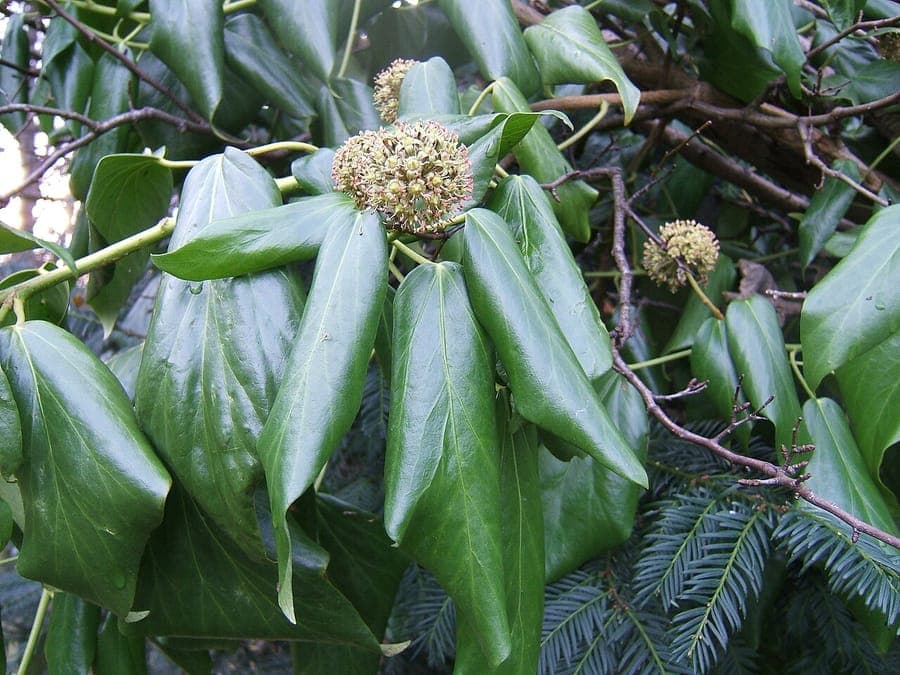
No machine-readable author provided. MPF assumed (based on copyright claims). / CC BY 2.5, via Wikimedia Commons
Colchis ivy: complete guide
Hedera colchica
Want to see Colchis ivy: complete guide in your garden?
1 minute, no credit card
Overview
Hedera colchica, commonly known as Colchis ivy, is a bold and vigorous evergreen climber that brings structure and year-round interest to gardens across the UK and Europe. Native to the forests and rocky slopes of the Caucasus, Turkey, and Transcaucasia, this ivy thrives in cool, shaded environments but adapts well to urban conditions. Unlike the more common Hedera helix, Colchica boasts larger, more robust foliage and a faster growth rate, making it ideal for covering large surfaces quickly.
Hardy to USDA zone 7 (-15°C), it's suitable for most temperate gardens. While it can climb up to 15 meters with support, it also works well as a spreading ground cover under trees or on banks. Its low-maintenance nature appeals to gardeners seeking reliable greenery without constant upkeep. On gardenworld.app, you can create a garden layout that integrates Colchis ivy seamlessly into shaded corners or vertical spaces.
Appearance & bloom cycle
The standout feature of Hedera colchica is its foliage: leaves are typically 10–20 cm wide, deeply five-lobed, and rich dark green with a glossy finish. Young shoots may appear slightly greyish or silver, adding subtle texture. In mature, flowering specimens (usually after 5–10 years), small yellow-green flowers appear in umbel-like clusters from October to November. These are highly attractive to late-season pollinators, including honeybees and hoverflies.
Following flowering, blackish berries develop and persist through winter, providing food for birds. However, these berries are toxic to humans and pets, so caution is advised in homes with children or curious animals. The plant climbs using aerial rootlets that adhere to walls, tree trunks, and stone without causing structural damage if managed properly.
Ideal location
Colchis ivy prefers partial to full shade, especially under tree canopies or on north-facing walls. It can tolerate some morning sun if soil moisture is consistent. Avoid hot, dry south-facing exposures unless irrigation is reliable. Use it to soften harsh architectural lines, cover unsightly fences, or stabilise steep, shaded banks.
It's excellent for woodland gardens or urban courtyards where little else thrives. Potted specimens do well on shaded patios, provided the container is large enough (minimum 40 cm diameter) to prevent drying out. Check gardenworld.app for design ideas showing how gardeners have used this ivy in small-space and vertical planting schemes.
Free design
Want to see Colchis ivy: complete guide in your garden? Make a free design now.
Soil requirements
Hedera colchica is adaptable to most soil types but performs best in moist, well-drained, humus-rich soils. It tolerates clay, loam, and even sandy soils if organic matter is incorporated at planting. Ideal pH ranges from slightly acidic to neutral (5.5–7.0). Avoid waterlogged soils or extremely dry, compacted patches. Adding leaf mould or compost at planting improves root establishment and long-term health.
Watering
During the first growing season, water weekly to help roots establish. Once settled, the plant is moderately drought-tolerant but thrives with consistent moisture. In prolonged dry spells, especially in summer, deep watering every 7–10 days is beneficial. Container-grown plants need more frequent watering-check soil moisture every few days during warm months.
Pruning
Annual pruning keeps growth in check and prevents ivy from invading roofs, gutters, or tree canopies. The best time is late winter or early spring (February–March), before new growth begins. Use sharp shears or a hedge trimmer for larger areas. Light trimming in August can tidy up straggly stems, but avoid heavy cuts during flowering or fruiting.
Maintenance calendar
- Jan: Inspect for frost damage, remove broken stems
- Feb: Prepare for pruning, clean tools
- Mar: Prune heavily if needed, apply slow-release organic fertiliser
- Apr: Monitor for new growth, water if dry
- May: Check for pests like spider mites or scale insects
- Jun: Water during dry periods, especially in containers
- Jul: Inspect for mildew or leaf spot in humid weather
- Aug: Light trim if desired
- Sep: Leave plant undisturbed to set flower buds
- Oct: Flowers appear, beneficial for pollinators
- Nov: Berries form, leave for birds
- Dec: Final check, ensure container plants are protected from hard frost
Winter hardiness
This ivy is fully hardy in USDA zones 7–10. Foliage remains evergreen, though young plants may show minor scorch in severe winters. Mature specimens rarely suffer damage. Container plants are more vulnerable; move to sheltered spots or wrap pots with hessian in cold regions.
Companion plants
Pair Colchis ivy with shade-loving perennials like Helleborus, Hosta, or Ferns. Under trees, it works well with Anemone nemorosa, Epimedium, or Lamium. Avoid invasive ground covers like ground elder. Combine with textured bark, mossy logs, or stone features for a naturalistic woodland feel.
Closing
Hedera colchica is a resilient, attractive climber that adds depth and coverage to challenging spots. With minimal care, it delivers lasting green structure and ecological benefits. Buy from reputable garden centres across the UK, and explore planting layouts on gardenworld.app to see how this ivy enhances both modern and traditional garden designs.
Want to see Colchis ivy: complete guide in your garden? Make a free design now.
Upload a photo, pick a style, and get a photorealistic design with plant list in under a minute.
No credit card required


Similar plants
American marsh pennywort: complete guide
Hydrocotyle americana
Everything about Hydrocotyle americana: location, soil, moisture and winter care. A delicate groundcover for shaded pond edges and boggy garden borders.
Devil's club: complete guide
Oplopanax horridus
Full guide to growing Oplopanax horridus: ideal site, soil, watering, and care for this dramatic spiny woodland shrub.
Water pennywort: complete guide
Hydrocotyle umbellata
Everything about Hydrocotyle umbellata: ideal location, soil, watering, winter care and pond planting. A versatile aquatic plant for garden ponds and boggy spots.