
João Medeiros / CC BY 2.0, via Wikimedia Commons
Hancornia speciosa: complete guide
Hancornia speciosa
Want to see Hancornia speciosa: complete guide in your garden?
1 minute, no credit card
Overview
Hancornia speciosa, better known as Mangabeira or Souari, is a fascinating tropical tree from the Apocynaceae family. This tree is naturally at home in the green rainforests of Brazil, Peru, and Paraguay, where it is known as Mangaba. In Europe, the tree is becoming increasingly popular for those living in warmer regions and seeking an exotic yet low-maintenance ornamental fruit tree.
Hancornia speciosa is especially interesting for gardeners in Mediterranean regions and southern parts of Europe. The tree also grows well in containers, making it practical for colder climates where it can be protected during winter.
Appearance and bloom
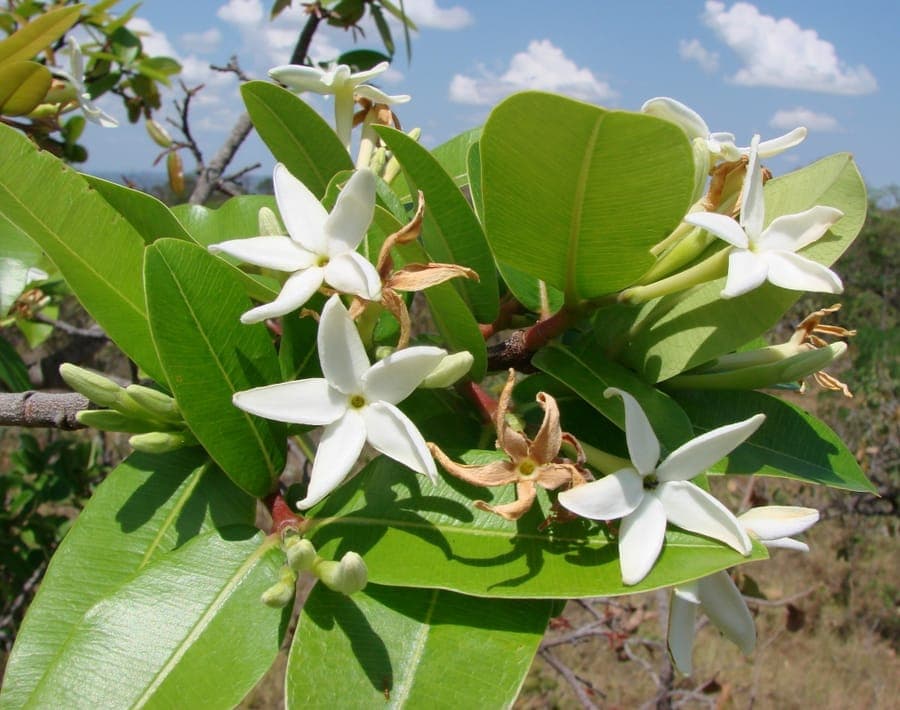
Hancornia speciosa is a mid-size tree that can reach 5-10 meters at full maturity. In containers and topped cultivation, it remains much smaller. The tree has dense, attractive foliage consisting of large, oppositely arranged leaves. The leaves are elliptical to lanceolate, glossy green with fine venation.
Flowers appear in clusters at the leaf axils and are small but very pretty. They have a white or cream color and are highly fragrant. The flowers attract butterflies and other insects, adding a nice biological element to the garden.
After flowering, unknown green fruits develop that become yellow to orange when ripe. These fruits are the real beauty of Hancornia speciosa. They are oval-shaped and reach approximately 3-4 centimeters in diameter. The fruits have a delicious sweet taste and can be eaten raw or processed into jam, juice, or liqueur.
Ideal location
Hancornia speciosa grows best in very sunny locations. The tree needs at least 6-8 hours of direct sunlight daily for optimal growth and fruiting. In partial shade, it can survive but will grow less and produce fewer fruits.
The tree is fairly sensitive to strong winds, especially when young. Provide protection from harsh wind gusts, especially in coastal areas. A sheltered spot against a wall or garden wall is ideal.
In cooler northern regions, the tree can only be grown outdoors in the most southern parts, and it is better to keep it in containers so it can be moved indoors during winter. In warmer southern European regions, it grows well as a full garden tree.
Soil
Hancornia speciosa prefers well-draining soil that doesn't become too wet. A well-draining, humus-rich soil is ideal. Sandy to sandy-loamy soils work well, as long as they provide good drainage.
The pH can be neutral to slightly acidic (6.0-7.0). Add plenty of organic matter when planting, especially compost and leaf mold. This improves both drainage and nutrient content.
In containers, use potting soil with extra drainage mix. A good mixture is approximately 40% potting soil, 30% coarse sand or gravel, and 30% leaf mold or compost. This ensures perfect drainage without drying out.
Free design
Want to see Hancornia speciosa: complete guide in your garden? Make a free design now.
Watering
Hancornia speciosa should be watered regularly and well, especially during the growing period (spring and summer). When the tree is actively growing, the soil should stay moist but not waterlogged. Ensure excess water drains properly.
During dry summer months, you may need to water 1-2 times per week, depending on temperature and soil type. In containers, regular watering is essential because pots dry out faster.
In winter, when growth slows, significantly reduce watering. Let the soil dry out somewhat between waterings. Too much water in winter can cause root rot.
Make sure you use clean, non-chalky water. Rainwater is ideal.
Pruning
Hancornia speciosa requires moderate pruning to maintain shape. When young, you can pinch the top to encourage branching. This results in a thicker, more compact plant silhouette.
Crushed and dead branches should always be removed. Prune best in early spring (March) before the growing season starts. Remove internal branches that cross each other or are damaged.
In containers, you can trim the tree regularly to maintain shape and encourage more compact growth. Always use sharp, clean tools.
Maintenance calendar
- January-February: Check watering needs. Ensure good anchoring in pots.
- March-April: This is the best time to prune. Active growth begins. Start feeding in containers.
- May-July: Water regularly. Blooming and young fruit set may occur.
- August-September: Fruit set continues. Preceding growth slows down.
- October-November: Reduce watering as growth slows.
- December: Protect container plants from frost. Withhold feeding.
Winter hardiness
Hancornia speciosa is not winter hardy in countries like the Netherlands, Belgium, or northern Germany. The tree cannot tolerate temperatures below 8-10 degrees Celsius and will die in frost.
In regions with winters longer than 8-10 degrees Celsius, the tree should be grown in a container that can be brought indoors during winter. A light, ventilated room with minimal heating is ideal. In such a room, the tree will retain its leaves and grow slowly.
In southern regions around the Mediterranean and similar climates, the tree can remain outdoors, but protection is important.
Companion plants
With Hancornia speciosa, you can combine other tropical and subtropical plants:
- Other tropical fruit trees such as mango or avocado
- Passiflora (passion fruits)
- Citrus fruit trees in warm climates
- Decorative tropical foliage plants
Ensure all companion plants share the same preference for full sun, warmth, and well-drained soil.
Closing
Hancornia speciosa is perfect for those seeking exotic value in the garden and living in warmer climates. The tree offers not only ornamental value with its green foliage and fragrant white flowers but also food in the form of delicious sweet fruits.
While the tree requires caution in cold climates, it is relatively low-maintenance and reliable. For Southern Europe, it is a true asset. Discover more on gardenworld.app for garden design inspiration.
Want to see Hancornia speciosa: complete guide in your garden? Make a free design now.
Upload a photo, pick a style, and get a photorealistic design with plant list in under a minute.
No credit card required


Similar plants
Asclepias speciosa: complete guide
Asclepias speciosa
Showy milkweed: striking pink-white flowers, fragrant blooms. Essential monarch butterfly host plant.
Plumeria obtusa: complete guide
Plumeria obtusa
Discover the Singapore graveyard flower: an exotic evergreen with mesmerizing white blooms and exquisite fragrance. Expert cultivation, care, and maintenance tips.
Wrightia arborea: complete guide
Wrightia arborea
Wrightia arborea, known as doodhi, is an elegant tree from South Asia with delicate white flowers. Discover how to cultivate this exotic plant.