
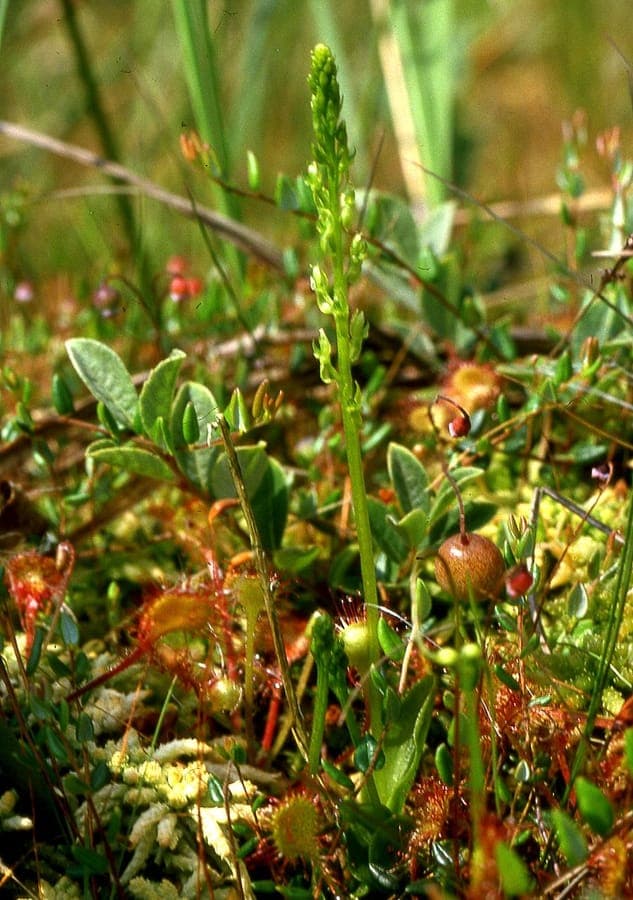
Orchi / CC BY-SA 3.0, via Wikimedia Commons
Bog adder's-mouth orchid: complete guide
Hammarbya paludosa
Want to see Bog adder's-mouth orchid: complete guide in your garden?
1 minute, no credit card
Overview
Hammarbya paludosa, commonly known as the bog adder's-mouth orchid, is a diminutive, evergreen orchid native to cold temperate and subarctic peatlands across North America, Europe, and parts of Asia. Found from Alaska and British Columbia through Scandinavia to Siberia and the Baltic States, this orchid thrives in undisturbed, acidic, waterlogged bogs where few other plants can survive. It's not a showy garden specimen, but its subtle charm and ecological rarity make it a prized find for native plant enthusiasts. In the wild, it grows in sphagnum moss mats, often in partial shade under dwarf shrubs or scattered trees.
This orchid spreads slowly via creeping rhizomes and rarely forms large colonies. It's easily overlooked due to its small size and green flowers, but for gardeners committed to recreating natural bog habitats, it's a rewarding choice. It's not widely available in garden centres, and wild collection is illegal-always source from licensed nurseries.
Appearance & bloom cycle
The bog adder's-mouth orchid reaches just 10–15 cm in height. It produces a single, glossy, ovate leaf each spring, 3–5 cm long, which remains green throughout the year. This evergreen leaf helps the plant photosynthesize slowly even in cool, low-light conditions.
From July through September, a slender, upright flowering stem emerges, bearing 20–50 tiny green flowers. Each flower is only 2–3 mm wide, with a rounded lip and a faint, sweet scent. Though not visually striking, the bloom period lasts four to six weeks, and the flowers attract small flies and midges. After pollination, seed capsules form, but germination in cultivation is rare without symbiotic mycorrhizal fungi present in natural peat soils.
Ideal location
This orchid prefers dappled to full shade, scoring 8 on the light scale (with 10 being full sun). It thrives under open canopies of birch, alder, or willow, where sunlight filters gently through. Avoid hot, direct afternoon sun-this will scorch the leaf and dry out the roots. A north-facing bog garden or shaded wetland edge works best.
In the home garden, mimic its natural habitat by planting near a pond edge with light overhead cover, or in a shaded bog bed. Use gardenworld.app to plan a moisture-rich, shaded garden zone tailored to Hammarbya paludosa and other bog specialists.
Soil requirements
Soil must be highly acidic, with a pH between 4.0 and 4.5. Use pure, low-nutrient peat or a peat-free sphagnum substitute mixed with coarse sand and pine litter. Never use compost, manure, or lime-these will kill the plant over time. The soil should be rich in organic matter but low in nutrients, especially nitrogen.
Avoid standard potting mix. Look for specialist orchid or bog plant soil at garden centres, or order online from reputable native plant suppliers.
Free design
Want to see Bog adder's-mouth orchid: complete guide in your garden? Make a free design now.
Watering
Constant moisture is non-negotiable. The roots must never dry out. Use rainwater or distilled water only-tap water with high calcium content raises pH and harms the delicate root system. The soil should feel moist but not waterlogged.
In summer, check daily during dry spells. A shallow bog garden with a liner and constant seepage works well. Consider installing a small reservoir or drip system to maintain humidity.
Pruning
No pruning is required. Leave all foliage in place until it naturally withers in late winter. Removing green leaves weakens the plant. In early spring, gently remove any dead leaf fragments to prevent fungal issues, but do not disturb the crown.
Maintenance calendar
- January–February: Dormant. No action.
- March: Remove dead leaf debris gently. Check moisture.
- April–May: New leaf emerges. Keep soil consistently damp.
- June: Flower spike begins to rise. Prevent drying.
- July–September: Blooming phase. Water with rainwater during dry periods.
- October–December: Plant enters dormancy. Leave foliage for winter protection.
Winter hardiness
Hardy to USDA zone 4 (-30°C). The plant survives freezing temperatures as long as the root zone stays moist and insulated. In harsh winters, a light mulch of pine needles can help, but avoid thick layers that trap moisture and cause rot.
Container-grown plants are more vulnerable-overwinter in a cold frame or unheated greenhouse where moisture can be controlled.
Companion plants
Pair with other bog lovers: sphagnum moss, cotton grass (Eriophorum angustifolium), cranberry (Vaccinium oxycoccos), and small sedges like Carex pauciflora. Dwarf pitcher plants (Sarracenia purpurea) and small ferns such as delicate lady fern (Athyrium filix-femina) also work well.
Avoid vigorous perennials or grasses that dominate space and light.
Closing
Hammarbya paludosa isn't for every garden, but for those willing to create a true bog habitat, it's a quiet marvel. It asks for precision-acidic soil, constant moisture, and shade-but rewards with year-round presence and a delicate summer bloom. Always purchase cultivated stock, never wild-dug plants.
With a thoughtful layout from gardenworld.app, you can design a native wetland garden where this rare orchid thrives among mosses and sedges, bringing a slice of northern bog into your backyard.
Want to see Bog adder's-mouth orchid: complete guide in your garden? Make a free design now.
Upload a photo, pick a style, and get a photorealistic design with plant list in under a minute.
No credit card required


Similar plants
Ram's-head lady's slipper: complete guide
Cypripedium arietinum
Everything you need to know about growing Cypripedium arietinum, a rare woodland orchid for cool, moist garden settings. Soil, care and planting tips.
Sparrow's-egg lady's slipper: complete guide
Cypripedium passerinum
Everything about growing Cypripedium passerinum, a cold-hardy subarctic orchid suited to cool, moist, shaded garden spots. Soil, care and companion plants.
Algerian Butterfly-orchid: complete guide
Platanthera algeriensis
Everything about Platanthera algeriensis, the rare Mediterranean orchid with greenish flowers native to Algeria, Morocco, Corsica and Spain.