
Perimeter285 / Public domain, via Wikimedia Commons
Two-wing silverbell: complete guide
Halesia diptera
Want to see Two-wing silverbell: complete guide in your garden?
1 minute, no credit card
Overview
Two-wing silverbell (Halesia diptera) is a small to medium-sized flowering tree native to the south-eastern United States, from Alabama and Florida through to Texas. A member of the storax family Styracaceae, it is still relatively uncommon in European gardens despite offering one of the most beautiful spring flower displays of any deciduous tree. Visitors to gardenworld.app frequently ask for outstanding flowering trees that bring something genuinely special to the front garden - this is one of the answers. The name 'two-wing' distinguishes it from its close relative Halesia carolina (Carolina silverbell), which produces four-winged fruit; Halesia diptera produces distinctively two-winged seed pods that persist on the branches through winter and add skeletal decoration when the leaves have fallen. The tree grows at a moderate rate to an eventual height of 4 to 8 metres, forming a broadly spreading, open crown that fits comfortably into a domestic garden setting.
Appearance and bloom cycle
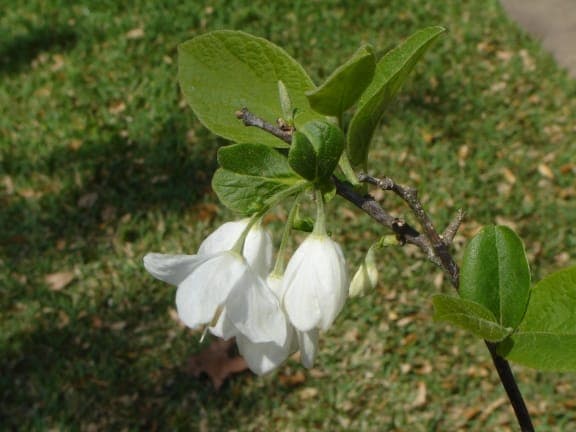
The flowers of two-wing silverbell are the tree's defining feature and the reason gardeners seek it out. They emerge in April and May, hanging in drooping clusters of two to six blooms along the length of every branch, appearing simultaneously with or just before the leaves unfurl. Each individual flower is pure white, broadly bell-shaped to funnel-shaped, and around 2 cm long. The variety 'Magniflora' produces noticeably larger flowers than the species type and is especially sought after by collectors. Stamens are cream to pale yellow, forming a delicate contrast with the white petals. After flowering, the characteristic two-winged fruits develop - elongated, pale green turning to brown in autumn, and persisting on the bare branches through winter. Foliage is broad-ovate to elliptic, deep green through summer, turning a warm golden-yellow in October. The bark of mature trees shows an attractive, pale grey, slightly scaly pattern that provides winter interest.
Ideal location
In its native woodland habitat, two-wing silverbell grows as an understorey species along stream banks and in moist, shaded forest margins. This background gives it better tolerance of partial shade than most flowering trees, making it suitable for a wider range of garden positions. A spot with morning sun and afternoon shade, or dappled light through a high canopy, suits it well. In cooler northern European climates it can cope with full sun, provided the soil is kept consistently moist. Shelter from strong winds protects the delicate flowers in spring. Avoid hot, dry south-facing exposures in continental climates and any position where drainage is poor or standing water accumulates. The tree works beautifully as a specimen in a mixed border, at the woodland edge, or as a focal point near a pond or stream.
Soil
Two-wing silverbell prefers moist, humus-rich, well-draining, moderately acidic soil with a pH of 6 to 8. Soils similar to those of a temperate woodland floor - rich in leaf mould and organic matter, moisture-retentive but not waterlogged - replicate its natural habitat most closely. Strongly alkaline or calcareous soils cause yellowing (chlorosis) and stunted growth; if your garden soil has a high pH, improve it with generous quantities of acidic compost, composted pine bark, or ericaceous planting mix before planting. Heavy clay soils should be amended with coarse organic matter and possibly some horticultural grit to improve structure and drainage. A thick mulch of composted bark or leaf mould spread 5 to 8 cm deep around the root zone conserves moisture, moderates soil temperature, and gradually improves soil structure as it breaks down.
Watering
For the first two to three years after planting, consistent moisture is important. The root system is wide-spreading and relatively shallow, making it susceptible to drought stress during hot dry spells. Water thoroughly and regularly during dry summer periods, directing water to the base of the tree rather than overhead. Once established, the tree is considerably more drought-tolerant, but prolonged summer heat without rain can cause premature leaf drop and may reduce the following year's flowering. A consistent layer of organic mulch around the root zone acts as the most effective single measure for conserving moisture between rain events. In wet summers or climates with reliable summer rainfall, supplemental watering is rarely needed.
Free design
Want to see Two-wing silverbell: complete guide in your garden? Make a free design now.
Pruning
Two-wing silverbell has a naturally attractive, open branching structure and requires minimal routine intervention. Basic maintenance involves removing dead, damaged, or crossing branches, carried out in late spring after flowering finishes in May or June. Avoid heavy renovation pruning: the flowers are produced on wood from the previous year, so cutting back heavily will sacrifice the following season's display. Allow the tree to develop its natural form as far as possible. In the first three years, light formative pruning to establish a single clear leader and a well-spaced branch framework is worthwhile. For mature trees, an annual inspection and removal of any problem wood is sufficient. Always use clean, sharp tools and treat any large pruning wounds.
Maintenance calendar
January - February: no active work required; check mulch depth, top up if thin. March: flower buds beginning to swell; remove any dead twigs spotted from winter damage. April: peak flowering; enjoy the display, no intervention. May: blooming concludes; carry out any necessary light pruning now. June: fresh foliage fully expanded; replenish mulch if needed. July - August: warm season; water during extended dry spells; apply a slow-release balanced fertiliser in early July if growth seems sluggish. September: foliage begins its autumn colour change. October: leaf fall; collect fallen leaves for composting or use as mulch around other plants. November: two-winged fruits remain on bare branches for winter interest; no action needed. December: tree fully dormant; inspect bark and structure during this quiet period.
Winter hardiness
Two-wing silverbell is reliably cold-hardy in USDA zones 5 to 9, tolerating temperatures down to around -20 degrees Celsius without significant damage when sited in a sheltered position. This makes it suitable for the vast majority of north-west European gardens, including those in the United Kingdom, the Netherlands, Belgium, and most of Germany. Young trees in their first two winters benefit from a protective mulch layer over the root zone. The main cold-related risk is late spring frost catching the opening flowers in April; a single frost event will damage individual open blooms, turning them brown, but the tree typically continues to produce further flowers from buds further down the branches. At gardenworld.app, we recommend this tree for gardeners who want four-season interest: winter silhouette and fruit, spring flowers, summer foliage, and autumn colour.
Companion plants
Two-wing silverbell pairs most naturally with acid-loving, woodland-edge species that share its preference for moist, humus-rich conditions. Rhododendrons and azaleas are classic companions: identical soil requirements, overlapping bloom times in April and May, and a stunning colour contrast between the white Halesia bells and the purple, red, or pink Rhododendron trusses. Heuchera provides decorative ground cover under the canopy year-round. Leucothoe fontanesiana adds arching, glossy dark foliage and good autumn colour. Fothergilla gives early spring interest with its bottlebrush-white flowers. Hostas thrive in the dappled shade cast by the tree's crown and provide bold textural contrast through summer. For a natural woodland look, combine with ferns such as Dryopteris or Athyrium as ground-level planting.
Closing
Two-wing silverbell is a tree that earns its place in the garden four times over: the spring flower cascade, the summer green canopy, the autumn gold, and the sculptural winter silhouette with its dangling two-winged fruits. It is patient, relatively trouble-free once established, and suited to most temperate European climates. Seek it out from specialist tree nurseries and larger garden centres that carry unusual ornamental trees. Give it the moist, humus-rich, slightly acidic soil it craves, a mulched root zone, and protection from the harshest summer drought, and this native of the American South will reward you with decades of exceptional garden beauty. Visit gardenworld.app for personalised planting advice to incorporate this outstanding flowering tree into your own garden design.
Want to see Two-wing silverbell: complete guide in your garden? Make a free design now.
Upload a photo, pick a style, and get a photorealistic design with plant list in under a minute.
10,000+ gardens designed already
No credit card required


Similar plants
Halesia carolina: complete guide
Halesia carolina
Discover Halesia carolina, a stunning American snowdrop tree. Complete guide to planting, growing, and caring for this beautiful ornamental tree.
Juneberry: complete guide
Amelanchier lamarckii
Everything about the Juneberry (Amelanchier lamarckii): spring blossom, autumn colour, edible berries and care. Expert tips for this versatile four-season tree.