
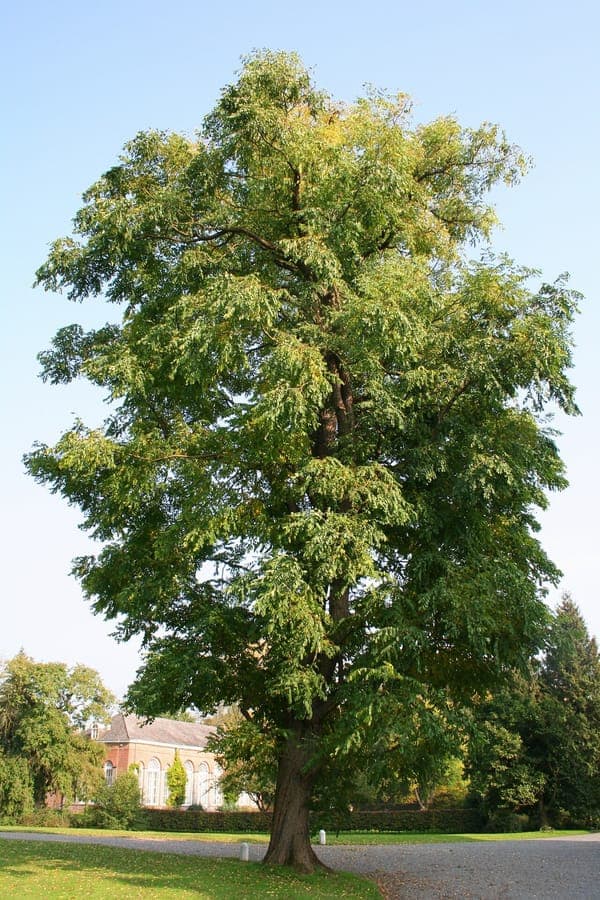
Jean-Pol GRANDMONT / CC BY 3.0, via Wikimedia Commons
Kentucky coffee tree: complete guide
Gymnocladus dioicus
Want to see Kentucky coffee tree: complete guide in your garden?
1 minute, no credit card
Overview
The Kentucky coffee tree (Gymnocladus dioicus) is a large, imposing deciduous tree native to central and eastern North America, ranging from southern Ontario in Canada south to Texas and Alabama. A member of the legume family (Fabaceae), it was formally described in 1869 by the German botanist Karl Koch and has been used as an ornamental in European parks and large gardens for more than two centuries. Despite its stately presence and exceptional resilience, it remains surprisingly underplanted compared to more familiar trees.
The genus name Gymnocladus derives from Greek words meaning 'bare branch', referring to the long leafless period this tree displays each year. Dioicus means 'two houses', reflecting the tree's dioecious nature: male and female flowers are borne on separate trees. Only female trees produce the large, leathery seed pods that are one of the tree's most distinctive ornamental features in autumn and winter.
In its native range, the Kentucky coffee tree can reach 15 to 20 metres in height with an open, spreading crown 8 to 12 metres wide. In European gardens it typically reaches 10 to 15 metres over several decades, growing at a slow to moderate rate of 20 to 30 cm per year. This modest rate of growth makes it suited to large private gardens, parks and boulevard plantings where a long-lived specimen tree is desired.
The species is highly tolerant of urban conditions: it withstands air pollution, compacted soil, drought and variable pH, making it a valuable choice for challenging urban sites. In North America it has been used as a street tree for decades. Its deep taproot also makes it less likely to lift paving than shallow-rooted species.
Appearance & bloom cycle
The Kentucky coffee tree's most striking feature is its enormous compound leaf, one of the largest of any northern temperate tree. Leaves are twice-pinnate (bipinnate), reaching 60 to 90 cm in length and 30 to 60 cm in width, composed of numerous oval leaflets arranged in opposite pairs along secondary leafstalks. This lacy, tropical appearance sets the tree apart immediately from all other temperate specimens.
Leaf emergence is notably late - typically not until May - and leaf fall is early, from September to October, leaving the tree bare and sculptural for more than half the year. The bark is grey-brown and deeply furrowed, adding further textural interest in winter. Thick, blunt twigs with their prominent terminal buds create a striking architectural silhouette against the winter sky.
Flowers appear in May to June as fragrant, whitish-green panicles 10 to 30 cm long. They are not showy but have a pleasant, light fragrance. Male and female flowers are on separate trees; only female trees develop fruit. The fruit pods are large - 15 to 25 cm long, 3 to 5 cm wide - thick, leathery and dark brown, hanging in clusters through autumn and well into winter. They contain large, hard seeds embedded in a sweet, sticky pulp that early American settlers roasted and used as a coffee substitute (hence the common name). Raw seeds and pulp are toxic to humans, dogs and horses.
Spacing: plant at least 8 metres from buildings and underground services; crown spread at maturity is 8 to 12 metres.
Ideal location
The Kentucky coffee tree performs best in full sun to very light shade. Full sun encourages the best leaf development, most vigorous growth and pod production on female trees. The tree is tolerant of wind and handles dry spells once established, making it particularly useful in exposed sites where more delicate species would struggle.
Choose a spacious position with room for the crown to develop fully. The deep taproot is less damaging to paving than surface-rooted species, but adequate soil volume beneath the crown is still important. Avoid planting too close to structures: allow at least 6 metres clearance to buildings and 3 metres to pathways.
The tree suits parks, large private gardens, wide driveways and boulevard plantings. In the front garden, a single specimen creates year-round structural interest: in summer, the tropical-looking foliage provides dappled shade; in winter, the bold branching pattern becomes a living sculpture. Plan your specimen tree placement with gardenworld.app for a visualisation of how this tree anchors a garden design.
Soil requirements
Gymnocladus dioicus is adaptable to a wide range of soil conditions - a key reason for its value in urban settings. It thrives on soils ranging from light sand to moderately heavy clay, and tolerates pH 6.0 to 8.0. Good drainage is the primary requirement; prolonged waterlogging causes root rot and decline.
On nutrient-poor soils the tree grows more slowly but remains healthy. Being a legume, it has the capacity to fix atmospheric nitrogen through symbiotic Rhizobium bacteria in its roots, giving it an advantage on lean soils. At planting, work in a generous amount of well-rotted compost - around 10 litres per tree - to the backfill, but avoid high-nitrogen fertilisers that will push fast, soft growth vulnerable to frost damage.
The deep taproot penetrates compacted subsoil layers that many other species cannot traverse, making the Kentucky coffee tree suitable for challenging urban soils. When planting, dig a hole at least twice the width of the root ball and equally deep; backfill with a mixture of native soil and compost, ensuring the root collar sits at the original soil level.
Free design
Want to see Kentucky coffee tree: complete guide in your garden? Make a free design now.
Watering
Once established, Gymnocladus dioicus is remarkably drought-tolerant. Its deep taproot can access moisture from lower, cooler soil horizons during dry spells. However, in the first two years after planting, consistent watering is critical to establish a strong root system.
In the planting year, water weekly during summer, delivering enough water to moisten the soil to a depth of 40 cm each time. In the second year, water fortnightly in dry periods. From year three onward, supplemental watering is rarely necessary except during exceptionally prolonged droughts (several weeks above 30 °C).
Avoid overwatering: the tree does not tolerate poorly drained, waterlogged soil. Heavy clay sites with a high water table are unsuitable unless artificial drainage is provided. A mulch ring of 10 to 15 cm of bark or wood chip around the base - kept clear of the trunk itself - retains soil moisture during dry periods and moderates soil temperature.
Pruning
The Kentucky coffee tree requires minimal pruning. It develops a naturally attractive open crown and does not need regular shaping to look its best. Remove dead, diseased or crossing branches in late winter or very early spring, before the tree comes into leaf.
Because the tree leafs out very late, always wait until the foliage is fully expanded before concluding that a branch is dead - what appears dead in April may leaf out perfectly well in May. Use clean, sharp tools for all cuts. Coat saw wounds on branches over 5 cm diameter with a wound sealant to reduce infection risk.
Avoiding unnecessary pruning is the most important rule. Heavy re-shaping cuts weaken the crown's structural integrity and create entry points for fungal pathogens. If the tree is outgrowing its allocated space, it is better to reconsider its placement than to attempt major reduction pruning.
On female trees, the large seed pods may drop and cause a nuisance on lawns and paths through the winter. Remove fallen pods promptly where dogs or horses have access, as the seeds are toxic. If pod litter is problematic, select a male cultivar such as 'Espresso' or 'Prairie Titan', which are available at specialist tree nurseries in the UK.
Maintenance calendar
January – February: assess the winter crown structure; remove clearly dead branches; collect fallen seed pods if present on female trees.
March – April: tree still dormant; check mulch depth and top up to 10-15 cm if needed; do not mistake late bud-break for dead branches.
May: leaves begin to unfurl; water young trees during dry spells; apply a light top-dressing of compost around the drip-line if growth looks weak.
June – July: flowering period on mature trees; continue regular watering for trees in their first three years; enjoy the tropical-looking foliage.
August – September: leaves begin to turn yellow early; seed pods ripen on female trees; water during prolonged drought.
October – November: early leaf fall; rake large leaves from paths where they may cause a slip hazard; female trees drop pods - collect them where pets have access.
December: fully dormant; evaluate pruning needs for late winter; sculptural winter silhouette at its most visible.
Winter hardiness
The Kentucky coffee tree is one of the hardiest trees in its genus, tolerating temperatures as low as -30 °C (USDA hardiness zones 3 to 8). Across the British Isles, Belgium, the Netherlands and Germany (zones 7 to 8), it is fully hardy and requires no winter protection once established.
Young trees in their first one to three years may occasionally show frost crack damage to the thin bark; wrapping the trunk in hessian for the first two winters provides adequate protection. Once the tree is well established - after four to five years - no protection is needed.
The late bud-break is actually an advantage: by leafing out in May, the tree has usually avoided the most damaging late spring frosts that can affect early-leafing species. This reliability in the face of variable spring temperatures makes the Kentucky coffee tree a dependable long-term investment.
Companion plants
Under the open canopy of Gymnocladus dioicus, shade-tolerant ground-covering perennials thrive, particularly during the extended leafless period. Vinca minor (lesser periwinkle), Pachysandra terminalis and Waldsteinia ternata cope well with the combination of dry shade in summer and full light in winter and spring.
Ornamental grasses such as Luzula sylvatica (greater woodrush) and Carex pendula (pendulous sedge) add texture beneath the canopy. Spring-flowering perennials - Pulmonaria (lungwort), Epimedium (bishop's hat) and Astrantia major (masterwort) - provide colour early in the season before the canopy closes in.
Avoid planting other legumes (Fabaceae) directly adjacent, as they may compete for the same Rhizobium bacteria. Shrubs such as Cornus sanguinea, Viburnum opulus and Sambucus nigra make good companions in mixed shrubbery plantings on larger sites. For personalised planting schemes including the Kentucky coffee tree, visit gardenworld.app.
Conclusion
The Kentucky coffee tree is a magnificent and underappreciated specimen tree that deserves a place in every large garden and park. Its extraordinary bipinnate foliage, dramatic winter silhouette, tolerance of challenging soil conditions and exceptional cold-hardiness make it one of the most reliable and architecturally striking deciduous trees available to European gardeners. For those with the space to accommodate it, few trees offer such year-round presence with so little maintenance demand.
Want to see Kentucky coffee tree: complete guide in your garden? Make a free design now.
Upload a photo, pick a style, and get a photorealistic design with plant list in under a minute.
10,000+ gardens designed already
No credit card required


Similar plants
Tall Silky Lupine: complete guide
Lupinus elatus
Tall silky lupine is a fast-growing Californian perennial with silvery foliage and blue-purple flower spikes, ideal for a prairie-style garden.
Garfield Lupine: complete guide
Lupinus garfieldensis
The Garfield lupine is a rare, fast-growing American perennial for alkaline, dry grassland gardens, with striking blue flower spikes.
Lupinus elegans: complete guide
Lupinus elegans
Lupinus elegans, the elegant lupine, is a spectacular blooming plant from Mexico with blue flower spikes. Care, cultivation and garden use.