
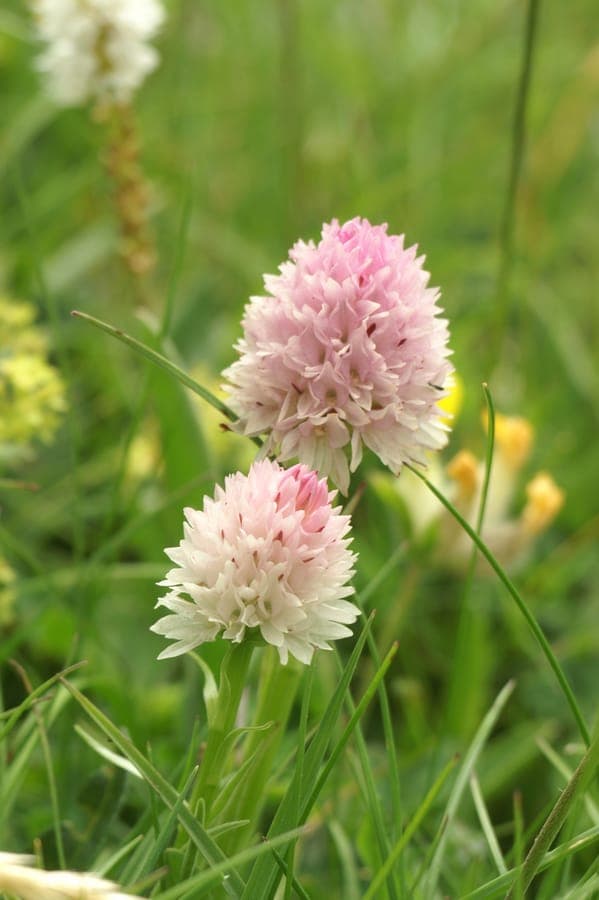
Benjamin Zwittnig / CC BY 2.5 si, via Wikimedia Commons
Gymnadenia lithopolitanica: complete guide
Gymnadenia lithopolitanica
Want to see Gymnadenia lithopolitanica: complete guide in your garden?
1 minute, no credit card
Overview
Gymnadenia lithopolitanica, also known as Schwarzes Mannertreu or Austrian Gymnadenia, is a fascinating alpine orchid from the Southeast Alps. This extremely rare and protected plant belongs to the Orchidaceae family and is endemic to a limited mountainous region. It was first scientifically recognized in 1998 and is now on the red list of endangered species.
This is a plant for the true orchid enthusiast and mountain lover. The plant grows exclusively at high altitude (usually 2000-2500 meters) in very specific microhabitats within alpine grassland vegetation. Cultivation at home is difficult but possible with proper conditions.
Appearance and Bloom
Gymnadenia lithopolitanica is a compact orchid only 15-25 cm tall. The plant forms a small rosette of narrow, linear leaves at the base. The flowers are very small, approximately 8-12 mm in diameter, growing in a characteristic dense cylindrical inflorescence (spike).
The flowers display a striking blackish to dark purple color, sometimes with grayish tones. Fragrance is present but subtle. Each flower has a short spur on the back. Blooming occurs in June and July. After pollination, the orchid produces small capsules with countless microscopic seeds.
Ideal Location
This alpine orchid requires very cool, mountainous growing conditions. The plant grows best in a full sun to light shade location with well-draining, mineral-rich soil. In cultivation, an alpine greenhouse or cold frame is recommended.
The plant does not thrive in warm, humid conditions typical of lowland gardens. For those in flatlands, an alpine trough or alpine house with controlled cooling is required. gardenworld.app advises: this is a plant for specialized gardens and experts, not beginners.
The plant requires good air circulation and wind exposure, as naturally occurs in mountain regions.
Soil
Gymnadenia lithopolitanica grows naturally on alpine grassland with well-draining, highly mineral-rich, slightly acidic soils. In cultivation, special alpine orchid compost must be used, mixed with extra gravel and sand.
Ideal soil composition is: 40% alpine orchid compost, 30% gravel, 20% sand, and 10% leaf mold. pH should be between 5.5 and 6.5. Perfect drainage is essential - no water stagnation is acceptable.
Minimal feeding is needed. Use extremely diluted fertilizer, only once per growing season. Many cultivators use no fertilizer at all.
Free design
Want to see Gymnadenia lithopolitanica: complete guide in your garden? Make a free design now.
Watering
Alpine orchids, including Gymnadenia lithopolitanica, must be kept beyond dry but not completely desiccated. During the growing season (April through August), water moderately, maintaining moisture level without waterlogging.
In winter (when the plant is dormant) very minimal water is given. The critical time is autumn - gradually reduce watering as temperatures decline.
Rainwater or distilled water is much better than tap water. Heavy minerals in tap water can harm the plant. Water in the morning, not evening.
Pruning
Minimal pruning is required. Remove only dead leaves and wilted flowers as they appear. After seeding (usually September-October), you can carefully remove the entire above-ground plant if completely dry.
When cultivating in pots, careful repotting once every two years in early spring while the plant is still dormant is recommended.
Maintenance Calendar
February to April: Growth resumes. Begin careful watering. Plant emerges from dormancy.
April to June: Active growth. Regular watering. Flower preparation.
June to August: Bloom and seed drop. Water carefully. No feeding needed.
August to October: Slow transition to dormancy. Reduce water significantly.
October to February: Winter dormancy. Minimal water. Cold conditions (usually underground or in cold frame). Plant completely frost-hardy.
Winter Hardiness
Gymnadenia lithopolitanica is completely frost-hardy. Indeed, the plant requires cold winter dormancy for successful rest period. Temperatures of -15 to -20 degrees Celsius are normal in the mountain habitat and pose no problem.
Problems can occur in warm winters in lowland areas where the plant does not experience true dormancy. This can lead to plant weakening and eventual death. gardenworld.app advises cooling through alpine house or controlled cold frame.
Companion Plants
In alpine gardens, Gymnadenia lithopolitanica can be grown with other alpine wildflowers and alpine orchids such as Orchis mascula subsp. signifera, Coeloglossum viride, and other alpine species.
Other suitable companions are alpine grasses and sedges, small mountain saxifrages, and other alpine species. gardenworld.app advises against mixing with non-alpine or warmth-loving species.
Closing
Gymnadenia lithopolitanica is a very rare, difficult-to-grow alpine orchid requiring substantial knowledge and special conditions. It is not a plant for beginners. For those with experience in alpine gardening, alpine houses, and orchid cultivation, it can, however, be a very rewarding cultivation.
The plant is protected in nature and must not be collected from the wild. Only cultivated specimens from responsible sources should be grown. gardenworld.app advises: contact specialized alpine orchid nurseries.
Not available in regular garden centers. Only available through specialized orchid nurseries and online sources.
Want to see Gymnadenia lithopolitanica: complete guide in your garden? Make a free design now.
Upload a photo, pick a style, and get a photorealistic design with plant list in under a minute.
No credit card required


Similar plants
Ram's-head lady's slipper: complete guide
Cypripedium arietinum
Everything you need to know about growing Cypripedium arietinum, a rare woodland orchid for cool, moist garden settings. Soil, care and planting tips.
Sparrow's-egg lady's slipper: complete guide
Cypripedium passerinum
Everything about growing Cypripedium passerinum, a cold-hardy subarctic orchid suited to cool, moist, shaded garden spots. Soil, care and companion plants.
Algerian Butterfly-orchid: complete guide
Platanthera algeriensis
Everything about Platanthera algeriensis, the rare Mediterranean orchid with greenish flowers native to Algeria, Morocco, Corsica and Spain.