
Margaret Donald / CC BY-SA 2.0, via Wikimedia Commons
Giant-rhubarb: complete guide
Gunnera tinctoria
Want to see Giant-rhubarb: complete guide in your garden?
1 minute, no credit card
Overview
Giant-rhubarb (Gunnera tinctoria) is a bold, herbaceous perennial that commands attention with its enormous, umbrella-like leaves. Native to southern Chile and Argentina, this plant thrives in wetlands, along stream banks, and in boggy forests. In the UK and northern Europe, it's often planted near ponds, in damp corners, or as a dramatic focal point in moisture-rich gardens. While it looks tropical, it's surprisingly hardy-if given the right conditions.
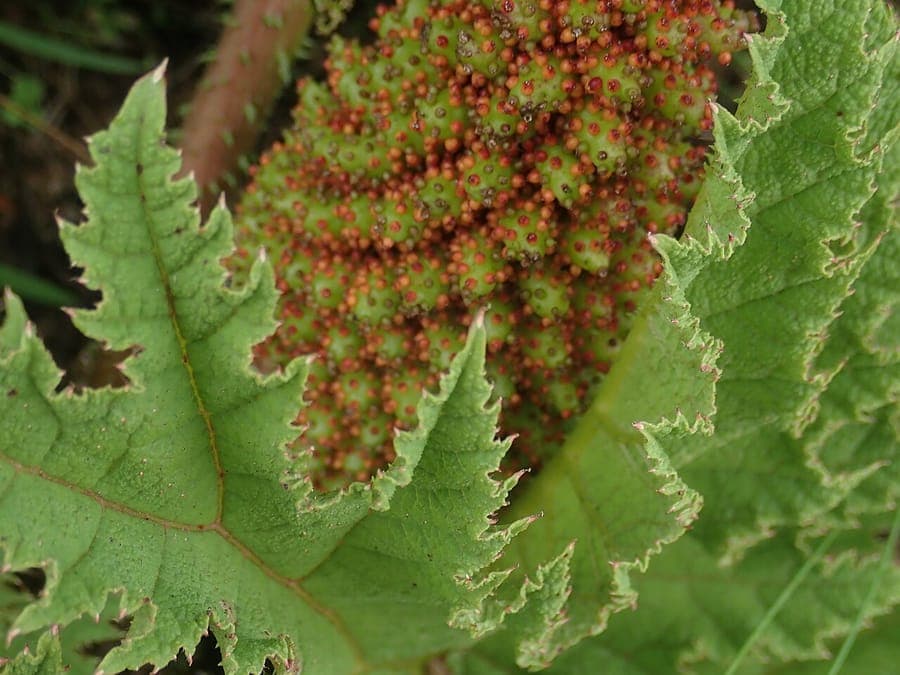
Mature plants can reach 2.5 meters in height and spread, with leaves spanning 1.5 to 2 meters across. The foliage is deeply veined, rough to the touch, and supported by thick, spiky stems that can grow up to 1.5 meters long. These stems are armed with sharp yellow spines-always wear gloves when handling. The plant flowers from June to July, producing tall, cone-shaped inflorescences up to 80 cm high, in shades of reddish-brown. Though not showy, the blooms add architectural interest.
By late summer, the leaves begin to yellow, and by October, they collapse and die back completely. The plant survives winter as a dormant crown, ready to regrow with vigor in spring.
Appearance & bloom cycle
New growth emerges in April, with tightly furled leaf buds that slowly unfurl into massive, rhubarb-like foliage. The upper surface is dark green and slightly wrinkled, while the underside often has a purplish tinge. The leaf stalks are thick, fleshy, and covered in sharp, golden spines-handle with care. Flowering occurs mid-summer, with erect, spike-like panicles rising above the foliage. Each inflorescence can hold hundreds of tiny flowers. Seed production is possible, but the plant spreads primarily through vigorous rhizomes.
Leaf drop begins in September, triggered by cooler temperatures and shorter days. This dieback is natural and essential for the plant's dormancy period.
Ideal location
Choose a spot in full sun to partial shade. Full sun encourages the densest growth, but in hot summers, afternoon shade helps prevent leaf scorch. The ideal setting is beside a pond, in a bog garden, or in any consistently damp area. Allow at least 2 x 2 meters of space-this plant needs room. On gardenworld.app, you can design a garden layout that accommodates giant-rhubarb's scale and moisture demands, ensuring it doesn't overwhelm smaller neighbours.
Be aware: Gunnera tinctoria is considered invasive in some regions, including parts of the UK and Ireland. Avoid planting it near natural waterways where rhizomes could spread unchecked.
Free design
Want to see Giant-rhubarb: complete guide in your garden? Make a free design now.
Soil requirements
The plant thrives in rich, moisture-retentive soil high in organic matter. A pH between 5.5 and 7.0 is ideal. Amend the planting hole with well-rotted manure or compost to boost fertility. The soil must stay constantly damp but not waterlogged. Heavy clay soils work well if they don't dry out, while sandy soils need frequent watering and organic mulch to retain moisture.
Watering
This is a thirsty plant. From April to September, water deeply and regularly-daily during dry spells. Young plants are especially vulnerable to drought. Positioning near a water source or using a rainwater collection system helps maintain moisture. Avoid tap water high in lime; rainwater is best. On gardenworld.app, you can set up a custom watering schedule based on local weather and soil type, tailored for moisture-loving plants like giant-rhubarb.
Pruning
No pruning is needed in the traditional sense. In early spring (March–April), clear away last year's dead leaves and stems, cutting them back to ground level. Wear thick gloves to protect against the spines. If the plant spreads too aggressively, dig and divide the rhizomes in early spring before new growth starts.
Maintenance calendar
- Jan: Dormant; check crown protection
- Feb: Assess winter damage
- Mar: Remove dead foliage, apply mulch
- Apr: New shoots emerge; begin regular watering
- May: Rapid leaf expansion
- Jun: Flowers appear; monitor for slugs
- Jul: Peak bloom; maintain soil moisture
- Aug: Full foliage; continue watering
- Sep: Leaves start yellowing
- Oct: Foliage collapses; leave debris to protect crown
- Nov: Dormancy established; no action needed
- Dec: Fully dormant
Winter hardiness
Giant-rhubarb is hardy to USDA zone 7 (-15°C). In colder zones (6 and below), protect the crown by folding dead leaves over it and stuffing the centre with dry straw or leaves. This mimics natural insulation. In milder areas (zone 8), it usually survives without extra cover.
Companion plants
Pair with moisture-loving perennials like Astilbe, Rodgersia, or Carex. The bold texture of gunnera contrasts beautifully with fine-leaved ferns or airy meadowsweet. Avoid drought-tolerant plants like lavender or sedum. Near water, it combines well with Iris or hostas.
Closing
Giant-rhubarb brings a bold, prehistoric feel to damp gardens. With consistent moisture, rich soil, and space to grow, it becomes a standout feature. Buy from trusted garden centres like B&Q, Wyevale, or local nurseries. Always check local guidelines-some areas restrict planting due to invasiveness. With proper care, this plant delivers drama year after year.
Want to see Giant-rhubarb: complete guide in your garden? Make a free design now.
Upload a photo, pick a style, and get a photorealistic design with plant list in under a minute.
No credit card required


Similar plants
Acer pycnanthum: complete guide
Acer pycnanthum
Acer pycnanthum, the Japanese swamp maple, is a fast-growing tree with early red flowers and brilliant autumn color, ideal for damp garden settings.
Freeman maple: complete guide
Acer × freemanii
Everything about the Freeman maple (Acer x freemanii): a fast-growing shade tree with spectacular autumn colour for large gardens.
Silver vine: complete guide
Actinidia polygama
Discover silver vine (Actinidia polygama): a hardy climbing plant with silvery foliage, loved by gardeners and cats alike.