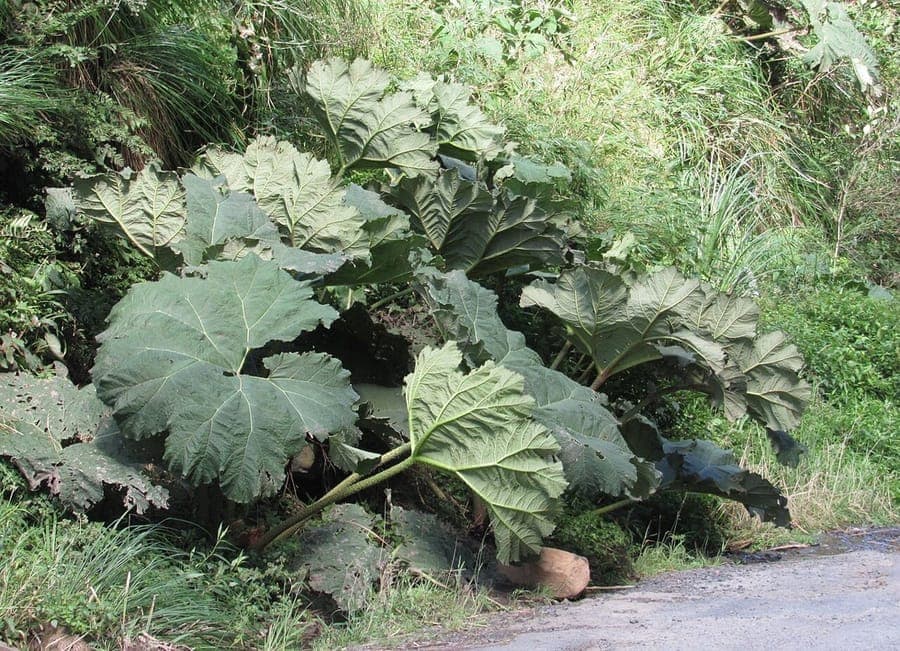
no rights reserved / CC0, via Wikimedia Commons
Giant Rhubarb (Gunnera manicata): complete guide
Gunnera manicata
Want to see Giant Rhubarb (Gunnera manicata): complete guide in your garden?
Full design in HD: €7.99
Look after your Giant Rhubarb with the GardenWorld app
Identify plants with your camera and get a care calendar with reminders for this plant.


Overview
Gunnera manicata, known in Britain as giant rhubarb or Brazilian giant rhubarb, has the largest leaves of any plant you can grow in a north-western European garden. A single leaf can reach 1.5 to 2 m across, held on a prickly stalk that is sometimes taller than a grown adult. Anyone who has stood beneath one of these leafy umbrellas at a great English garden such as Trebah in Cornwall will remember it.
The species is native to the damp highlands of south-eastern Brazil, where it grows along streams, on wet slopes and on roadside banks. The photo was taken there, at Urubici in the state of Santa Catarina: it shows the characteristic, almost round, deeply veined leaves on thick stalks beside a mountain road. Despite its common name, it is not related to culinary rhubarb; it belongs to its own family, the Gunneraceae.
A remarkable detail: at the base of its leaf stalks the plant lives in partnership with cyanobacteria (Nostoc), which fix nitrogen from the air. That partly explains how it manages to build such an enormous mass of foliage every year.
Gunnera manicata is not a plant for every garden. It needs space, water and some winter protection. There is also an important point about invasiveness and confusion with its relative Gunnera tinctoria, which we cover in detail below. At gardenworld.app you can have a garden design made that takes the sheer scale of this plant into account, so it becomes a focal point rather than a problem.
Appearance and bloom cycle
In April the first crumpled leaves push up from the fat, hairy buds. Within weeks they expand into round, palmately lobed leaves with toothed margins and a rough, deeply veined surface. The leaf stalks grow 1.5 to 2 m long and, like the veins on the underside, are covered in red prickles. A mature plant reaches 2 to 2.5 m tall and 3 to 4 m across.
In May and June cone-shaped flower spikes, 50 cm to 1 m tall, appear at the base of the plant. They are greenish to reddish and made up of long, thin side branches packed with tiny petal-less flowers. They are curious rather than beautiful. Small berry-like fruits follow.
With the first frost in October or November the leaves collapse. The plant spends winter as a cluster of large, brown-haired buds sitting on the soil surface.
Ideal location
Gunnera manicata wants sun to part shade and shelter from wind. Full sun only works if the ground stays sodden; in most gardens a spot with morning sun and light afternoon shade is best. Wind tears the huge leaves and dries them out, so a sheltered corner by a pond, among tall shrubs or in a damp hollow is ideal.
Allow at least 3 by 3 metres. Do not plant it right next to a path: the prickles on the stalks scratch and can irritate the skin. In a small town garden it is usually too large; there, the smaller Darmera peltata is a better choice.
Soil requirements
The soil must be deep, fertile and permanently moist. Clay or loam rich in organic matter is ideal. Dig a generous planting hole about 1 m wide and work in a couple of barrowloads of compost or well-rotted manure. The crown should sit just above soil level and should not stand under water for long periods, even though the plant loves wet feet.
The pH is not critical; slightly acidic to neutral is fine. A pond margin or the wet zone beside a stream is the classic position, provided the water is not connected to natural watercourses (see below).
Watering
Watering is the main job with this plant. The vast leaves can lose tens of litres a day in summer. Unless the plant is in a bog zone, water heavily every day or every other day in dry weather: 20 to 30 litres is not excessive. Limp leaves on a warm afternoon are a sign of thirst.
A thick mulch of compost or manure in spring holds in moisture and feeds at the same time. A soaker hose laid around the plant saves a great deal of effort.
Free preview
Want to see Giant Rhubarb (Gunnera manicata): complete guide in your garden? Make a free preview of your design.
Pruning
Pruning in the usual sense is not needed. After the first frost, cut off the dead leaves and fold them upside down over the crown as winter cover (see Winter hardiness). Remove that cover in spring.
Cut off the flower spikes as soon as they appear. This gives the plant more energy for foliage and, above all, stops seed from forming and spreading. Wear gloves and long sleeves: the prickles and rough hairs irritate the skin. As far as is known, the plant is not toxic to people or pets.
Maintenance calendar
March–April: Gradually remove the winter cover once hard frosts are over. Mulch around the plant with compost or manure.
April–May: New leaves emerge. Keep fleece handy for late frosts. Start watering in dry spells.
May–June: Cut off the flower spikes before they set seed.
July–August: Foliage at its peak. Water generously, especially in hot weather.
September–October: Keep watering in dry weather. Get straw or dry leaves ready for winter cover.
November–February: After the first frost, cut the leaves and lay them over the crown, topped up with straw if needed. If you do not want to forget these moments, add them to the planting calendar on gardenworld.app.
Winter hardiness
The foliage of Gunnera manicata is not frost hardy and dies at the first frost. The rootstock and large winter buds survive well in most of the UK and the Low Countries, as long as you cover them. Lay the cut leaves upside down over the crown and top up with straw or dry leaves. Protected like this, the plant tolerates frost down to about -10 °C, a little more in a sheltered garden. Left uncovered, the buds can be killed in a hard winter. In the mild south-west of England and in Ireland it often needs little protection at all.
Invasive? The difference from Gunnera tinctoria
Its relative Gunnera tinctoria, Chilean rhubarb, has been on the European Union's list of invasive alien species of Union concern since 2017. Across the EU it may no longer be sold, grown, planted or released, and its sale is also banned in Great Britain. On the western coasts of Ireland and Britain and on the Azores it runs riot along streams and coastal slopes, crowding out native plants.
Gunnera manicata is not on the EU list. It is not entirely unregulated, though: in Ireland it is listed, like G. tinctoria, on the Third Schedule of the habitats regulations, which makes it an offence to plant it or cause it to spread in the wild there. An Irish risk assessment rated it a medium risk.
There is a further complication. Research published in 2022 showed that nearly all plants grown as G. manicata outside Brazil are in fact hybrids with G. tinctoria, described as Gunnera × cryptica. The clearest difference lies in the flower spike: in G. tinctoria it is narrow, compact and brick red, with short, thick side branches of 5 to 7 cm; in true G. manicata it is broadly conical with long, slender side branches of around 10 cm. Hybrids fall in between.
In practice: buy only from a reputable nursery that knows its stock, cut off every flower spike before it sets seed, and never plant beside a stream, ditch or bank connected to the wider countryside.
Companion plants
Next to such a giant you need plants that bridge the difference in scale. Ornamental rhubarb (Rheum palmatum) and umbrella plant (Darmera peltata) enjoy the same wet soil and act as a middle size. Royal fern (Osmunda regalis) adds fine texture. At the water's edge, white skunk cabbage (Lysichiton camtschatcensis) and the giant cowslip Primula florindae, with its yellow bells, brighten the bank. Avoid the yellow Lysichiton americanus, which is also on the EU list.
Final thoughts
Gunnera manicata is a plant of superlatives: the biggest leaves, the greatest thirst and an unforgettable effect. Give it space, wet feet and a warm winter blanket, cut off the flower spikes in good time and buy with care. You will have a garden giant that stops visitors in their tracks year after year.
Frequently asked questions about Giant Rhubarb
Is Giant Rhubarb winter hardy?
The foliage of Gunnera manicata is not frost hardy and dies at the first frost. The rootstock and large winter buds survive well in most of the UK and the Low Countries, as long as you cover them.
When and how do you prune Giant Rhubarb?
Pruning in the usual sense is not needed. After the first frost, cut off the dead leaves and fold them upside down over the crown as winter cover (see Winter hardiness).
How much water does Giant Rhubarb need?
Watering is the main job with this plant. The vast leaves can lose tens of litres a day in summer.
Where does Giant Rhubarb grow best?
Gunnera manicata wants sun to part shade and shelter from wind. Full sun only works if the ground stays sodden; in most gardens a spot with morning sun and light afternoon shade is best.
What soil does Giant Rhubarb need?
The soil must be deep, fertile and permanently moist. Clay or loam rich in organic matter is ideal.

See it in your garden
See Giant Rhubarb in your garden
One photo of your garden and a few questions. You see the result in about a minute.
Try it with a photoIdentify this plant in your own garden. Identify a plant
Similar plants
Rheum palmatum: complete guide
Rheum palmatum
Chinese rhubarb is a dramatic ornamental with enormous hand-shaped leaves and bold red flower spikes. Perfect for large borders needing architectural structure and drama.
Darmera peltata: complete guide
Darmera peltata
Discover the giant umbrella plant with spectacular shield-shaped leaves. Perfect for moist gardens and shaded spots. Read our full care and cultivation guide.
Royal fern: complete guide
Osmunda regalis
Learn how to grow and care for Royal fern (Osmunda regalis) in your garden. Ideal light, soil, watering, and companion plants included.
