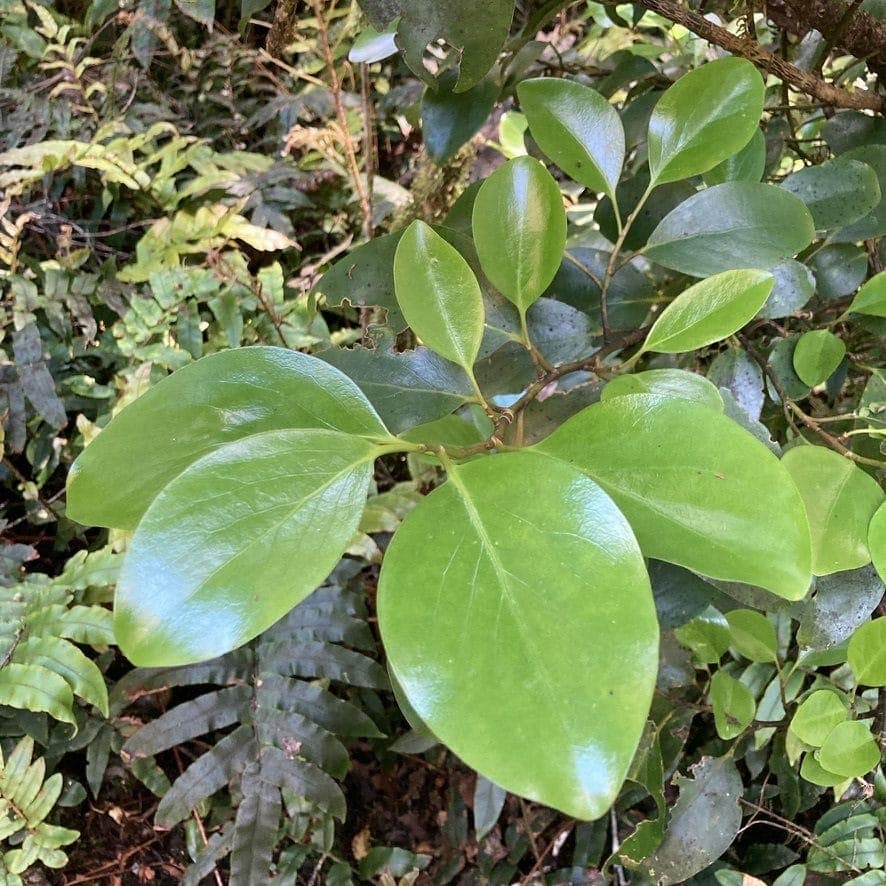
Mike Dickison / CC BY 4.0, via Wikimedia Commons
New Zealand broadleaf: complete guide
Griselinia littoralis
Want to see New Zealand broadleaf: complete guide in your garden?
Full design in HD: €7.99
Look after your New Zealand broadleaf with the GardenWorld app
Identify plants with your camera and get a care calendar with reminders for this plant.


Overview
Walk along almost any stretch of coast in Ireland, Cornwall or Brittany and you will see it: dense, apple-green hedges with glossy, leathery leaves that shrug off sea wind and salt spray. That is Griselinia littoralis, an evergreen shrub from New Zealand that has become one of the most popular hedging plants for seaside gardens in western Europe and the UK.
In its homeland the species is called kāpuka or New Zealand broadleaf. There it grows in coastal and montane forest into a tree of 10 metres or more. In gardens here it usually stays a sturdy shrub or hedge of 1.5 to 3 metres, although an unpruned plant in a mild climate can reach 5 to 6 metres. The species name littoralis means "of the shore", which says a lot about where it feels at home.
Griselinia littoralis grows fairly fast, especially in its first years, putting on 30 to 50 cm a year. Within a few seasons you have a dense green screen that gives privacy and shelter all year round. Its fresh green looks lighter and friendlier than cherry laurel or conifers, and it takes clipping well. On gardenworld.app you can have a garden design made in which a griselinia windbreak shelters your terrace or vegetable patch, giving more tender plants behind it a chance.
Appearance and bloom cycle
The foliage is what this plant is all about. The leaves are oval to almost round, 4 to 10 cm long, thick and leathery, with smooth edges. The upper surface is glossy apple green to yellow-green, the underside slightly paler. The leaf base is often a little lopsided, a small detail that helps you recognise the species. The young stems are green to yellowish. The photo at the top shows a branch with those typical large, shiny leaves, growing wild among ferns in a New Zealand forest.
Flowering takes place in April and May but is easy to miss: tiny yellow-green flowers in short panicles among the leaves. The plant is dioecious, meaning there are separate male and female plants. Only female plants produce small purple-black berries in autumn, and only when a male plant is nearby. In most hedges you will notice little of the flowers or fruit; griselinia is grown for its leaves.
There are a few variegated cultivars. 'Variegata' has leaves edged in creamy white, while 'Dixon's Cream' has a creamy yellow centre. They grow more slowly and are a little more sensitive to frost than the plain green form.
Ideal location
Griselinia littoralis grows in full sun and partial shade. In sunny spots it becomes denser and the leaves slightly more yellow; in partial shade they stay a deeper green. Deep shade under trees is less suitable, as the hedge becomes thin there.
Its greatest asset is its tolerance of wind and salt. It copes with salty sea winds on the front line, where many other hedging plants scorch. That makes it ideal as a windbreak in coastal gardens. It also does well in towns and cities, where temperatures stay a little higher and buildings give shelter. In colder inland gardens, choose a sheltered position out of cold easterly winter winds.
For a hedge, plant two to three plants per metre, so 35 to 50 cm apart. As a standalone shrub, allow it 1.5 to 2 metres of space.
Soil requirements
The plant is not demanding: sandy soils, loam and light clay are all suitable, whether slightly acidic or chalky. Good drainage does matter, though. In soil that stays wet through winter the roots struggle and Phytophthora root rot can set in. Improve heavy clay with coarse grit and organic matter, or plant on a slight ridge.
Mix compost into the planting soil. After that, a thin layer of compost or an organic hedge feed in spring is enough. Too much fertiliser produces soft, frost-prone growth.
Free preview
Want to see New Zealand broadleaf: complete guide in your garden? Make a free preview of your design.
Watering
Young plants need regular watering in their first year, especially in dry spells in spring, when the roots are establishing. Give a thorough soak once or twice a week. A mulch of compost or bark chips helps to hold moisture.
Once established, griselinia is fairly drought tolerant. Only in long summer droughts is extra water wise, particularly for hedges on sandy soil. Overwatering is more dangerous than underwatering.
Pruning
As a hedge, trim griselinia once or twice a year. Do the first trim in late May or June and the second in late August. Avoid cutting later than early September so the new shoots can harden before winter. Trim a young hedge a little every year for the first few years so it thickens up from the base.
Because the leaves are large, a hedge can look a bit ragged after a pass with a powered hedge trimmer: cut leaves brown at the edges. For a neat result on a short hedge or a single shrub, you can prune with secateurs, but for long hedges a trimmer is simply practical. The damaged leaves are soon hidden by new growth.
Griselinia tolerates hard pruning in spring and regrows well from older wood. A hedge that has grown too tall can therefore be cut back substantially in April.
Maintenance calendar
March-April: Remove frost damage. Apply compost or organic hedge feed. A good time to plant. Carry out renovation pruning if needed.
May-June: First shaping trim of the hedge. Water young plants in dry weather.
July: Little to do. Water during prolonged drought.
August-early September: Second, light trim.
October: Container-grown plants can still be planted. Mulch around young hedges.
November-February: Rest period. Protect young plants in inland gardens with fleece during hard frost.
Winter hardiness
The RHS rates Griselinia littoralis H4: hardy to roughly -5 °C to -10 °C. Mature plants in a sheltered spot sometimes survive a little more, but young plants and variegated forms are more vulnerable. In coastal areas and large towns in the UK and the Low Countries it usually overwinters without trouble. In colder areas, hedges can be damaged in severe winters, mainly by cold, dry easterly winds. The plant often regrows afterwards, but inland it is best to plant a griselinia hedge only in a sheltered position.
There are no reports of Griselinia littoralis being toxic to people or pets, but the berries are not food and are best left uneaten.
In the British Isles the species has escaped from gardens here and there, for example in south-west Ireland, Cornwall and on the Isle of Man, where seedlings turn up. It is not on the EU list of invasive species, but avoid planting it in or right next to natural coastal habitats and pull up any seedlings that appear outside the garden.
Companion plants
Griselinia littoralis makes an excellent green backdrop for other coastal plants. Escallonia (Escallonia rubra) flowers pink to red in summer and also tolerates sea wind; together they make a mixed hedge with more colour. Pittosporum tenuifolium and Olearia macrodonta are other New Zealand shrubs that thrive in the same conditions.
For the border in front of the hedge, try New Zealand flax (Phormium tenax) with its sword-shaped leaves, African lily (Agapanthus africanus) and thrift (Armeria maritima). The fresh green griselinia leaves make blue and purple flowers stand out even more.
Want to know when to trim your hedge and when to plant? On gardenworld.app you will find a plant calendar that shows, month by month, which jobs your garden needs.
Final thoughts
Griselinia littoralis is the hedging plant of choice for seaside gardens: fast-growing, evergreen, unbothered by salty wind and dressed in fresh, glossy leaves. Give it free-draining soil, trim it once or twice a year and choose a sheltered spot inland, because hard frost remains its weak point. In return you get a dense, lively green screen that shelters your garden all year round.
Pruning
Frequently asked questions about New Zealand broadleaf
Is New Zealand broadleaf winter hardy?
The RHS rates Griselinia littoralis H4: hardy to roughly -5 °C to -10 °C. Mature plants in a sheltered spot sometimes survive a little more, but young plants and variegated forms are more vulnerable.
When and how do you prune New Zealand broadleaf?
As a hedge, trim griselinia once or twice a year. Do the first trim in late May or June and the second in late August.
How much water does New Zealand broadleaf need?
Young plants need regular watering in their first year, especially in dry spells in spring, when the roots are establishing. Give a thorough soak once or twice a week.
Where does New Zealand broadleaf grow best?
Griselinia littoralis grows in full sun and partial shade. In sunny spots it becomes denser and the leaves slightly more yellow; in partial shade they stay a deeper green.
What soil does New Zealand broadleaf need?
The plant is not demanding: sandy soils, loam and light clay are all suitable, whether slightly acidic or chalky. Good drainage does matter, though.

See it in your garden
See New Zealand broadleaf in your garden
One photo of your garden and a few questions. You see the result in about a minute.
Try it with a photoIdentify this plant in your own garden. Identify a plant
Similar plants
Escallonia rubra: complete guide
Escallonia rubra
Redclaws is a beautiful South American shrub with stunning red flowers. Learn how to cultivate this ornamental plant in your front garden.
Pittosporum tenuifolium: complete guide to Tawhiwhi
Pittosporum tenuifolium
Tawhiwhi is an elegant New Zealand tree with thin leaves and fine texture. Learn growth, shaping and maintenance requirements.
Olearia macrodonta: complete guide
Olearia macrodonta
New Zealand holly: hardy shrub with large toothed leaves. Care, growth and cultivation tips.
