
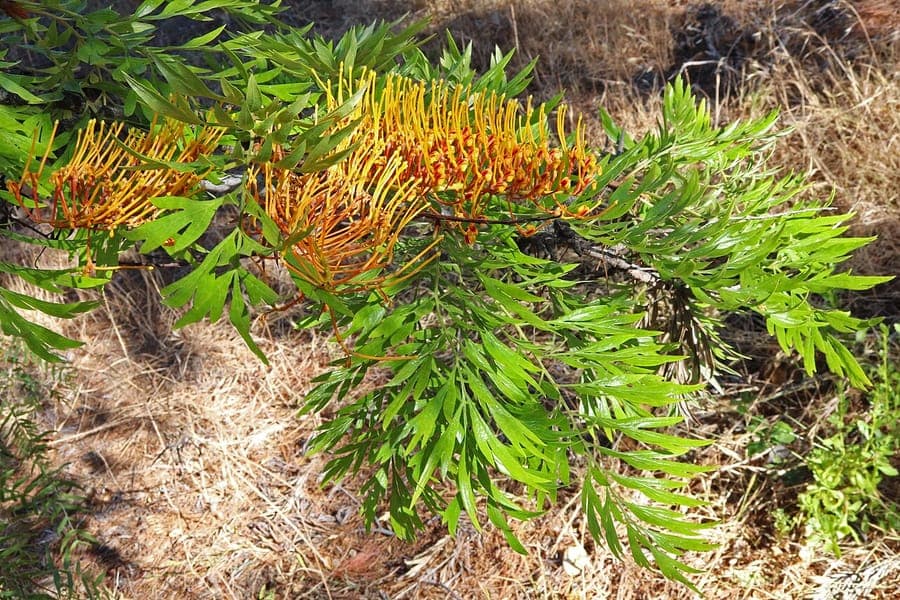
Joseph C Boone / CC BY-SA 4.0, via Wikimedia Commons
Grevillea robusta: complete guide
Grevillea robusta
Want to see Grevillea robusta: complete guide in your garden?
1 minute, no credit card
Overview
Grevillea robusta, commonly known as Australian silky oak or silk oak, is a beautiful, fast-growing tree originating from the subtropical coastal regions of Queensland and New South Wales in Australia. This tree belongs to the Proteaceae family and is recognized for its elegant, feather-like foliage, spectacular orange-gold flower displays, and rapid growth rate.
This is an ideal tree for large gardens, landscape projects, and Mediterranean/subtropical climate zones. The tree grows quickly (up to 50-60 cm per season), delivers decorative bloom and valuable habitat for birds and pollinators. The fine foliage screen creates an elegant silhouette that complements both modern and classical landscape designs.
Appearance and Bloom
Grevillea robusta grows as a slender, upright tree with a single trunk and lower branching. Mature specimens can reach 15-25 meters tall (in cultivation often smaller, approximately 8-15m). The tree has a pyramidal to columnar form, especially when young, and opens into a broader crown with age.
The characteristic foliage is very fine and compound (pinnatifid), approximately 15-20 cm long, giving a light, elegant appearance. Leaves are dark green and sometimes display a silvery gray underside that creates shimmering effects.
Flowering is spectacular: dense racemes of orange to golden-yellow flowers appear in late spring through summer (May-July in temperate climates). These flowers are very nectar-rich and strongly attract native birds (in Australia), hummingbirds, and other insects. The bloom period lasts several weeks and can be very abundant on mature trees.
Ideal Location
Grevillea robusta must have full sun for optimal growth and flowering. A minimum of 6-8 hours of direct sunlight daily is essential. In warm subtropical regions, light afternoon part shade can be beneficial in preventing stress.
This tree is hardy to wind exposure but does not tolerate heavy pollution or excessive salt spray (not suitable for coastal beach gardens). In large gardens, this makes an excellent specimen tree where it can develop fully.
Soil
Grevillea robusta is not particularly fussy about soil but thrives in well-draining, dry to moderately moist soil. The tree can tolerate sand, loam, and even slightly acidic soils. pH 6.0-7.5 is ideal.
Heavy wet soils are problematic: ensure excellent drainage at planting, especially in regions with heavy rains. Add sand and humus to heavy clay soils. This is a tree that, once established, can tolerate considerable drought.
Free design
Want to see Grevillea robusta: complete guide in your garden? Make a free design now.
Watering
In the first growing season after planting, water regularly and deeply to encourage root development. For established trees, water can be significantly reduced; this tree is drought-tolerant once roots are well-established.
In subtropical and Mediterranean climates, watering is only needed during prolonged dry periods. In cool-temperate climates with abundant rain, minimal supplemental watering needed. Avoid persistently wet soil, especially in young years.
Pruning
Grevillea robusta needs minimal pruning thanks to its naturally elegant form. Perform light formative pruning in early years to establish a strong central leader. This encourages a well-formed tree with strong stem structure.
Once mature, pruning is mainly limited to removal of dead wood and shape maintenance. Avoid heavy cutting: this tree can have difficulties recovering from drastic pruning. Prune after flowering (July-August) if needed.
Maintenance Calendar
Spring (March-April): Water regularly. Start feeding with slow-release fertilizer. Monitor for new growth.\nSummer (May-July): Enjoy flowering. Minimal pruning. Continue watering program if dry conditions.\nFall (August-October): Reduce watering as temperatures cool. Monitor growth.\nWinter (November-February): Minimal maintenance. In warm regions, very little watering needed.
Winter Hardiness
Grevillea robusta is not frost-hardy and cannot tolerate soft frost (below approximately -2 to -5 degrees Celsius). The tree is suitable for climate zones 9-11 (temperate subtropical).
In temperate climates with cold winters, this is better grown as a container plant that can be sheltered, or in very protected locations. Young trees are much more sensitive than established specimens.
Companion Plants
Complement your Australian silky oak with underplanting and surrounding plantings:
- Leptospermum: Australian tea tree for native theme
- Westringia: Australian rosemary with complementary bloom timing
- Acacia: Native Australian acacias for layered effect
- Ornamental grasses: Miscanthus or Stipa for contrast and movement
- Maidenhair ferns: Airy undercanopy planting
Closing Thoughts
Grevillea robusta is a spectacular choice for large gardens in warm climates and subtropical regions. With its rapid growth, elegant foliage, and spectacular flowering, the tree offers immediate impact and lasting beauty. Perfect as a specimen tree where the natural form can be admired, or in landscape schemes where height and structure are needed.
Searching for this tree? Check with specialized tree nurseries in warm regions; local Mediterranean suppliers have possible availability.
Want to see Grevillea robusta: complete guide in your garden? Make a free design now.
Upload a photo, pick a style, and get a photorealistic design with plant list in under a minute.
No credit card required


Similar plants
Gevuina avellana: complete guide
Gevuina avellana
Chilean hazel, Chilean wildnut, Gevuina avellana - South American tree with edible nuts. Exotic, interesting silhouette. Warm zones only. Requires winter protection.
Macadamia tetraphylla: complete guide
Macadamia tetraphylla
Discover how to grow Macadamia tetraphylla or rough-shelled macadamia. Tips for location, soil, water and maintenance.
Protea cynaroides: complete guide
Protea cynaroides
King protea (Protea cynaroides) is a spectacular South African flower with huge pink-red flowerheads. Perfect for cut flowers and exotic gardens.