Chhe (talk) / Public domain, via Wikimedia Commons
Zebra plant (Goeppertia zebrina): care guide
Goeppertia zebrina
Want to see Zebra plant (Goeppertia zebrina): care guide in your garden?
Full design in HD: €7.99
Look after your Zebra plant with the GardenWorld app
Identify plants with your camera and get a care calendar with reminders for this plant.


Overview
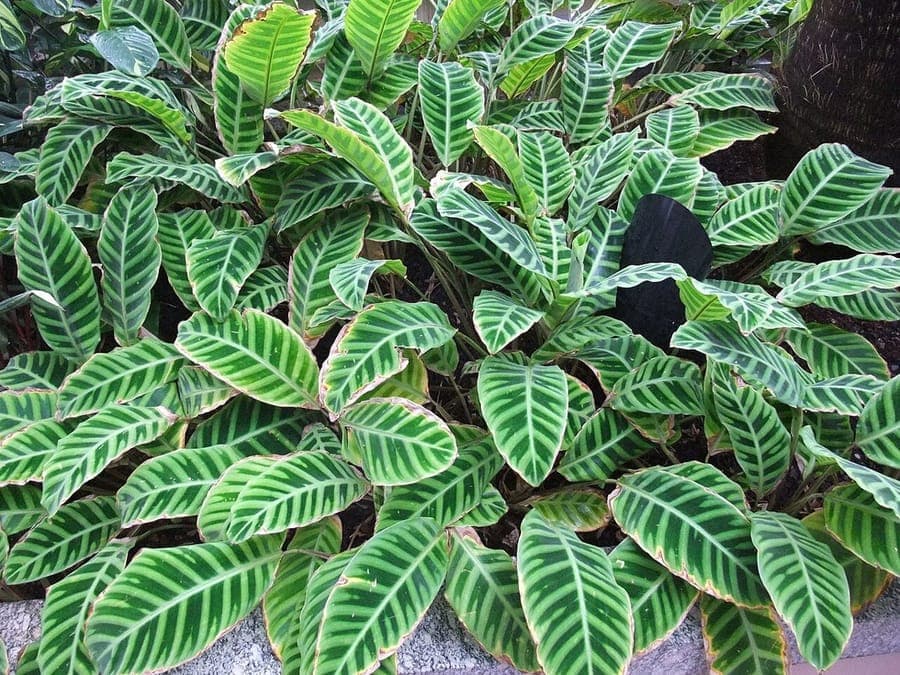
Goeppertia zebrina is the classic calathea. It has been grown in European glasshouses since the nineteenth century, long before most of its relatives found their way into living rooms. What catches the eye are its large, velvety leaves in bright green, barred with dark green stripes along the side veins like a zebra. It is widely known as the zebra plant and is still nearly always sold as Calathea zebrina, because only in 2012 did DNA research move most of the genus Calathea into Goeppertia.
One word of caution about that common name: zebra plant is also used for Aphelandra squarrosa, an entirely different houseplant with yellow flower spikes. Always check the botanical name on the label.
The species belongs to the arrowroot family (Marantaceae) and comes from the Atlantic Forest of south-eastern Brazil. There it grows in the shady understorey, in loose, humus-rich soil and warm, humid air. Of all the calatheas commonly sold, it grows the largest, and a mature plant soon claims a corner of the room. If you want to give a showpiece like this a home in a conservatory that flows out into the garden, you can have a garden design made at gardenworld.app that brings indoors and outdoors together.
Appearance and growth
The leaves are elongated ovals, 25 to 40 cm long indoors and up to 15 cm wide, held on long, sturdy stalks. The upper surface feels soft thanks to a fine layer of hairs, giving the leaf a matt, velvet sheen. The pattern is crisp: a light green ground with broad dark green bands running diagonally from the midrib to the edge. The underside is grey-green, turning purplish-red on older leaves.
Indoors the plant reaches 60 to 90 cm tall and at least as wide, and in a heated glasshouse it can grow larger still. The photo shows a dense group in a botanic garden: dozens of striped leaves side by side, with the odd brown edge here and there, the classic sign that the air has been a little too dry.
Well-grown plants occasionally flower, mostly under glass: compact, roundish heads close to the ground, with purple and white flowers tucked between overlapping bracts. They are more curious than ornamental. Like every calathea, it moves its leaves through the day and raises them slightly in the evening.
Position in the home
Plan for space. A mature zebrina needs nearly a metre across and should not brush against furniture or walls, because damaged leaf edges turn brown. A spare corner of the living room or a spot in a heated conservatory is ideal. A low plant table shows off the pattern nicely.
Keep it away from outside doors, radiators and the airflow from air conditioning. Large leaves lose a lot of water, and draughts or warm, dry air show up straight away as curling leaves.
Light
Bright, indirect light is the rule. One to two metres from an east or west window, perhaps behind a sheer curtain, works well. A north window can suit it too, provided the plant stands close to the glass. Direct midday sun scorches the soft leaves within hours and leaves pale, dry patches.
Too little light produces long, floppy leaf stalks and a less crisp stripe. If the leaves turn very pale and the markings fade, the plant is usually getting too much light instead.
Humidity
With so much leaf surface, humidity matters even more for zebrina than for smaller species. Aim for 60% or higher. In a heated home in winter, you will rarely manage that without a humidifier. A tray of water and pebbles helps a little, but under a large plant the effect is limited.
Do not mist the leaves. Droplets sit on the hairy surface for a long time and easily leave marks. For the same reason never use leaf shine: it clogs the hairs and leaves a greasy film. Remove dust with a soft, dry brush or a barely damp cloth, without rubbing.
Free preview
Want to see Zebra plant (Goeppertia zebrina): care guide in your garden? Make a free preview of your design.
Compost and repotting
Choose a humus-rich, airy and slightly acidic mix, for example three parts houseplant compost to one part perlite and one part bark or coir. Because the plant grows large and uses plenty of water, the pot can be generous, as long as it has a good drainage hole.
Repot young plants every spring and older ones every other year. Zebrina forms a dense rhizome that divides easily. Cut the clump into two or three pieces with a sharp knife, each with a few leaves and a good root system. That keeps a big plant manageable and gives you one to pass on.
Watering
Keep the compost evenly moist. During the growing season let only the top two centimetres dry before watering again; in winter it can stay a little drier. A large plant in a warm room will often need water twice a week in summer.
Like other calatheas, zebrina reacts to lime and salts in tap water with brown leaf tips. Rainwater or filtered water at room temperature is the best choice. Avoid wet feet by emptying the saucer after fifteen minutes. Leaves curling during the day point to thirst or dry air; yellowing lower leaves with wet compost point to overwatering.
Care and pruning
A big plant needs a little more food than a small calathea, but here too less is better than more. From April to September, give a half-strength liquid houseplant feed every three to four weeks.
Cut old, yellowing or damaged leaves away at the base, close to the rhizome. That keeps the plant fresh and lets light into the centre. Brown edges can be trimmed, but leave a thin brown margin so you do not cut into healthy tissue. Check regularly for spider mite and mealybug, especially on the leaf undersides and in the leaf axils.
Care calendar
March to April: repot or divide. Start feeding again.
May to August: full growth. Water generously, feed every three to four weeks, watch for spider mite and strong sun.
September to October: gradually reduce water and feed. Get the humidifier ready.
November to February: slower growth. No feed, a little less water, extra care with humidity.
Use the plant calendar at gardenworld.app if you would like a reminder for repotting, dividing and feeding, so the bigger jobs happen on time.
Temperature
Goeppertia zebrina is a tropical plant and not hardy. It grows best between 18 and 25°C. Below 15°C growth stalls and the leaves develop dark, glassy patches, so cold nights by a window or a tilted window in winter are out of the question. It will not survive frost.
We would not put it outside in summer in north-western Europe: nights are too cool, wind damages the large leaves and the sun quickly gets too strong.
Toxicity to pets
The ASPCA, the American animal welfare charity that runs its own poison control centre, lists the genus Calathea as non-toxic to dogs, cats and horses. We found no separate entry for zebrina, but it is covered by that genus listing. That makes it a safe choice alongside a cat or dog. Eating a lot of leaf can still cause a mild stomach upset, and the large leaves quickly look shabby after being chewed.
Companion plants
Zebrina is big enough to be the centrepiece. Smaller plants that share its love of warm, humid air sit well around it. Bird's nest fern (Asplenium nidus) and maidenhair fern (Adiantum raddianum) add glossy and fine foliage. An Aglaonema commutatum with silver-marked leaves echoes the light-and-dark pattern, and a peace lily (Spathiphyllum wallisii) brings white flowers to the shade. Grouped together, they also keep the air around each other a little more humid.
Final thoughts
Goeppertia zebrina is the calathea for anyone with room to spare and a taste for a bold plant. It asks for more space and humidity than its smaller relatives, but in return you get a lush clump of soft, striped leaves that looks good all year. Give it a warm, bright spot out of the sun, soft water and humid air, then let it grow in peace.

See it in your garden
See Zebra plant in your garden
One photo of your garden and a few questions. You see the result in about a minute.
Try it with a photoIdentify this plant in your own garden. Identify a plant
Similar plants
Asplenium nidus: complete guide
Asplenium nidus
Learn all about the Bird's Nest Fern (Asplenium nidus), a stunning tropical houseplant with glossy green fronds. Expert care tips, light requirements and optimal growing conditions.
Delta Maidenhair Fern: complete guide
Adiantum raddianum
Discover Adiantum raddianum, an elegant fern with delicate silky fronds. Care guide for indoor and shaded garden spots.
Chinese Evergreen: complete guide
Aglaonema commutatum
Chinese Evergreen is a popular houseplant with silver-spotted leaves. This tropical plant grows to 60 centimeters and is perfect for semi-shaded interiors. Very easy to maintain.
