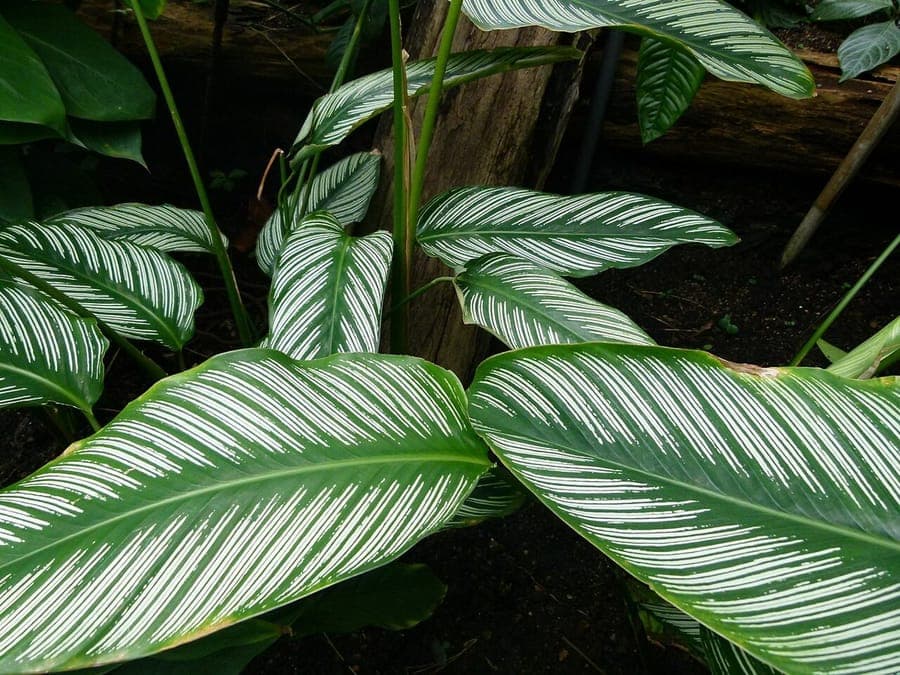
Dinkum / CC0, via Wikimedia Commons
Pinstripe calathea (Goeppertia ornata): complete guide
Goeppertia ornata
Want to see Pinstripe calathea (Goeppertia ornata): complete guide in your garden?
Full design in HD: €7.99
Look after your Pinstripe calathea with the GardenWorld app
Identify plants with your camera and get a care calendar with reminders for this plant.


Overview
Few houseplants look as immaculate as the pinstripe calathea. On every dark green leaf, someone seems to have drawn thin pink or white lines with a fine brush, always neatly paired between the veins. Botanically it is now called Goeppertia ornata. Since 2012 most calatheas have been moved to the genus Goeppertia, but shops and labels almost always still say Calathea ornata. It is the same plant.
Goeppertia ornata belongs to the prayer plant family (Marantaceae) and grows wild in the tropical forests of Colombia and Venezuela. There it lives in the understorey: warm, humid, in filtered light and on a floor of leaf litter that never fully dries out. Recreate those conditions at home, even roughly, and you will have a stunning plant. Ignore them, and you will get brown leaf edges and curling leaves.
So the pinstripe calathea is not a plant for the forgetful, but nor is it an impossible diva. It comes down to three things: soft light, evenly moist compost watered with soft water, and humid air. If you are planning a green corner or a conservatory that connects with your garden, you can have a garden design made on gardenworld.app so that indoors and outdoors work as one.
Appearance and growth
The leaves are oval to lance-shaped and usually reach 15 to 25 cm long indoors. They sit on long, slender stalks rising straight from the rhizome, so the plant forms a loose, upright clump about 40 to 60 cm tall. In a glasshouse or in the wild it can grow much larger.
The upper surface of the leaf is deep green with the characteristic fine stripes. On young leaves the stripes are pink; on older leaves they fade to creamy white. The underside is a striking purplish red. New leaves emerge rolled up from the heart of the plant and unfurl over a few days.
Like all members of the prayer plant family, the pinstripe calathea moves its leaves. In the evening they lift and half fold, and in the morning they drop open again, thanks to a small joint at the base of each leaf. Sometimes you can even hear the leaves rustle softly. Flowering is rare indoors and inconspicuous: small white to lilac flowers on a short spike close to the compost.
Ideal location
Place the plant in bright light but out of direct sun. A couple of metres from a north- or east-facing window is ideal, or behind a net curtain at a west-facing window. Direct sun fades the stripes and causes brown, scorched patches. Too little light slows growth and blurs the markings.
The pinstripe calathea likes a steady temperature between 18 and 24 °C. Never put it in a draught, next to a door that is often opened or above a radiator. Cold draughts and dry, hot air are its worst enemies. A bathroom with a window, a kitchen or a spot among other plants often works surprisingly well, because the air there is more humid.
Compost and repotting
Use an airy, humus-rich compost that holds moisture without staying soggy. A good mix is two parts houseplant compost, one part coir or peat-free leaf mould and one part perlite. A pot with a drainage hole is essential.
Repot every one to two years in spring, into a pot no more than 2 to 4 cm wider. An oversized pot stays wet for too long. When repotting, you can divide a large plant: gently pull or cut the root ball into sections, each with a few leaves and roots. This is the easiest way to propagate it.
Free preview
Want to see Pinstripe calathea (Goeppertia ornata): complete guide in your garden? Make a free preview of your design.
Watering and humidity
Keep the compost evenly and lightly moist. Water as soon as the top 2 cm feels dry. In summer that is often twice a week, in winter once a week or less. Never let the root ball dry out completely, but do not leave the plant standing in a saucer of water either.
Water quality matters. Calatheas are sensitive to lime, chlorine, fluoride and salts in tap water, which show up as dry, brown leaf tips and edges. Use rainwater, filtered water or tap water left to stand overnight where possible, and always at room temperature.
Humidity of at least 60% is ideal. You can achieve this with a humidifier, by standing the plant on a tray of wet clay pebbles or by grouping it with other plants. Misting helps only briefly and in cool rooms can leave marks on the leaves.
From April to September, feed every three to four weeks with a liquid fertiliser for foliage plants at half strength. Too much feed burns the roots and also causes brown edges.
Care and pruning
Pruning in the usual sense is not needed. Cut leaves that are fully yellow or brown off at the base of the stalk. Leaves with just a brown edge can be trimmed with clean scissors, following the shape of the leaf so it still looks tidy.
Curling leaves usually point to thirst or air that is too dry. Yellowing lower leaves often mean too much water. Check the undersides of the leaves regularly for spider mites and thrips, which thrive in warm, dry indoor air. A lukewarm shower now and then keeps the foliage clean and discourages pests.
Maintenance calendar
March–April: Repot or divide if needed. Start feeding again at half strength.
May–June: Strong growth. Keep the compost evenly moist and humidity high.
July–August: Protect from strong sun and heat. Check more often for spider mites.
September–October: Reduce feeding. Move the plant slightly closer to the window as light levels fall, but never into direct sun.
November–February: Water less and stop feeding. Keep it away from radiators and cold draughts, and boost humidity once the heating is on.
Temperature and hardiness
Goeppertia ornata is not hardy at all. It prefers 18 to 24 °C and should never spend long periods below 15 °C. Leaves can already be damaged at 10 to 12 °C. In the UK and northern Europe it can only go outside during the warmest summer weeks, in a sheltered, shady spot, and really it is better off indoors. In winter, watch out for cold windowsills and draughts when airing the room.
Toxicity to pets
Good news for cat and dog owners: the pinstripe calathea is considered non-toxic to pets and people. It contains none of the calcium oxalate crystals found in many aroids. A cat nibbling the leaves is therefore at no serious risk, though eating a lot of plant material may cause a mild upset stomach.
The bigger risk is to the plant itself, as chewed leaves do not recover. If your animals like to graze on greenery, put it somewhere a little higher. Also remember that fertilisers and pest treatments in the pot can be harmful to animals.
Companion plants
A pinstripe calathea looks best in a group of plants that enjoy the same humid air and soft light. A bird's nest fern (Asplenium nidus) has broad, glossy leaves that contrast beautifully with the fine stripes. Blue star fern (Phlebodium aureum) adds a soft grey-blue tone. A spider plant (Chlorophytum comosum) and a Chinese money plant (Pilea peperomioides) bring different shapes to the group. A fishbone fern (Nephrolepis cordifolia) also fits in well. All of these are likewise non-toxic to pets, so you can create a completely pet-friendly green corner.
Final thoughts
Goeppertia ornata is a houseplant with exceptionally elegant foliage that rewards your attention. Give it bright but indirect light, evenly moist compost, soft water at room temperature and humid air, and it will keep its crisp stripes. The fact that it is safe for cats and dogs makes it even more appealing.
To remember when to repot, divide or start feeding again, use the plant calendar on gardenworld.app. That way you can care for your pinstripe calathea at exactly the right moment.
Frequently asked questions about Pinstripe calathea
Is Pinstripe calathea winter hardy?
Goeppertia ornata is not hardy at all. It prefers 18 to 24 °C and should never spend long periods below 15 °C.
How much water does Pinstripe calathea need?
Keep the compost evenly and lightly moist. Water as soon as the top 2 cm feels dry.
Where does Pinstripe calathea grow best?
Place the plant in bright light but out of direct sun. A couple of metres from a north- or east-facing window is ideal, or behind a net curtain at a west-facing window.

See it in your garden
See Pinstripe calathea in your garden
One photo of your garden and a few questions. You see the result in about a minute.
Try it with a photoIdentify this plant in your own garden. Identify a plant
Similar plants
Asplenium nidus: complete guide
Asplenium nidus
Learn all about the Bird's Nest Fern (Asplenium nidus), a stunning tropical houseplant with glossy green fronds. Expert care tips, light requirements and optimal growing conditions.
Phlebodium aureum: complete guide
Phlebodium aureum
Golden polypody is a tropical fern with golden rhizomes and distinctive fan-shaped fronds. Perfect for indoor and warm gardens. Complete care guide.
Chlorophytum comosum: complete guide
Chlorophytum comosum
Discover everything about Chlorophytum comosum (spider plant). Learn care requirements, propagation, location and maintenance for thriving indoor plants.
