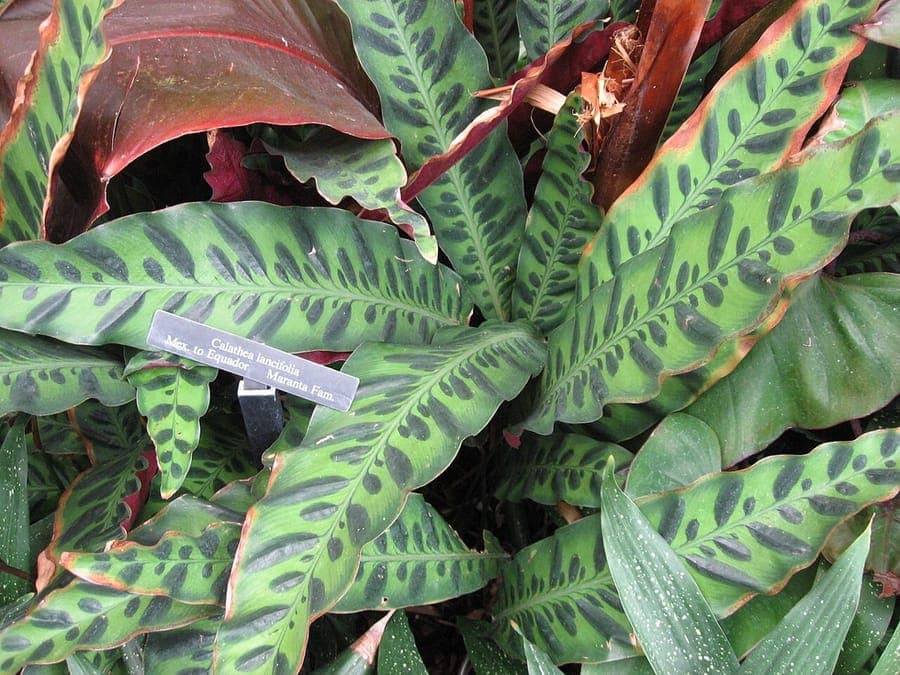
Chhe (talk) / Public domain, via Wikimedia Commons
Rattlesnake plant (Goeppertia insignis): care guide
Goeppertia insignis
Want to see Rattlesnake plant (Goeppertia insignis): care guide in your garden?
Full design in HD: €7.99
Look after your Rattlesnake plant with the GardenWorld app
Identify plants with your camera and get a care calendar with reminders for this plant.


Overview
Goeppertia insignis is the calathea with narrow, wavy leaves and a snakeskin pattern. Along the midrib of each light green leaf sit dark green oval blotches, alternating large and small, while the margin ripples like a ribbon. It is widely known as the rattlesnake plant, after that reptilian pattern, and in shops you will almost certainly find it labelled Calathea lancifolia. That name was standard for decades, but the older epithet insignis takes priority, and since most of the genus Calathea moved to Goeppertia in 2012 the correct name is Goeppertia insignis.
It belongs to the arrowroot family (Marantaceae) and comes from the Atlantic Forest of eastern Brazil, where it grows in the shaded lower layer of the forest on humus-rich soil. The photo, taken in a botanic garden, shows a label reading "Calathea lancifolia, Mex. to Ecuador". That range does not fit this plant: it belongs to a different, Central American species that was also once called Calathea insignis. Name tangles like this are common among calatheas.
Among enthusiasts, Goeppertia insignis is regarded as one of the easiest calatheas. It copes with slightly drier air than the orbifolia or the ornata, grows firmly upright and stays compact, which makes it a good first calathea. If you want your indoor and outdoor spaces to work together, you can have a garden design made at gardenworld.app that includes the conservatory or patio.
Appearance and growth
The leaves are lance-shaped, 20 to 45 cm long indoors and 5 to 10 cm wide, with a strongly wavy edge. The upper surface is yellow-green to fresh green with the characteristic markings: large, elongated blotches alternating with smaller ones, all at right angles to the midrib. The underside is a deep wine-red to purple, clearly visible when the leaves lift in the evening. The photo also shows the reddish-brown leaf edge, which is normal for this species.
The plant forms an upright, narrow clump 50 to 75 cm tall and about 40 to 50 cm wide. New leaves unfurl from the centre, showing their purple underside first. Flowers are rare indoors and inconspicuous.
Thanks to that upright habit, it takes up less floor space than a zebrina or an orbifolia. It fits on a narrow plant table, an east-facing sill or a corner beside the sofa.
Position in the home
Choose a permanent spot in a room with an even temperature. Like other calatheas, it dislikes being moved, draughts and the warm updraught above a radiator. A living room, study or bright bathroom is fine.
The most striking feature is the contrast between the spotted upper side and the purple underside, so it looks best at or just below eye level, where you can see both. A plant stand near a window where evening light shines through the leaves shows this off beautifully.
Light
Bright, indirect light is ideal. An east window with morning sun filtered by a sheer curtain, or a spot one to two metres from a west or south window, works well. It tolerates a little more light than many calatheas, but direct midday sun will still bleach its leaves and leave brown patches.
Too little light makes the leaf stalks long and floppy, so the plant splays open and the pattern loses its crispness. Turn the pot now and then, as the leaves lean noticeably towards the light.
Humidity
Goeppertia insignis is one of the few calatheas that manages reasonably well in an ordinary living room at 45 to 50% humidity. Higher, around 60%, is still better: the leaf tips stay green and the leaves do not roll up during the day.
During the heating season it helps to group it with other plants or stand the pot on a tray of water and pebbles. In a dry flat, a small humidifier is still the best investment. Misting achieves little and leaves limescale marks if your water is hard.
Free preview
Want to see Rattlesnake plant (Goeppertia insignis): care guide in your garden? Make a free preview of your design.
Compost and repotting
An airy, humus-rich and slightly acidic mix suits it best: houseplant compost with about a fifth perlite and a fifth fine bark or coir. Water should drain freely, but the root ball should not dry out quickly. Always use a pot with a drainage hole.
Repot every two years in spring into a pot a few centimetres larger. A mature plant divides easily at the same time. Gently pull or cut the rhizome apart, keeping at least three or four leaves on each piece, and keep the new plants warm and humid for a few weeks while they settle.
Watering
Keep the compost evenly and lightly moist. Water as soon as the top two to three centimetres are dry. In summer that often means once or twice a week, less in winter. Never leave water standing in the saucer.
This species also reacts to lime, chlorine and fluoride in tap water with brown tips. Rainwater, filtered water or water that has stood overnight, at room temperature, is best. Leaves rolled up during the day suggest thirst or dry air. Limp stalks with wet compost and a musty smell point to root rot from overwatering.
Care and pruning
From April to September, give a half-strength liquid houseplant feed every four weeks. Pruning is limited to removing old or damaged leaves as low down as possible. If a leaf is half brown, cut it off completely; the plant will replace it.
Wipe dust away with a damp cloth so the leaves keep catching the light. Check the undersides regularly for spider mite, which multiplies quickly in dry air. If you find it, rinse the plant with lukewarm water and raise the humidity.
Care calendar
March to April: repot or divide. Start feeding at half strength.
May to August: growing season. Regular watering, monthly feed, checks for spider mite, protection from strong sun.
September to October: reduce feeding, then stop. Make sure the plant is not too close to a radiator that will soon be switched on.
November to February: slower growth. Less water, no feed, attention to humidity.
To make sure repotting and feeding do not slip your mind, add the plant to the plant calendar at gardenworld.app and get a timely reminder.
Temperature
Goeppertia insignis is not hardy. It grows best at 18 to 24°C and prefers not to drop below about 16°C at night. Cold draughts or a chilly windowsill in winter cause curling leaves and brown patches. Below 10°C there is a real risk of damage, and it will not survive frost.
In summer it is best kept indoors in north-western Europe: nights are too cool and the sun on a patio soon becomes too strong.
Toxicity to pets
The ASPCA, the American animal welfare charity that runs its own poison control centre, has a separate entry for this species: Calathea insignis, listed with the common name rattlesnake plant, is non-toxic to dogs, cats and horses. The genus Calathea as a whole is also listed as non-toxic. You can bring it home without worry if you have pets. Eating a lot of leaf can still cause a mild stomach upset, and chewing damage shows clearly on the patterned leaves.
Companion plants
With its upright habit, insignis pairs well with plants that grow wider or trail. A bird's nest fern (Asplenium nidus) forms a low, glossy rosette beside it. Phlebodium aureum adds blue-green, deeply cut fronds that contrast nicely with the wavy, spotted leaves. An Aglaonema commutatum shares the same needs for light and warmth, and a spider plant (Chlorophytum comosum) in a hanging pot above adds movement. All of these tolerate ordinary room air reasonably well, which keeps care simple.
Final thoughts
Goeppertia insignis is the ideal calathea to start with: striking, compact, more forgiving than its relatives and safe for pets. Give it bright light without harsh sun, evenly moist compost with soft water and a warm spot away from draughts. You will then see its wavy, spotted leaves rise every evening and settle again every morning, year after year.

See it in your garden
See Rattlesnake plant in your garden
One photo of your garden and a few questions. You see the result in about a minute.
Try it with a photoIdentify this plant in your own garden. Identify a plant
Similar plants
Asplenium nidus: complete guide
Asplenium nidus
Learn all about the Bird's Nest Fern (Asplenium nidus), a stunning tropical houseplant with glossy green fronds. Expert care tips, light requirements and optimal growing conditions.
Phlebodium aureum: complete guide
Phlebodium aureum
Golden polypody is a tropical fern with golden rhizomes and distinctive fan-shaped fronds. Perfect for indoor and warm gardens. Complete care guide.
Chinese Evergreen: complete guide
Aglaonema commutatum
Chinese Evergreen is a popular houseplant with silver-spotted leaves. This tropical plant grows to 60 centimeters and is perfect for semi-shaded interiors. Very easy to maintain.
